
Lee Strobel’s Fragile Argument

Lee Strobel likes to introduce himself as a former atheist—quite an unpleasant atheist, in fact.  As a tough-minded and award-winning journalist, he wanted to get to the bottom of the nonsense about Christianity when his wife became a Christian.

He was the legal editor at the Chicago Tribune where they had a sign reading, “If your mother says she loves you, get a second opinion.”  Sounds like they take their fact finding seriously!

Journalists are great; it’s hypocrisy that I don’t care for.  Strobel’s The Case for Christ starts off with this tough-minded search, and yet everyone interviewed in his book is a committed Christian.  If this is journalism, where is the other side of the story?

Looks like the conclusion was drawn before he started.

I have no problem with a Christian writing a Christian book; just don’t try to pass off this project as unbiased journalism.

Strobel recently wrote a summary of this search.  I’d like to respond to his arguments.

He first picks up elements from the gospels—that Jesus was executed, that the tomb was empty, and that the opponents had to claim that the body was stolen—and uses them to argue for the truth of the overall story.  That’s like saying that in The Godfather, the motivations of the movie studio guy made complete sense because he’d found a horse head in his bed.

The gospel story is a story.  There really wasn’t a horse head, Indiana Jones didn’t really find the lost Ark of the Covenant, and Dorothy didn’t really land in Oz.  Why imagine that there was a resurrection?  Don’t show internal consistency between elements of the gospel story without first showing that it’s history.

Strobel next says:

[The disciples] wouldn’t have been willing to die brutal martyrs’ deaths if they knew this was all a lie.

How do we know that this is accurate?  Continue reading

Faith Shows the Emperor has No Clothes

The emperor parades around in public wearing his new (invisible) clothesSuppose a religion worshipped a god that didn’t exist.  How could it endure?  Wouldn’t it be immediately exposed as a fraud?

Not if it turned thinking on its head and argued that not reason but faith* is actually the proper way to look at the world, or at least the religious part of it.  Fellow believers would encourage this faith-trumps-reason worldview.  Pay no attention to the man behind the curtain and just have faith!

Defending an invisible God and celebrating faith is exactly what Christians would do if their religion were manmade.  Faith is always the last resort.  If there were convincing evidence, Christians would be celebrating that, not faith.

Augustine said, “Do not understand so you may believe; instead believe so you may understand.”  But why?  You don’t do that in any other area of life.  You don’t pick a belief system first and then select facts to support it; it’s the other way around.  You follow the facts where they lead.

Faith is permission to believe without good reason.  Believing something because it is reasonable and rational requires no faith at all.  If you don’t have enough evidence to cross an intellectual gulf to the belief on the other side, and if only faith will get you there, then don’t cross that gulf.

It’s a bizarre world where faith not only trumps reason but is celebrated since we use reason all the time to get through life.  Only by using reason and following the evidence—that is, rejecting beliefs built on faith—did we build the technology-filled world we live in today.

In fact, faith is the worst decision-making and analytical tool possible.  You don’t use faith to cross a busy street, or learn French, or treat malaria.  It provides no method for distinguishing between true and false propositions.  Faith doesn’t provide a reliable answer but simply encourages an end to questioning.  It’s even worse than guessing, because with a guess, you’re at least open to revisiting a decision in the face of new evidence.  Not so with faith.

No one relies on faith unless their god weren’t just invisible but was actually nonexistent.

Photo credit: Wikipedia

*By faith, I mean belief without sufficient evidence.  Christians might respond that their definition of faith is identical to that for trust: belief in accord with sufficient evidence.  In my experience, however, Christians use each of these definitions for faith, switching them as necessary.  If they only stuck to the idea that faith and trust were identical, that might clear up a lot of problems.

Related posts:

“I Used to be an Atheist, Just Like You”

Mechanical drawing of a ratchetI can believe that you used to be an atheist.  An atheist is simply someone without a god belief.  It’s the “just like you” part that I’m having trouble with.
Lots of Christian apologists introduce themselves as former atheists.  Lee Strobel, for example, often begins presentations with a summary of his decadent, angry atheist past.  The implied message is that people like me convert to Christianity all the time.  No, I don’t think so.

To see this, let’s look at three groups of people.

  1. Group 1 are the Christians.
  2. The atheists need two groups.  Group 2 are technically atheists because they don’t have a god belief, but they don’t know much about arguments in favor of Christianity, rebuttals to those arguments, or arguments in favor of atheism.  Nothing wrong with that, of course—the God question doesn’t interest everyone—but they’re simply poorly informed about atheism.
  3. Group 3 includes the well-educated atheists.  This group does understand the arguments on both sides of the issue.  I put myself into this group (with justification, I hope).

Now, back to the conversion/deconversion question.

  1. I know of people in Group 1 (Christians) who’ve deconverted: Rich Lyons from the Living After Faith podcast.  Matt Dillahunty of the Atheist Community of Austin.  Dan Barker of the Freedom From Religion Foundation.  Bob Price, the Bible GeekBart Ehrman, author of Misquoting Jesus.  They’re now all in Group 3 and they’re particularly interesting because they were very well educated Christians.  Education actually turned them away from Christianity.
  2. I’m sure many people formerly in Group 2 (uninformed atheists) have converted to Christianity.  This sounds like the group that the imagined former-atheist-now-Christian came from.
  3. But here’s my point: I’ve never heard of anyone in Group 3, the well-educated atheists, who converted to Christianity.  Of course, this makes me vulnerable to the No True Scotsman fallacy—rejecting any counterexample with, “Oh, well that guy wasn’t truly a well-educated atheist”—but I invite you to add a comment if you can think of someone.

Well-educated Christians deconvert to atheism, but well-educated atheists don’t convert to Christianity.  More education about the history and origins of Christianity increases the likelihood that the Christian will deconvert, but more education increases the likelihood that the atheist will stay put.  Education pushes you in one direction only.

This is an asymmetry that apologists don’t seem to appreciate.  Becoming a well-educated atheist is a one-way street.  It’s a ratchet.  Once you become a well-educated atheist, you’re stuck there.

This is why “just like you” makes no sense.  If you were a Group 2 atheist, uninterested and uninformed about the arguments, and you converted to Christianity, that’s not surprising.  But if you’d been a well-educated atheist (Group 3), you wouldn’t make the arguments that you do.  You wouldn’t make arguments to which I have an immediate rebuttal.  Indeed, you would make only those arguments which you knew (since you’d been just like me) I had no response to.

It never seems to work that way.

Photo credit: Wikimedia

Related posts:

Confused Thinking About Homosexuality

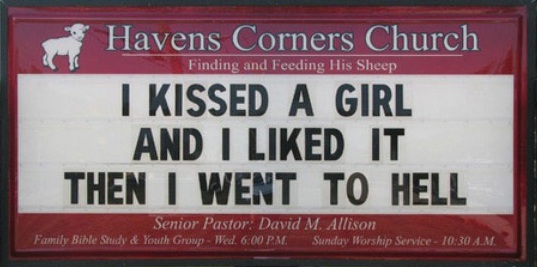
A church sign says "I kissed a girl and I liked it then I went to Hell"In an article subtitled “Christian defense against Homosexuality,” the Christian Apologetics and Research Ministry (CARM) attacks homosexuality.  I’ve pulled out claims that need a response.

Homosexuals want others in society to think like them (and behave like them?).

Is this the fabled Gay Agenda® where homosexuals will make all Americans homosexual to weaken the country for an eventual Communist takeover?  Or something?

“If you have to ask, you are probably already under its pernicious influence and blithely hop-scotching your way straight to Hell.”  Thank you, Betty Bowers.

They want others to accept them.

Well, yeah.  Is that a problem?

What gives them the right to try and change society into what they want it to be?

I’m pretty sure that’s what they said about African Americans during the Jim Crow period.

Saying that homosexuality is natural because it occurs in the animal kingdom does not mean it is morally correct. Animals also eat each other alive, devour offspring, etc. Should we imitate those things as well because the animals do it?

So then do we at least agree that homosexuality occurs in nature and then is, by definition, natural?

As for morality, let’s not get cocky.  For barbarism, no one beats humans.  Only humans have invented Continue reading

Christianity is Self-Defeating

The book of Exodus gives God’s demand that the Jews avoid foreign religions when they returned to Canaan (“You shall have no other gods before me,” etc.).  God had to make sure that they weren’t corrupted.
[SFX: Record scratch]

Wait a minute! How could they have been corrupted?

The Jews enter a land full of foreign gods—invented gods—but God had made plain the correct religion.  How would those made-up gods look next to the real deal?  Judaism would be a stunning and brilliant jewel compared to the other religions’ tawdry plastic beads.

Imagine the Hollywood set of a Western town, built with plywood facades, compared to a real building—Neuschwanstein castle, say.  Who’d be tempted to stray to the cutout imposter if you could have the real thing?

Another example: imagine that God provided Disney World for the Jews but warned against moving into the filthy trailer park across the street.  Why bother with the warning?  How could anyone possibly be tempted?

Similarly, with the Jews given the correct religion, how could God have ever been worried that another religion would be the least bit compelling?

… or maybe Judaism didn’t look special.  Perhaps the prohibitions—remember that these were imposed by priests—made a lot of sense because in fact early Judaism looked similar to all the other Canaanite religions.

The very existence of these prohibitions argues that Judaism was made up, just like the rest.

Photo credit: Wikipedia

Related posts:

Jesus and Aliens

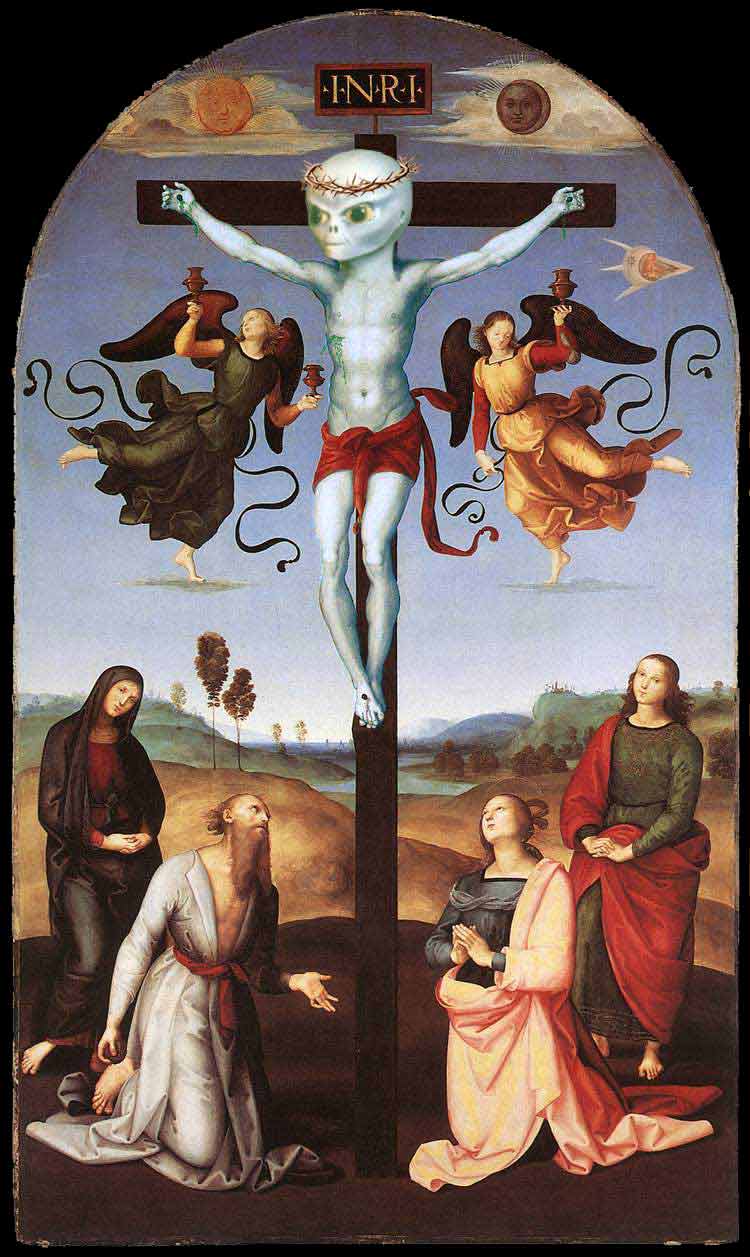
Raphael’s “Mond Crucifixion” painting is modified to show an alien-headed Jesus on the crossThe editor of the New York Times recently published an article called “Asking Candidates Tougher Questions About Faith.”  He opens with this:

If a candidate for president said he believed that space aliens dwell among us, would that affect your willingness to vote for him?  Personally, I might not disqualify him out of hand; one out of three Americans believe we have had Visitors and, hey, who knows?  But I would certainly want to ask a few questions.  Like, where does he get his information?  Does he talk to the aliens?  Do they have an economic plan?

Yet when it comes to the religious beliefs of our would-be presidents, we are a little squeamish about probing too aggressively.

My own view is that religion is off topic.  Candidates for a job as pastor can expect questions about religion.  But for the job of president?  Religious questions are out of bounds.  We’re governed by a secular constitution that includes the constraint, “No religious Test shall ever be required as a Qualification to any Office or public Trust.”

I long for the day when a candidate will dismiss a question about his/her religion with, “That’s irrelevant.  Next question.”  Ask about candidates’ values, their specific plans, their qualifications, and so on, but one’s religion is as relevant and as personal as questions about the style of one’s underwear.

A columnist from GetReligion.org was quick with a response.  She seemed outraged at the Jesus/aliens comparison, but her most substantial comment was to reprint the comparison and state, “I’m not joking.”

Is outrage appropriate?  Which belief—in aliens or Jesus—raises the bigger questions about a candidate’s ability to reason?

Sure, I see the difference between Jesus belief and alien belief.  Jesus is supernatural.  Space aliens are not.  We have nothing to compare a supernatural Jesus to except myths or legends, which sure makes the Jesus story look like a myth or a legend.

On the other hand, aliens aren’t supernatural.  They are life forms (we know about plenty of those) who travel using technology (we know about plenty of that).  Science keeps finding strange new animals on earth living in extreme environments—at the bottom of the ocean, under miles of rock, in glaciers.  Is it so hard to imagine them on other worlds?  Their discovery would be surprising or even shocking, but we wouldn’t need to discard any scientific laws if aliens presented themselves.

I’ll agree that belief in aliens with insufficient evidence is a bit nutty.  But that’s nothing like believing in supernatural beings with insufficient evidence.  I’m not joking.

Photo credit: Jesus Was a Space Alien

Related links:

  • Bill Keller, “Asking Candidates Tougher Questions About Faith,” New York Times Magazine, 8/25/11.
  • Sarah Pulliam Bailey, “NYT takes on aliens, baggage, Trojan horse faith,” GetReligion.org, 8/25/11.
  • Issues, Etc. interviewed GetReligion.org columnist Sarah Pulliam Bailey in its 9/1/11 podcast, “Media Coverage of the GOP Candidates’ Religious Views.”