Escape from the Creation Conference (2 of 2)

Statue of triceratops with a saddle from the Creation MuseumThis is the second of two posts about the Reality-Distortion Zone that is a Creationist conference.  Read the first one here.

The second lecture was by a science teacher.  He injected more than a dozen Bible quotes and Christian imagery into what was otherwise a decent astronomy lecture.

The irony was lost on him.  He used videos, animations, presentation software, a PC.  He showed Hubble photos of galaxies and satellite photos of solar flares.  He lauded the Apollo program.  This was science revealed to us by technology built on science.  He made a good case—science delivers!

One video took us on a five-minute trip through the universe, accelerating from Earth past the solar system, Alpha Centauri, our galaxy, and our local group of galaxies to eventually take in the entire universe.  And the ancient prescientific desert tribe that made up the Genesis account was stuck back there on Earth 3000 years ago, trying to make sense of things with their Iron Age worldview.

There was yet more unacknowledged irony when he emphasized the size of “God’s creation.”  The Bible says, “[God] also made the stars” (Gen. 1:16).  That’s it.  That’s all the Bible says about the 99.9999999999999999999999999% of the universe1 that’s not the earth.  Makes you think that the authors of Genesis didn’t know about the vastness of the universe.

He played the audio of Apollo 8’s famous Christmas Eve 1968 reading of Genesis 1:1–10.  According to that passage, here’s what God was up to on the second day:

And God said, “Let there be a vault between the waters to separate water from water.”  So God made the vault and separated the water under the vault from the water above it.  And it was so.  God called the vault “sky.”

See if that sounds like this: “[They] envisioned the universe as a closed dome surrounded by a primordial saltwater sea.  Underneath the terrestrial earth, which formed the base of the dome, existed an underworld and a freshwater ocean.”  This was the cosmology of the Sumerians, who preceded the Jews by centuries.

To me, the Apollo reading of this prescientific view of nature doesn’t sound majestic but is meaningful only as it highlights what we’ve discarded.

The speaker made the obligatory slam of Continue reading

Faith Shows the Emperor has No Clothes

The emperor parades around in public wearing his new (invisible) clothesSuppose a religion worshipped a god that didn’t exist.  How could it endure?  Wouldn’t it be immediately exposed as a fraud?

Not if it turned thinking on its head and argued that not reason but faith* is actually the proper way to look at the world, or at least the religious part of it.  Fellow believers would encourage this faith-trumps-reason worldview.  Pay no attention to the man behind the curtain and just have faith!

Defending an invisible God and celebrating faith is exactly what Christians would do if their religion were manmade.  Faith is always the last resort.  If there were convincing evidence, Christians would be celebrating that, not faith.

Augustine said, “Do not understand so you may believe; instead believe so you may understand.”  But why?  You don’t do that in any other area of life.  You don’t pick a belief system first and then select facts to support it; it’s the other way around.  You follow the facts where they lead.

Faith is permission to believe without good reason.  Believing something because it is reasonable and rational requires no faith at all.  If you don’t have enough evidence to cross an intellectual gulf to the belief on the other side, and if only faith will get you there, then don’t cross that gulf.

It’s a bizarre world where faith not only trumps reason but is celebrated since we use reason all the time to get through life.  Only by using reason and following the evidence—that is, rejecting beliefs built on faith—did we build the technology-filled world we live in today.

In fact, faith is the worst decision-making and analytical tool possible.  You don’t use faith to cross a busy street, or learn French, or treat malaria.  It provides no method for distinguishing between true and false propositions.  Faith doesn’t provide a reliable answer but simply encourages an end to questioning.  It’s even worse than guessing, because with a guess, you’re at least open to revisiting a decision in the face of new evidence.  Not so with faith.

No one relies on faith unless their god weren’t just invisible but was actually nonexistent.

Photo credit: Wikipedia

*By faith, I mean belief without sufficient evidence.  Christians might respond that their definition of faith is identical to that for trust: belief in accord with sufficient evidence.  In my experience, however, Christians use each of these definitions for faith, switching them as necessary.  If they only stuck to the idea that faith and trust were identical, that might clear up a lot of problems.

Related posts:

Bungling the Facts Behind Evolution

A series of images show how the horse evolved over 50 million yearsA Huffington Post article earlier this week asked, “Does Questioning Evolution Make You Anti-Science?

Yeah, pretty much.

The author notes the flak Rick Perry received for stating that evolution was “just a theory” and that it has “some gaps in it” and tried to make the case that Republicans aren’t as anti-science as they’re portrayed.  I’m not interested in the politics here, but the science (or failure to understand science) is worth mentioning.

Denial of both climate change and evolution is popular among conservatives.  The author said, “While I cannot comment on climate-change science, I do have a great deal to say about evolution.”  He lists his credentials as organizing an annual science vs. religion debate at Oxford University, which were typically about evolution, and giving Richard Dawkins a good thrashing at another debate for good measure.

But for someone who’s well versed in these matters, his understanding of science seems stunted.

What I learned from these debates, as well as reading extensively on evolution, is that evolutionists have a tough time defending the theory when challenged in open dialogue.

I doubt that, but let’s assume it’s the case.  Who cares?  Science, not debate, is where our confidence in evolution comes from.

[Attacks on evolution do not] mean that evolution is not true or that theory is without merit or evidence. It does, however, corroborate what Governor Perry said.  Evolution is a theory.  Unlike, say, the laws of thermodynamics, it has never been proven beyond the shadow of a doubt to be true.

Wow—where do you start?

Evolution is an explanation.  It claims to give us the mechanism explaining how life got to be the way it is.  The best evolution can hope for is to become a theory, and it has done so.  The same is true for germ theory, another explanation, which has also reached that pinnacle and can’t become anything better.

By contrast, a scientific law is Continue reading

“I Used to be an Atheist, Just Like You”

Mechanical drawing of a ratchetI can believe that you used to be an atheist.  An atheist is simply someone without a god belief.  It’s the “just like you” part that I’m having trouble with.
Lots of Christian apologists introduce themselves as former atheists.  Lee Strobel, for example, often begins presentations with a summary of his decadent, angry atheist past.  The implied message is that people like me convert to Christianity all the time.  No, I don’t think so.

To see this, let’s look at three groups of people.

  1. Group 1 are the Christians.
  2. The atheists need two groups.  Group 2 are technically atheists because they don’t have a god belief, but they don’t know much about arguments in favor of Christianity, rebuttals to those arguments, or arguments in favor of atheism.  Nothing wrong with that, of course—the God question doesn’t interest everyone—but they’re simply poorly informed about atheism.
  3. Group 3 includes the well-educated atheists.  This group does understand the arguments on both sides of the issue.  I put myself into this group (with justification, I hope).

Now, back to the conversion/deconversion question.

  1. I know of people in Group 1 (Christians) who’ve deconverted: Rich Lyons from the Living After Faith podcast.  Matt Dillahunty of the Atheist Community of Austin.  Dan Barker of the Freedom From Religion Foundation.  Bob Price, the Bible GeekBart Ehrman, author of Misquoting Jesus.  They’re now all in Group 3 and they’re particularly interesting because they were very well educated Christians.  Education actually turned them away from Christianity.
  2. I’m sure many people formerly in Group 2 (uninformed atheists) have converted to Christianity.  This sounds like the group that the imagined former-atheist-now-Christian came from.
  3. But here’s my point: I’ve never heard of anyone in Group 3, the well-educated atheists, who converted to Christianity.  Of course, this makes me vulnerable to the No True Scotsman fallacy—rejecting any counterexample with, “Oh, well that guy wasn’t truly a well-educated atheist”—but I invite you to add a comment if you can think of someone.

Well-educated Christians deconvert to atheism, but well-educated atheists don’t convert to Christianity.  More education about the history and origins of Christianity increases the likelihood that the Christian will deconvert, but more education increases the likelihood that the atheist will stay put.  Education pushes you in one direction only.

This is an asymmetry that apologists don’t seem to appreciate.  Becoming a well-educated atheist is a one-way street.  It’s a ratchet.  Once you become a well-educated atheist, you’re stuck there.

This is why “just like you” makes no sense.  If you were a Group 2 atheist, uninterested and uninformed about the arguments, and you converted to Christianity, that’s not surprising.  But if you’d been a well-educated atheist (Group 3), you wouldn’t make the arguments that you do.  You wouldn’t make arguments to which I have an immediate rebuttal.  Indeed, you would make only those arguments which you knew (since you’d been just like me) I had no response to.

It never seems to work that way.

Photo credit: Wikimedia

Related posts:

I Survived the Creation Conference (1 of 2)

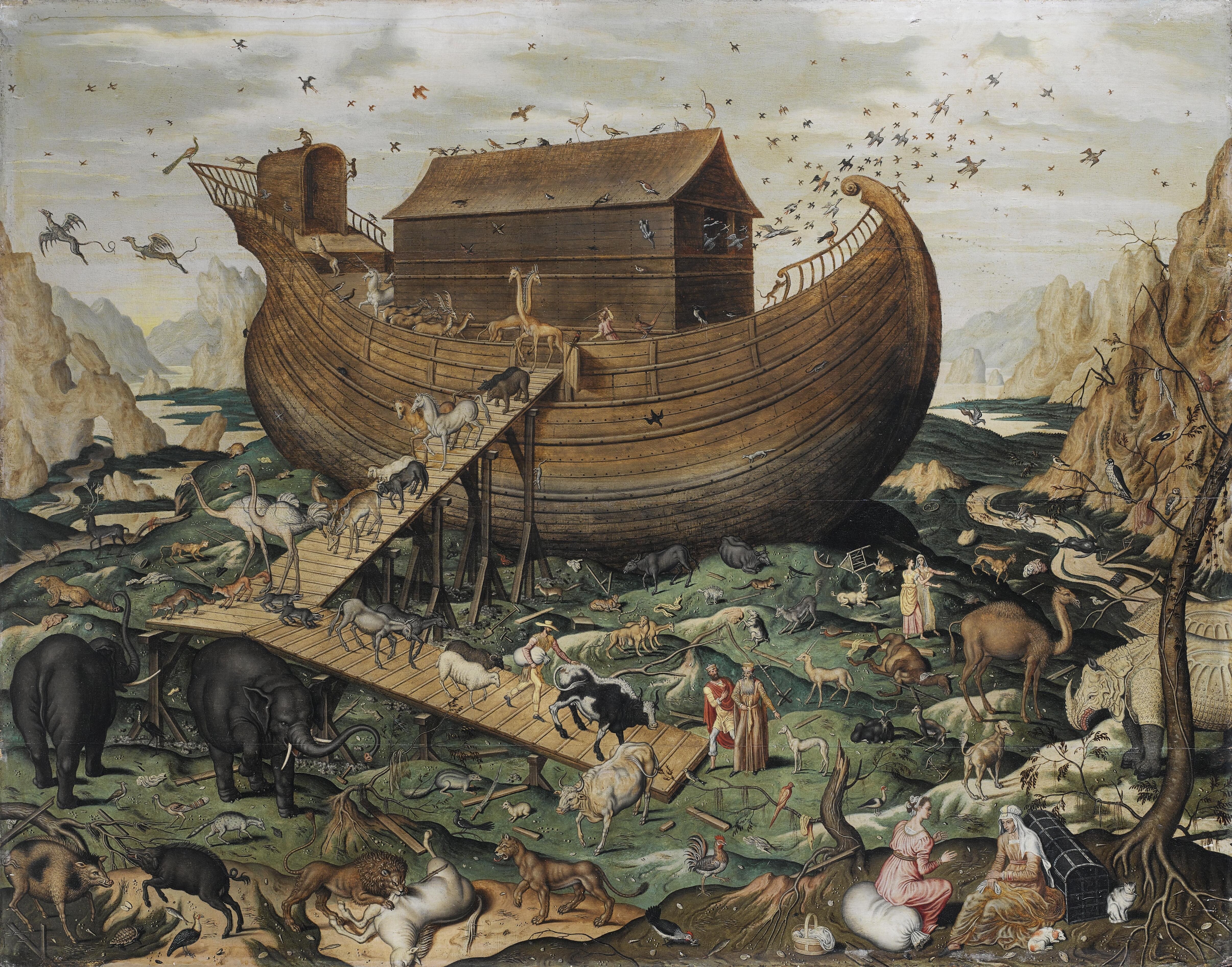
Noah's ArkI attended the 2011 Seattle Creation Conference and made it out to tell the tale.

The slogan of the conference was, “Dedicated to glorifying God through the scientific study of His Creation and refuting the false claims of Evolutionism.”  (Is it just me or does that last phrase betray a presupposition?)  There were prayers galore, sometimes both opening and closing a single lecture.

If the speakers were confident that science will eventually support the biblical view, they could let the science speak for itself.  They could show confidence that science will lead us to the biblical answer.  The question, “If Science and Scripture diverged, which one would you follow?” came to mind, but the answer was obvious.

This was a young-earth Creationism conference.  “Young earth” means: the earth is less than 10,000 years old.  “Creationism” means: evolution is nonsense.  There were probably some old-earthers there too, but I’m pretty sure that I was the only one stupid enough to accept the scientific consensus on evolution.

The remainder of this post is about lectures by Mike Oard from Creation Ministries International, who spoke for two hours on Noah’s flood.  (Let me add that everyone was polite, including me, so I’m attacking the “science,” not the speakers.)

Oard began with a couple of Bible quotes to justify using reason.  It’s odd to need such a justification in a conference “dedicated to … scientific study,” but OK.  One quote was, “Examine carefully; hold fast to that which is good” (1 Thes. 5:21).  I suspect that the last phrase was seen as license to pick and choose.

He stressed that, while some Christians imagine this to be a local flood, it was global.  I enjoy seeing Creationists attack each other, but Continue reading

Confused Thinking About Homosexuality

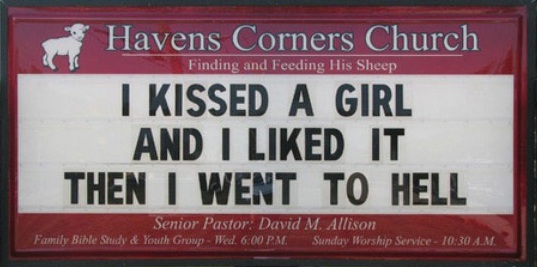
A church sign says "I kissed a girl and I liked it then I went to Hell"In an article subtitled “Christian defense against Homosexuality,” the Christian Apologetics and Research Ministry (CARM) attacks homosexuality.  I’ve pulled out claims that need a response.

Homosexuals want others in society to think like them (and behave like them?).

Is this the fabled Gay Agenda® where homosexuals will make all Americans homosexual to weaken the country for an eventual Communist takeover?  Or something?

“If you have to ask, you are probably already under its pernicious influence and blithely hop-scotching your way straight to Hell.”  Thank you, Betty Bowers.

They want others to accept them.

Well, yeah.  Is that a problem?

What gives them the right to try and change society into what they want it to be?

I’m pretty sure that’s what they said about African Americans during the Jim Crow period.

Saying that homosexuality is natural because it occurs in the animal kingdom does not mean it is morally correct. Animals also eat each other alive, devour offspring, etc. Should we imitate those things as well because the animals do it?

So then do we at least agree that homosexuality occurs in nature and then is, by definition, natural?

As for morality, let’s not get cocky.  For barbarism, no one beats humans.  Only humans have invented Continue reading