Jesus and Santa Claus

What is Christianity?  And how does Santa Claus help?Harriett Hall (the SkepDoc) wrote a clever story about two kids trying to figure out whether the tooth fairy really exists or not.  Inspired by that, and in keeping with the season, I’d like to imagine two kids arguing about Santa.

It was early December, and little Jerry had begun to doubt the existence of Santa Claus.  He made his case to his younger brother Kyle.

“I don’t think Santa is real.  I think it’s just Mom and Dad buying us presents,” Jerry said.

“Prove it,” Kyle said.

“Okay, why are there all those Santas on the street corners ringing for money?  How can Santa be at all those stores at once?”

“They’re not the real Santa, just his helpers,” Kyle said.  “And maybe they’re just testing us to see if we’ll still believe.  I’m going to believe, because if you don’t, you don’t get presents.”

“But I recognized one of them—it was the father of one of my friends.”

“Then those are just ordinary people imitating Santa, raising money for a good cause.  Anyway, I’ve seen Santa on TV at Thanksgiving—everyone has.”

Jerry sees that he’s not making any progress, so he gives up.  On Christmas afternoon, he’s alone with Kyle and tries again.  “Remember that video game that you told Mom about and then you forgot to tell Santa?” Jerry said.  “But you got it anyway.  Mom must’ve bought it and written on the package that it came from Santa.” 

“Mom just told Santa,” Kyle said. 

“But how can Santa get around the world in one night?”

“My friends all say that Santa is real.  Anyway, Santa has magic.  And the cookie plate we leave out for Santa always has just crumbs on Christmas morning.”

“With the Junior Detective kit that I got this morning, I dusted the cookie plate for fingerprints, and they were Mom’s.”

“Mom set out the plate, and Santa wears gloves.”

Jerry gives up for the year.  On Christmas afternoon the next year, he tries again.  “Lots of the older kids don’t believe in Santa.  They say that their presents only come from their parents.”

“Sure,” Kyle said.  “Santa only gives presents to those who still believe in him.”

“A few months ago, I was snooping in Dad’s sock drawer, and I found every letter we ever wrote to Santa.”

“Why not?  Santa didn’t need them anymore and each year just gives them to Mom and Dad for keepsakes.”

“The only fingerprints on our presents are Mom’s or Dad’s.” 

“Mom and Dad always get up early on Christmas.  They could’ve rearranged them.”

“Last week, I found all our presents hidden in a corner in the attic.”  Jerry pawed through some of the torn wrapping paper.  “I wrote my initials on the bottom of each package.  And look—here they are.  That proves that Santa didn’t bring them here last night.”

“I asked Mom, and she said that Santa is real.  Anyway, how do I know you didn’t write your initials on the wrapping paper this morning?”

Like little Kyle, if you’re determined to believe something, you can rationalize away any unwelcome evidence.  (By rationalize, I mean taking an idea as fact and then selecting or interpreting all relevant evidence to make it support that idea.)

It’s tempting to list the many ways Christians rationalize.  They rationalize away contradictions in the Bible, the oddity of a hidden God, or why so much bad happens to the people God loves.  They can find a dozen reasons why a particular prayer wasn’t answered, even though the Bible promises, “Ask and ye shall receive.”  But the Christian says that he’s simply defending the truth: “I’m not rationalizing; I’m right.”

In five minutes we can see flaws in others that we don’t see in ourselves in a lifetime.  Perhaps this episode with Jerry and Kyle will encourage us to see our own rationalizations.

I recently came across the Galileo Was Wrong; The Church Was Right blog.  That’s right, it argues for geocentrism, an earth-centered universe.  With a little work, even the nuttiest theory can be given a scholarly sheen, so imagine what a few thousand years of scholarly work can do to a religion.  Any Christian can point to centuries of scholarship to give a patina of credibility to their position (but, of course, so can Muslims, Hindus, and those in many other religions).

I can’t prove Santa doesn’t exist.  Nor can I disprove the existence of leprechauns, Russell’s Flying Teapot, the Flying Spaghetti Monster, or God.  The thoughtful person goes where the evidence points rather than accepting only the evidence that supports his preconception.

And Jesus is Santa Claus for adults.

Photo credit: Robot Nine

Plantinga’s Nutty Evolutionary Argument Against Naturalism

Where is Jesus?What better way to respond to atheists but to turn one of their own tools against them?  That’s the approach philosopher Alvin Plantinga tries to use with his Evolutionary Argument Against Naturalism (EAAN).  It’s not a new idea, and both C.S. Lewis and Charles Darwin anticipated it.  In brief, the question is: how can a human mind that’s the result of the clumsy process of evolution be trusted?

About “Darwin’s doubt,” Plantinga argues that only Christians can have confidence that their interpretation of the world is correct.  Naturalists can’t prove that minds are reliable until they’ve proven that the source of this claim (the mind!) is worth listening to.

Here’s where Plantinga claims to have turned the tables:

The high priests of evolutionary naturalism loudly proclaim that Christian and even theistic belief is bankrupt and foolish.  The fact, however, is that the shoe is on the other foot.  It is evolutionary naturalism, not Christian belief, that can’t rationally be accepted.

He says that if evolution is true, human beliefs have been selected for survival value, not truth, so why trust them?  And yet our beliefs are reliable, suggesting to Plantinga that something besides evolution created them.

Before we get into the specifics of Plantinga’s argument, let’s first establish a baseline.  Plantinga and naturalists agree that humans’ needs and desires are pretty logically matched:

Plantinga normal world

This is straightforward.  You go toward cuddly things, you run from scary things, you get to clean air if you can’t breathe, and so on.  This is the world we all know and understand.  But Plantinga imagines the naturalist’s world in which these links are jumbled.  He imagines a hominid Paul who has some problematic beliefs about predators:

Perhaps [Paul] thinks the tiger is a large, friendly, cuddly pussycat and wants to pet it; but he also believes that the best way to pet it is to run away from it.

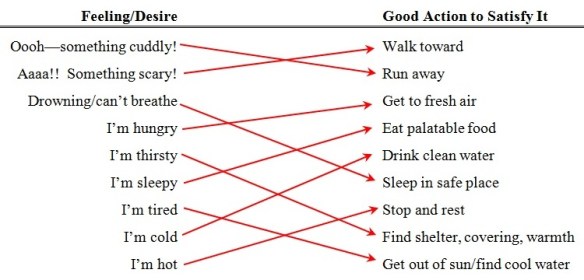
So Paul’s instincts toward tigers keep him alive, but only by luck.  But unreasonable beliefs don’t stop with tigers.  Plantinga imagines the naturalist’s view of the world with beliefs having no connection with reality.  That is, he imagines something like this:

Paul’s response to the tiger was just a roll of the dice, and he got lucky.  But Plantinga supposes that all of Paul’s beliefs are arbitrary, not just those about tigers.  Some actions in this chart are benign, but some are dangerous.  When Paul sees something scary, his reaction is to walk toward it.  When he’s drowning, he’ll try to sleep.  When he’s hungry, he’ll satisfy that need with fresh air, and so on.  With his basic desires paired with ineffective methods, this guy is clearly too dumb to live.

This is where natural selection comes in.  Natural selection is unforgiving, and actions that don’t lead to survival are discarded.  Evolution easily explains why Plantinga’s Paul could not exist.

An article at Skeptic.com neatly skewers Plantinga’s argument with a familiar example.

If a professional baseball player [incorrectly perceived reality,] that is, if his perception of the movement and location of a baseball was something other than what it actually is, then he would not be able to consistently hit ninety-five mile per hour fastballs.

As an aside, let me admit that I have a hard time maintaining respect for those at the leading edge of philosophy.  Do they do work that’s relevant and pushes the frontier of human knowledge?  I’d like to think so, but when this is the kind of argument they give, it’s hard to keep the faith.

My advice to philosophers: when you get the urge to play scientist, better lie down until the feeling goes away.

Photo credit: Wikimedia

Related links:

  • “EAAN—a sad footnote to an illustrious career,” Shamelessly Atheist blog, 8/22/09.
  • “Evolutionary Argument Against Naturalism,” Iron Chariots Wiki.
  • PZ Myers, “Alvin Plantinga Gives Philosophy a Bad Name,” Pharyngula blog, 5/29/09.
  • Michael Dahlen, “What’s So Great About Kant?  A Critique of Dinesh D’Souza’s Attack on Reason,” eSkeptic, 8/17/11.
  • Greg Kokul, “The Evolutionary Argument Against Naturalism,” Stand to Reason (video, 3:59), 8/15/11.
  • “Evolutionary Argument Against Naturalism,” Wikipedia.

How Science Works (and How Christianity Thinks it Wins)

Christian apologists like to imagine that science's errors give them an advantageThis argument was made at the Creationism conference that I recently attended: science isn’t trustworthy because every time you turn around, it’s changing its mind.

  • The sun goes around the earth … no, wait a minute—it’s the other way around.
  • Here’s the fossil of an early human … no, hold on—that one’s a hoax.
  • Living things hold a special energy or force—an élan vital—that animates them … nope, that’s passé.
  • Every wave needs a medium, so space must be filled with “ether” for light to propagate through … oops, wrong again.

An early theory of the formation of the moon said that the fast-spinning early earth flung out the moon and that the big circular Pacific Ocean basin is where it came from.  The question of origin of the moon has been an active area of research, and the flung-out idea is just another discarded scientific theory—this was one of the areas of research that was lampooned at this conference.

The Creationist argues that when you turn from changeable Science to Christianity’s unchanging God and an unchanging Bible, you have something solid that you can trust.

Science does change, but let’s notice that the size of any change tends to decrease for a single theory.  When the door is first opened to a new field of inquiry—say by Leeuwenhoek’s discovery of single-celled organisms or Galileo’s use of the telescope—new theories based on insufficient evidence try to organize the chaos.  One theory might quickly supersede another, but as theories become better at explaining more, changes becomes smaller.  Here are some examples.

  • Geocentrism to heliocentrism was an enormous change for the model of the solar system.  Our understanding of the solar system continues to change (new theories about why Uranus is tipped on its side or reclassification of Pluto as a dwarf planet, for example), but these are comparatively minor.
  • Evolution revolutionized biology, and the changes in biology today are merely refinements to this theory.
  • The intuitive flat earth model was replaced by a spherical earth, and the observation that it’s actually not spherical but slightly flattened at the poles is a small change.
  • Quantum physics continues to change, but new discoveries are not likely to say that matter is not made up of atoms, which are themselves not made up of protons, neutrons, and electrons.

Christians eager to paint the Bible as an unchanging rock in a sea of chaos don’t seem to understand that they point to science’s strength.  Science realizes that new discoveries may obsolete old theories, and every scientific statement is provisional.  And, remarkably, science is self-correcting.  It finds its own errors.

Science changes, and that’s its strength.  The Bible never changes, and that’s its weakness.

Related posts:

Word of the Day: Apologetics

Dictionary or Bible, we can ask: Does God exist?Apologetics is the discipline of defending a position using reason.  The word is so tied to the defense of Christianity that “Christian apologetics” is almost redundant.  An apologetic is a specific argument (the Design Argument or Pascal’s Wager, for example).

Though “apologetics” has its origin in common with the word “apology,” the apologist does not apologize.  The original Greek work apologia meant to make a spoken defense, such as you’d give if you were the defendant in court.

A Christian could argue for Christianity in an emotional way, but that wouldn’t be apologetics.  These nonapologetic claims might be “Christianity makes me feel good” or “I just like the worldview” or “You’ll love the community.”

Counter-apologetics uses reason to rebut specific Christian apologetic arguments.

Photo credit: Wikimedia

Related posts:

Related links:

Pointless Parables

I like some of the parables in the New Testament.  The parables of the Good Samaritan and the Prodigal Son, for example, give good examples of the right path and add to the moral vocabulary of the West.

Lately, however, I’ve come across a few modern apologetic parables that fall far short of those in the Bible.  Let me start with “The Blind Faith of Atheism” a tediously long story making a very small point.  (I’ve abbreviated all the parables here.  You’re welcome!)

An atheist professor was harassing his Christian students about their God belief, so they challenge him to a debate.  The arrogant professor agrees, thinking he could shut down this God thing once and for all.

The atheist’s opening remark likens God belief to Santa Claus belief.  We give up one when we grow up; why not both? 

The Christian then goes through a long process of arguing that the atheist doesn’t know everything, to which the atheist agrees.  And now he releases the snare: isn’t it possible that evidence of God could exist in that huge fraction of all knowledge that the atheist doesn’t understand?  “Have you been to South Yemen?” the Christian asks.  “Maybe God is in South Yemen.”

The debate isn’t going his way, so the atheist complains that the debate isn’t fair.

The Christian pushes his point and gets the atheist, now meek and whiney, to admit that the claim “There is no God” is indefensible and that the atheist’s claim is actually a faith position.  A little more back and forth, and the atheist slinks away, publicly humiliated.

This is rather like the Chick tract in which the nasty Biology professor gets shredded and then converted by a calm and polite Christian.

Chick tract that argues that God doesn't exist

So the moral is: don’t say, “God absolutely, for sure doesn’t exist.”  Okay, but I already knew that.

In the first place, very few atheists are certain that there is no God.  They would say instead that they have no God belief, just like the Christian has no Poseidon belief.

Second, “there is no God” is a faith position just like “there are no unicorns” is—that is, not at all.  Could unicorns exist?  It’s possible, but the evidence strongly argues that they don’t.  We don’t have faith that unicorns don’t exist; we trust that they don’t because we have evidence that they don’t.  In the same way, belief in God is a faith position, but following the facts where they point (and tentatively concluding that God is in the same bin as Zeus, Shiva, and the other gods from history) is a trust position.

Next up, the story of a man and his barber.

As the barber trims the man’s hair, he says that he doesn’t believe in God.  He points to the problem of evil—why would there be so much pain and suffering in the world if God existed?

Wanting to avoid antagonizing the man who had his coiffure in his hands, the Christian customer doesn’t engage in the argument, but after leaving the shop, he sees a man with a scruffy beard and long unkempt hair.  He returns to the barber shop and says, “I just realized something—barbers don’t exist either.”

“But I just cut your hair!” the barber replies.

“If barbers existed, there would be no one with long hair, like the man I just saw.”

“Don’t blame me if they don’t come to me.”

“Exactly!” the Christian replies.  “And we can’t blame God if we don’t go to him.  He exists; the problem with pain and suffering is that people don’t seek God.”

Huh?  But Christians do go to God.  How does that help the pain and suffering in the world?  How does that remove pain and suffering from just the lives of Christians?  How does that undo the damage from tornadoes or tsunamis?  Praying to a God, even one who’s not there, can bring comfort, I’ll admit, but that’s hardly what the Christian in this story is claiming.

Finally, a well-made video from the Macedonian Ministry of Education and Science.

The video opens with a schoolboy running into school.  The time period looks to be about 1900.

The teacher at the front of the room speaks in German, with English subtitles.  He declares that if God exists then he is evil.  If he created everything, then he created evil, right?

Our schoolboy protagonist stands to challenge this: “Professor, does cold exist?”

“Of course it does.”

“No, sir, cold doesn’t exist.  Heat exists, and cold is merely the absence of heat.  Professor, does darkness exist?”

“Of course.”

“No, sir.  Darkness doesn’t exist.  It is merely the absence of light.  In the same way, evil doesn’t exist.  Evil is the result of what happens when man does not have God’s love in his heart.”

At the end, we see the name of this precocious schoolboy: Albert Einstein.  We’re left with the tagline: “Religion is knowledge too.  Bring religion back to school.”

With a tagline like that on a government video, I guess there’s not much separation of church and state here.  And a Macedonian ministry puts together a German video with English subtitles?  Why not Macedonian subtitles?  What possible goal of theirs could this serve?

Putting aside this mystery, this isn’t an honest portrayal of Einstein’s religious beliefs, at least not in his later life.  And we can quibble about whether evil is something or the absence of something, but the final statement (that evil is the result of not having God’s love) is simply an assertion without evidence.  Unconvincing.

Is it me, or have Christian parables gone downhill?

(And if you hear of any more, let me know!)

Photo credit: Rafael Lopez

Churches and the Corporate Org Chart

(Today, I’m pleased to have a guest post from Richard S. Russell, an atheist from Wisconsin and commenter at this blog.)

In these difficult economic times, you may have heard more than usual about GDP. It’s short for “Gross Domestic Product” and is the dollar value of all the goods and services produced within a given country (or state or region) in a year. “Goods” are products, material objects that customers want; “services” are procedures, actions performed to help customers. Together, these products and procedures reflect the wealth generated by the economy.

In the U.S., a lot of goods and services are produced by big corporations, which are organized to do so effectively and efficiently, using those techniques much beloved of Econ 101 courses, division of labor and specialization.

Here’s an organization chart for a typical manufacturing corporation, one that produces material goods:

And here’s what goes on inside each of those little boxes:

(1) Management makes decisions, tells everyone else what to do, and handles investor relations.

(2) Internal Services support the rest of the company in general; the category includes accounting, info tech, personnel (human resources), labor relations (employment relations or ER), safety, maintenance, regulatory compliance, and legal.

(3) Research and Development (R&D) investigates new ways of doing things and tests them out.

(4) Purchasing acquires raw materials, equipment, and property.

(5) Manufacturing (the biggest part of the company, employing the most people) generates actual useful products.

(6) Inventory Control deals with both raw materials and finished products and includes transportation, warehousing, shipping, delivery, and quality assurance.

(7) Marketing uses media to spread the word that people should buy the company’s products.

(8) Sales works directly with individual customers to get them the products they want in exchange for their money.

(9) Customer Service works directly with customers who are having problems with a product.

The chart gets slimmed down a little if we’re talking about services instead of goods. Here’s an org chart for a typical service corporation:

Notice that manufacturing has vanished altogether (no goods being produced), and that the bulk of the people working for the company are the ones directly helping customers. You still have Purchasing and Inventory Control, but these are much smaller operations (since they now deal mainly with furniture and office supplies instead of heavy machinery and raw materials) and so are generally subsumed under Internal Services.

Finally we have the kind of organizations that produce neither goods nor services, namely churches. Here’s how they work:

There are still lots of entries under Management (bishops, archbishops, abbots, cardinals, popes, etc.), since these guys (by which I mean “men”) are really into hierarchy.

There’s the normal array of Internal Services, with the diminished activity under ER (no unions, heavy emphasis on conformity and obedience) and regulatory compliance more than offset by the need for lots of work under legal (discrimination, pedophilia, etc.).

Nothing under R&D. (Create something new?!)

Nothing under Purchasing. (Spend? Contribute to the economy?!)

Nothing under Manufacturing. (Useful products!?)

Nothing under Inventory Control.

But tons and tons o’ time is devoted to (or, more properly, “wasted on”) Marketing and Sales. In fact, in the absence of goods and services, it’s the only thing religion does at all. In other words, the priest class spends all its time pushing companionship with themselves, in return for nothing useful or even (as in the case of more traditional prostitutes) pleasurable.

The most telling part of the chart, though, is Customer “Service,” where the ironic quotation marks emphasize the difference between what a church does and what an actual contributor to GDP does. A responsible, reputable company assumes that, if you’ve got a problem, it’s their own product’s fault, or the result of shoddy service from one of the company’s representatives. But in the case of religion, any counseling they provide for people with problems is designed to show, first and foremost, how the religion itself is never, ever at fault, that the problem is entirely the customer’s, because he or she didn’t follow directions properly. In short, the motto of Customer “Service” for a church is “The customer is always wrong.”

In effect, since religion never solves any problems (not even those of its own making), Customer “Service” is just another mechanism under Sales and Marketing, which is why it’s shown as subsidiary to those activities on the skeletal org chart above.

You know the short word for any activity that’s all talk and no walk (or, as they say in Texas, all hat and no cattle)? Scam!

Related posts: