16 Arguments Against Abortion, with Rebuttals (Part 2)

Atheism and Christianity discussionHere are the remaining arguments against abortion, with rebuttals. See part 1 here.

10. Why is murder wrong? Because it takes away a future like mine. If we found intelligent humanoids like us on another planet, killing them for sport would be wrong for this reason. And this is why abortion is wrong—it takes away a future like mine. This is Glenn Peoples’ Argument from the Future (podcast episode #29, 8/3/09).

Why focus on the future? Assuming these humanoids are largely unchanging month to month, like people, killing them for sport takes away a present like mine. I assume that Peoples focuses on the future only because he has no argument otherwise.

But let’s take the path that Peoples points us to. Killing a fetus would deprive it of a future like mine, but so would killing a single skin cell, once they are clonable into humans. Would it then a crime to scratch your skin? Or, let’s take it further back. Suppose I have two kids. Was it criminal to not have three? Or four? Or fifteen? I’ve deprived those people-to-be of life.

Extrapolating back to the twinkle in my eye, saying that we have a person deserving of life at every step is ridiculous. But the facts fit neatly and logically into the spectrum argument.

11. But a fetus has a soul! Does it? If the zygote has a soul and then it splits into twins, does each twin have half a soul or do they get another one as needed or did they get two to begin with? What about conjoined twins? Do they share a single soul like a shared body part? What about babies with terrible birth defects that leave them with very little brain function? What about a person cloned from a cell—would they have a soul? And if the story for the soul has a happy ending for the 50% of pregnancies that end in spontaneous (natural) abortion, why not for an artificial abortion?

This mess vanishes if we don’t insist on a soul. As Daniel Dennett said, “What isn’t there doesn’t have to be explained.”

12. “Abortion is much more serious than killing an adult. An adult may or may not be an innocent, but an unborn child is most definitely innocent.” These are the words of an archbishop from Brazil. He was outraged at the abortion done on a nine-year-old girl, raped and impregnated by her stepfather. In response to the abortion, the church excommunicated the family of the girl and the doctors who performed the abortion.

Wow. Let’s leave this example of how religion makes you do crazy things and focus on the claim. First, a fetus is not a child. Second, the spectrum argument defeats this claim.

Variations on this argument are popular, and they all have pretty much the same response. Here are a few.

12a. Abortion kills a human life (at the bottom of Maslow’s hierarchy) to help with another human’s self-actualization (higher on the hierarchy). That’s the opposite of the way it’s supposed to work. The two “human lives” are not comparable. This ignores the spectrum of development from single cell to trillion-cell newborn.

Killing a blastocyst with fewer cells than the brain of the fly troubles me less than killing a civilian in another country due to war or killing a criminal on death row.

12b. Don’t we normally go out of our way to defend the defenseless? Again, this ignores the spectrum. Defenseless people are more important than defenseless cells.

12c. Haven’t we been through this with racial minorities? Declaring that single cells aren’t human is like declaring that African-Americans aren’t human. Nice try. Spectrum argument.

12d. In response to your abortion clinic example: you argue that, if given a choice between saving a child and ten frozen embryos, you’d save the child. Okay, and if given the choice between your wife and a stranger, you’d save your wife, but that doesn’t mean that you can kill strangers. Spectrum argument.

13. Haven’t you heard of adoption? That’s the answer to an unplanned pregnancy. No, it’s clearly not the answer. Two percent of all births to unmarried women in the U.S. are placed for adoption. “Just have the baby and release it for adoption” is a pat on the head. It might make you feel good, but it doesn’t work.

14. You say that a trillion cells is definitely a person. Okay, how about a trillion minus one—is that a person? And if so, how about a trillion minus two? And so on. This same game could be played with the blue/green spectrum. If this color is “green,” what about just a touch more blue—isn’t that green as well? The point remains that the two ends of the spectrum are very different—green is not blue! Similarly, a single cell is not a newborn with arms, legs, kidneys, brain, and so on.

15. The woman who got pregnant knew what she was doing. Let’s encourage people to take responsibility for their actions. She didn’t necessarily know what she was doing—sex education is so poor that many teens become sexually mature without understanding what causes what.

But let’s assume that the woman knew what she was doing and was careless or stupid. What do we do with this? When someone shoots himself accidentally, that was stupid, but we all pay for the medical and insurance system that puts them back together. Let’s educate people, demand responsibility, and have a harm-reduction approach where we find the best resolution of problem. For a woman whose life would be overturned with a pregnancy, that resolution might be abortion.

16. If you’re so smart, where do you draw the line? I don’t. I find that pro-life advocates quickly turn the conversation to the definition of the OK/not-OK line for abortion, hoping to find something to criticize. I avoid this, both because it diverts attention from the spectrum argument—the main point I want to make—and because I have no opinion about the line and am happy to leave it up to the experts.

Barack Obama answered that question, “That’s above my pay grade,” which satisfies me, since he was running for Commander-in-chief, not Obstetrician-in-chief.

Next time: 5 Recommendations to the Pro-Life Movement

Photo credit

Related posts:

Related links:

Post #100

Using fiction to explore Christianity and atheismWelcome to post #100!  It’s time to see how far this blog has come since I started last August.
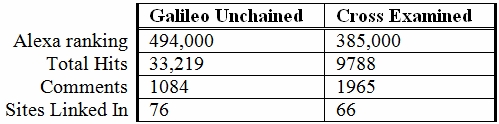
Many of you know that this is actually two blogs.  Galileo Unchained (“For Those Who Have No Use for Faith”) is the doorway aimed at atheists, and Cross Examined (“Clear Thinking About Christianity”) is aimed at Christians.  The content is the same, so hang out wherever you feel more comfortable.

In December, I launched my novel, Cross Examined: An Unconventional Spiritual Journey.  My goal with both the book and this blog is primarily to encourage Christians to think.  Whether they become atheists or stronger Christians isn’t the issue but rather that they think about the intellectual foundations that support their faith.  Too commonly, in my opinion, Christians act out their faith on autopilot, not thinking much about what they claim is life’s most important issue.

And, of course, I hope to have provocative content for atheists as well, both in this blog in the book.

If you haven’t poked around in the toolbar, that’s been gradually updated, with a page listing all the posts, a glossary (with each of the Words of the Day), and a summary of the book with the first couple of chapters.

Here are some of the stats for the blogs:

Alexa ranks web sites by global popularity, and a smaller number is better.  It says that 0.00034% of global Internet users visit CrossExaminedBlog.com.  (Woo hoo—look out, PZ Myers!)

There’s no easy way to figure out word count, but all the posts add up to roughly 50,000 words.

So what’s next?  I’m thinking about podcasting the blogs.  That is, the same content, just spoken.  I hope that will provide a new audience.  I’m also thinking about consolidating the blogs, which would mean focusing on Cross Examined and no longer updating or creating links to Galileo Unchained.  (Your thoughts on these changes?)

Here’s where I need your help.

  • Who do you think would find the book useful?  Do you know of any thoughtful Christians comfortable enough in their beliefs who would be interested in exploring the foundations of Christianity?  Please pass on a link.  I’m also looking for blurbs (brief recommendations), so let me know of anyone with interesting credentials—a pastor or professor, perhaps—who might share my goal of encouraging Christians to think and who would like a free review copy.
  • Who would find the blog interesting?  Please recommend it to anyone you think would appreciate plain talk on Christianity.
  • What recommendations do you have for the blog?  Any changes in format?  Topics ideas?  Add your thoughts to the comments below or email me.

Thanks for dropping by, and I hope you find this a worthwhile destination on the internet!

Bob Seidensticker

Photo credit: kslavin

Why is it Always Men Advancing the Pro-Life Position?

Christian apologetics and atheism meet hereIt’s Blog for Choice Day!

On this, the 39th anniversary of the Supreme Court’s Roe v. Wade decision making abortion legal in the U.S., Pro-Choice America (NARAL) asks, What will you do to help elect pro-choice candidates in 2012?

I will make it easier to be a pro-choice politician by spreading the word about the sensible arguments in favor of the pro-choice position.  My approach has been to post this series of articles on this topic.

Today let’s ask why it’s always men advancing the pro-life position.  It does seem unfair that the gender that isn’t personally inconvenienced by pregnancy is the one pushing the restrictions.  (Okay—it’s not always men who are the vocal pro-life advocates, but it often seems that way.)

I remember a podcast by a popular Christian apologist during which a woman caller asked this question.  The apologist (a man) seemed annoyed.  He said that murder was murder.  (I argue that abortion isn’t murder.)

More to the point, he said that his moral opinion was relevant regardless of his gender.  I’ll agree with that, as far as it goes.  But I think that the woman had an important point that is rarely acknowledged, since only a woman can have an abortion.

Let me try to create a symmetric male-only example.  This apologist is of the age where he might have been in the draft pool during the Vietnam War.  So let’s suppose it’s 1970, and this guy comes back from a tour fighting in Vietnam.  Readjusting to life in America is tough, and he has nightmares and other symptoms of what we now call PTSD.  His wife is sympathetic and, after some prodding, he shares the problem with her.

“Oh, you should go see Dr. Jones about that,” she says.  “I’m part of a community of veterans’ wives, and I’ve heard all about that.  He does wonders with returning soldiers, and he’ll fix you up in no time.”

Our hero hesitates, not comfortable discussing his demons with a stranger.  “I don’t think so.”

“No, really.  I’ve heard a lot about this, and that treatment should work for you.”

Tension increases as they go back and forth.  Finally, he says, “Honey, I really appreciate your sympathy.  I know you want to help.  But you must understand that you will never, ever understand what I’ve been through.  Put in 18 months in Vietnam and then we’ll have something to talk about.  Until then, you really don’t get it.”

Similarly, our 60-something male apologist will never, ever completely understand what it’s like to be 15 and pregnant, faced with disapproving parents and ridicule from classmates and pro-lifers shouting “murder!” at the suggestion of an abortion, wondering how she’s ever going to get her life back on track.

If the male apologist wants to comment on the topic, that’s fine, but a big dose of humility (and sympathy) would make his position easier to take.

Next time: 16 Arguments Against Abortion, with Rebuttals (Part 2)

Photo credit: tsand

Related posts:

16 Arguments Against Abortion, with Rebuttals

What would an atheist think of Christians in favor of this?I’ve argued the pro-choice position with Christians, and I’ve gotten a lot of responses to my arguments.  Here are some of the arguments I’ve heard, with my rebuttals.

1. The Bible says that abortion is wrong.  As I’ve argued before, it doesn’t and God has no problem killing people, including children.  The Bible is a poor justification for the argument that killing is wrong.

2. Abortion tinkers with the natural order.  We have cheerfully adopted medicine and technology that “tinkers with the natural order”—antibiotics, vaccines, and anesthesia, for example—to which we don’t give a second thought.  We prolong life beyond what the “natural order” would permit and allow it to happen where it otherwise wouldn’t (in vitro fertilization, for example).  Abortion might be bad, but that it changes the natural order is no argument.

3. You argue that a newborn has more cells than the zygote that it started from.  Is this just a size thing?  What about someone who’s lost a limb?  Or had tonsils, appendix, or gall bladder removed?  Are they less of a person?  The difference between an amputee and a newborn is trivial compared to that between the newborn and the single cell.  In the long list of organs, limbs, and systems, this amputee has one fewer.  Compare that with a single cell, which has none of those body parts!

We can push this thinking to the ridiculous.  Imagine technology that provides life support so that a human head could survive.  Is this less of a person?

Well, yeah—obviously.  Someone who’s been reduced to just a head isn’t as much of a person as they were.  Or consider Terry Shiavo, who was allowed to die after 15 years in a vegetative state.  Was she less of a person?  Her severe brain damage certainly made her less of something, and you can label this whatever you want.

4. Imagine that you’d been aborted!  I wouldn’t care, would I?

5. Imagine that you had two planned kids, and then you had a child after an unplanned pregnancy.  You wouldn’t want to give that child up.  But if you’d aborted it, your life would be emptier.  Of course I’d love my unplanned child as much as my other ones.  But what do we conclude from this?  That I should have not had two kids but rather three?  Or five?  Or fifteen?  Should I expect some tsk-ing behind my back as neighbors wonder why my wife and I could have been so callous to have not has as many as biology would permit?

By similar logic, is a woman’s menstrual cycle a cause for lamentation because that was a missed opportunity for a child?  It is a sign of a potential life, lost.  But in any life, there are millions of paths not taken.  C’est la vie.

I don’t think it’s immoral to limit the number of children you have, and I don’t see much difference between zero cells and one cell—it’s all part of the spectrum.  I’ll agree that the thought “Let’s have a baby” isn’t a baby … but then neither is a single cell.

6. What’s the big deal about traveling down the birth canal?  The big deal is that before that process, only the mother could support the baby.  Afterwards, it breathes and eats on its own.  The baby could then be taken away and never see its mother again and grow up quite healthy.  Before, the mother was essential; after, she’s unnecessary.

I’m not arguing that abortion should be legal up until delivery.  In fact, I’m not arguing for any definition of when abortion should become illegal.  My main point has simply been that the personhood of the fetus increases from single cell through newborn, which makes abortion arguable.

7. It’s a human from conception through adulthood!  The DNA doesn’t change.  What else would that single cell be—a sponge?  A zebra?  OK, if you don’t like “human,” let’s use “person.”  No—person means the same thing as human!

This name game is a common way to avoid the issue.  I don’t care what you call the spectrum as long as we use names that make clear what the newborn has that the single cell doesn’t.

8. What if the mother wanted to abort because the fetus had green eyes or was female or would likely be gay?  This is a red herring.  How many cases are we talking about?  Abortion to increase the fraction of male babies is done in India and China, but this isn’t a factor in the U.S.

Abortions for capricious or shallow reasons also aren’t the issue.  Mothers-to-be have plenty of noble instincts to judge what is appropriate so that society can rest assured that the right thing will usually be done.  (If you balk at the “usually,” remember that that’s how society’s laws work.  They’re not perfect, and we can only hope that they’re usually on target.)  We can certainly talk about the few special cases where a woman’s actions seem petty, but don’t let that change abortion rights for the majority.

The woman who aborts for some trivial reason would likely be a terrible mother.  Let’s let a woman who isn’t mature enough to take care of a baby opt out.

9. Abortions are dangerous!  Not really.  The chance of maternal death from delivering a baby is 12 times higher than through abortion.  This is just what you’d expect, since the fetus only gets bigger (and more dangerous to deliver) with time.  Of course, this statistic will change if abortion is made illegal and more dangerous.

There is no indication that abortion is a risk factor for cancer or women’s mental health.

Next time: Why is it Always Men Advancing the Pro-Life Position?

Part 2: 16 Arguments Against Abortion, with Rebuttals (part 2)

Photo credit: Wikimedia

Related posts:

Marriage vs. Religious Freedom

Black and white hands, claspedCatholic League president Bill Donohue hates the idea of same-sex marriage:

There is no world religion that embraces the bizarre idea that two men can get married, and there is no state in the nation where the people have directly chosen to approve it.  Yet because of some judges and state lawmakers, the prospect of same-sex marriage looms.

In fact, the Seattle Times reports about my own state, “The state Senate is just two votes shy of making Washington the seventh state to approve gay marriage.”  No, that wouldn’t be by a referendum of the voters, but so what?

Donohue is pleased, however, by “Marriage and Religious Freedom” a document recently signed by a number of conservative U.S. religious leaders that predictably rejects same-sex marriage.

The letter declares that ministers forced to conduct same-sex weddings is a manufactured fear, and it trusts in the First Amendment to rule out this possibility.  The real problem, it says, is same-sex married couples imposing on religion.  For example:

  • Religious adoption services couldn’t discriminate against same-sex married couples.
  • Marriage counselors couldn’t reject same-sex clients simply because they’re homosexual.
  • Religious employers couldn’t discriminate when giving health benefits to employees’ spouses.
  • Nor could they demote, reassign, or fire anyone for a same-sex marriage.

I’m not swept away with concern for the church.  Here’s why:

However free the exercise of religion may be, it must be subordinate to the criminal laws of the country.

That is part of the opinion of the Supreme Court in Davis v. Beason (1890), which effectively made polygamy illegal in the U.S.  In other words, when the state conflicts with religion on the definition of marriage, the state can prevail.

Another important Supreme Court case is Loving v. Virginia (1967), which overturned anti-miscegeny laws (that is, laws that prohibited mixed-race marriages) in 17 states.  Time declared this one of the “Top 10 Landmark Supreme Court Cases.”

Today’s fight over same-sex marriage closely parallels this fight over mixed-race marriage.  Let’s consider the facts in this case.  In 1959, Mildred and Richard Loving, a mixed-race couple, were convicted by a Virginia court for the crime of being married.  The judge used Christian justification for the decision:

Almighty God created the races white, black, yellow, malay and red, and he placed them on separate continents.  And but for the interference with his arrangement there would be no cause for such marriages.  The fact that he separated the races shows that he did not intend for the races to mix.

Do you see the parallels?  Here’s another comparison.  First, consider this proposed amendment to the U.S. Constitution from 1912:

Intermarriage between negroes or persons of color and Caucasians or any other character of persons within the United States or any territory under their jurisdiction, is forever prohibited.

Compare this to Proposition 8, a 2008 amendment to the California Constitution:

Only marriage between a man and a woman is valid or recognized in California.

If the first restriction is outrageous, why allow the second?

After listing some of the problems between religious organizations and same-sex couples, the “Marriage and Religious Freedom” manifesto says,

The refusal of these religious organizations to treat a same-sex sexual relationship as if it were a marriage marked them and their members as bigots, subjecting them to the full arsenal of government punishments and pressures reserved for racists.

Bingo!  Now you’re seeing the parallels.

Imagine if the manifesto whined about restrictions on religious organizations because of the legalization of not same-sex marriage but mixed-race marriage.  Adoption agencies couldn’t reject mixed-race couples who wanted to adopt.  Marriage counselors would have to accept mixed-race couples as clients.  Religious employers would be forced to give health benefits to (if you can believe it!) a “spouse” of another race.  And they would be barred from taking any kind of punitive action against an employee who married outside their race.

It’s amazing that the signatories to this document are high-level leaders within the Christian church.  Aren’t they supposed to be the enlightened, compassionate ones?  Aren’t they supposed to be the ones encouraging society onto the correct moral path?  Why is it the other way around?

I’m optimistic that the parallels between prohibitions on mixed-race marriage and same-sex marriage are too close for them to not eventually be treated the same.  But take note of the status quo.  Remember these religious arguments against same-sex marriage, because in 20 or 30 years, when same-sex marriage is as uncontroversial as mixed-race marriage, conservative Christians will be shocked that their leaders ever rejected it.

We’ll need to remind them of the harm that religious thinking can cause.

Photo credit: WolfSoul

Related posts:

Related links:

  • Christopher Shay, “Loving Day,” Time, 6/11/10.
  • “Time for Washington Legislature to legalize same-sex marriage” Seattle Times editorial, 11/14/11.

What Does the Bible Say About Abortion? Not Much.

Novel about Christianity and atheism (and Christian apologetis)The Old Testament patriarchs would scratch their heads at the problem conservative Christians have invented and seized upon.  “That’s not what ‘Thou shalt not murder’ means!” they’d say.  “It means that you shouldn’t take a stick and beat someone over the head until he’s dead!  We kill people around here at the drop of a hat—both our own people when they transgress the Law and people of other tribes when we get into border squabbles.  And God has no hesitation in killing people.  To simply make someone not pregnant is vastly different.  People try lots of folk remedies to bring about that very thing, and our only complaint is that they’re not effective.”

All this hand-wringing about the safety of a single cell, less than one trillionth the size of an infant, would baffle them.  God is happy to slaughter (or order slaughtered) lots ’n lots of humans—men, women, and children.

If the Big Man doesn’t care, why should we?  That’s a rhetorical question—of course we should care.  It’s just that we shouldn’t imagine an argument against abortion based on what the Bible says.

About Babylon, it says, “Happy is the one who seizes your infants and dashes them against the rocks” (Ps. 137:9).  And: “Their children also shall be dashed to pieces before their eyes; their houses shall be spoiled, and their wives ravished” (Is. 13:15–16).  Whether God uses genocide against the other guys, poisonous snakes against his own people, or an old-fashioned global flood against everyone, God has a broad palette of options when it comes to death, and he makes no special provision for children, infants, or fetuses.

The Bible even describes a potion to deliberately induce a miscarriage, used by the priest when a woman is suspected of adultery.

God himself has a hand in abortions.  Roughly half of all pregnancies end in spontaneous abortion, a far greater rate than that of clinical abortions.  If God exists, he’s the biggest abortionist of all.

Why imagine that the Bible is against abortion?  Maybe it’s that whole “thou shalt not murder” thing.

But you do know that “thou shalt not murder” isn’t in the Ten Commandments, right?  Let’s review the story.  Moses comes down from Mt. Sinai with the Ten Commandments (Exodus 20) and then smashes them when he sees the golden calf.  He goes back up for another set (Ex. 34), but God must’ve been stoned when he dictated them the second time because it’s quite a different set of rules.  But these rules aren’t just an addendum of some sort; these are the replacement Ten Commandments.  Exodus 34:28 makes this clear: “[Moses] wrote on the tablets the words of the covenant—the Ten Commandments.”  In other words, if you’d been able to peek inside the Ark of the Covenant to see this Ten Commandments 2.0, nowhere would it have said, “Thou shalt not murder.”

But let’s ignore that and assume that the scripture say not to murder.  What is “murder”?  Is capital punishment murder?  It’s illegal in Europe, and many people think it’s murder in the U.S., and yet it’s legal in 34 U.S. states.  What about killing in wartime?  Or killing in self-defense?  Or killing accidentally?  Or killing animals?  Or euthanasia?  Murder is undefined, so “Thou shalt not murder” is meaningless.

You’d think that this vaguely supported legal opinion that God is against abortion would give Christians pause, but I guess the hearts of pro-life Christian soldiers are resolute.  They’re quick to argue that God’s actions are beyond our understanding when it suits them—when confronted with the Problem of Evil or the justice of hell, for example—but at other times they acknowledge no vagueness and know for certain what God wants.  In particular, they know that God is against abortion!

Why is abortion that big a deal from the Christian standpoint when abortions send souls to heaven without the risk of doing the wrong thing in adulthood?  That murdered babies go straight to heaven was one way William Lane Craig tried to wriggle out of the moral consequences of God ordering the Canaanite genocide (“Christianity Can Rot Your Brain”).

Using Craig’s logic, abortion clinics may save more souls than churches!

Next time: 16 Arguments Against Abortion, with Rebuttals.

Photo credit: Wikimedia

Related posts: