Prayer Doesn’t Work as Advertised

Atheists, atheism, and Christian apologeticsThis is an excerpt from my book, Cross Examined: An Unconventional Spiritual Journey. A bit of background: Jim is a wealthy, housebound, and somewhat obnoxious atheist, and Paul is the young acolyte of a famous pastor, doing his best to evangelize. It’s 1906 in Los Angeles, and they’re in Jim’s study.

“Have you thought much about how prayer works?” Jim asked.

“The Bible tells us how: ‘Ask and ye shall receive.’”

“Does it really work that way? You just ask for things and then you get them?”

Paul breathed deeply to focus his mind. He had to think clearly. Jim’s arguments always seemed to trap him. “Well, no, of course not. And that frustrates some Christians. They don’t understand that they need to let God’s plan unfold for them. It may simply not be part of God’s plan to give you what you ask for right now. You can’t treat God as an all-powerful servant always at your elbow, fulfilling every whim that comes to mind. God isn’t a genie.”

Several white chess pieces—three pawns, a knight, and a bishop—lay on the center table. Though the table was not marked with a chessboard, Jim leaned forward and set them up on the table in their beginning positions. “Perhaps not, but ‘ask and ye shall receive’ is pretty straightforward. It makes God sound like a genie to me.”

“But that’s clearly not how prayer works.”

“I agree, but the Bible doesn’t. It makes plain that prayer is supposed to work that way—you ask for it, and then you get it. Prayer is a telephone call to God, and he always answers your call.”

“No—you’re misreading the Bible. It doesn’t say when you get it.”

Jim shook his head. “But it does say that you’ll get it.”

Paul tried another tack. “God answers every prayer, but sometimes the answer is No.”

“That’s not what the Bible says. Jesus said that if you have faith as tiny as a mustard seed, you will be able to move mountains. Jesus said that prayer offered in faith will make the sick person well. Jesus said that whatever you ask for in prayer, believe that you have received it, and it will be yours. Jesus said that all things are possible to him who believes. Jesus said, ‘Whatever you ask in my name, I will do it.’ No limitations or delays are mentioned.”

“Fine,” Paul said, clenching his teeth. “Fine.” He hated conceding ground, but he had no response.

“Okay,” Jim said, “let’s look at another aspect of prayer. When you pray, are you telling God something he doesn’t already know? That is, is prayer important because you’re informing God of some news, like ‘I’ve lost my job’ or ‘my brother has consumption’?”

“Certainly not—God is all-knowing. Obviously, he already understands your situation. It’s the asking part that’s important.”

“So you need to change it to ‘please help me get this new job’ or ‘please cure my brother’s consumption’?”

“That sounds better.”

Jim leaned forward. “But even this doesn’t make sense. God knows what’s best for you. For you to ask God to change his plans is presumptuous. It’s like an ant giving an engineer tips for designing a bridge. Will God think, ‘It’s best that you not get the new job, but since you asked nicely, I’ve changed my mind’? And maybe it’s simply part of his plan that your brother die from consumption.”

“But prayers are answered all the time! Lots of consumption patients can point to God as the reason they’re alive now.”

“Not with any justification. Let’s say Aunt May has an illness. She and her family pray, and then she gets well. She concludes that it was prayer and God’s intervention that cured her. But obviously there are other explanations, such as, that her treatment saved her. And if she had no treatment, perhaps it was simply her body healing itself.”

“And perhaps it was God!” Paul ached to pace around the room to burn off some of his tension, but he was a guest and thought better of it.

“Perhaps so, but you’re basing that on no evidence. I agree that we can’t rule out that it was God—or Vishnu or Osiris or a four-leaf clover. But we have no evidence that any of them did anything.” Jim was quickly running through different opening moves for his five chess pieces—tick, tick, tick as the pieces quickly struck the table, then a pause as he set them up again.

Paul wondered if his responses were so bland that Jim needed to play chess to keep his mind occupied.

Jim looked up and said, “The attraction of prayer in many cases is that it’s easier than doing the hard work yourself. Praying for a promotion is easier than doing what’s necessary to deserve a promotion. But let’s look at this from another angle. God has cured zero cases of birth defects—say, mental idiocy. We know this because zero cases have been cured by any cause, natural or supernatural. Millions of mothers have been devastated by the prospect of their children growing up with a disability or even dying an early death. Has God found none of their prayers worthy of an answer? Or amputations—there are probably men in your own church who have lost limbs due to war or injury. Has a single limb ever grown back? No. And since God has cured zero of these, maybe he has intervened in zero illnesses. That is, since God hasn’t performed any visible cures, maybe he hasn’t done any invisible ones, either.

“And think of the millions of people around the world who are starving. Prayers or no prayers, God apparently can’t be bothered to help them. If God is going to set aside the laws of physics and perform a miracle, is he to put my needs at the top of the list? If he won’t save a country starving during a famine, why should I think he’ll cure my rheumatism?”

Jim expanded his diversion, adding opposing black chess pieces to his imaginary board—three pawns and a knight from the other side of the table. He alternated moves from each side and held the captured pieces between his fingers so that the round bottoms embellished his hands like fat wooden rings.

“Consider smallpox,” Jim said as he set up the pieces for another mock game. “We don’t think of it much now, but it has been one of civilization’s most deadly diseases. In fact, the last smallpox outbreak in this country was here in Los Angeles, about thirty years ago. Suppose you have a large number of people who are vaccinated against smallpox and an equally large number who aren’t, and both groups are exposed to smallpox. Those who were vaccinated will do far better than those who don’t—regardless of who prays. You can look at this from the other direction—the high death rate from smallpox suggests that God’s plan is for it to be deadly. That is, vaccines interfere with God’s plan. Maybe we shouldn’t be using them.”

Every confident tick of a chess piece was a goad to Paul, a reminder that he was the novice in this discussion. Tick, tick, tick became “i-di-ot.” He said, “Maybe God doesn’t need to focus on smallpox anymore because science has stepped in. Maybe He’s focusing His miracle cures on diseases like consumption or cancer because that’s where the need still exists.”

“Did God ever focus on people with diseases?” Jim tossed away the chess pieces, and they clattered on the table. “Before vaccines, smallpox was life threatening. It killed hundreds of thousands of people every year. But in America, it’s now just a nuisance. Science has improved life expectancy; prayer hasn’t.”

Paul clenched the arms of his chair. “You can’t judge prayer with science,” he said, probably louder than he should have. “You can’t expect God to perform like a trained monkey at your command. It’s not our place, nor is it even possible, to judge God’s work. I agree that there are aspects of God’s actions that we just can’t explain. But I have the patience and the humility to accept God’s wisdom and wait for understanding. Perhaps I won’t understand until I get to heaven.”

“Fine, but if your argument is that you don’t understand, then say so. When asked, ‘Can we say that prayer gives results?’ the correct answer must then be ‘No, we cannot because we don’t understand.’ God might answer every prayer as you suggest, but we have no reason to believe that. A sufficient explanation is that prayers don’t appear to work because there is no God to answer them. The invisible looks very much like the nonexistent. Which one is God—invisible or nonexistent?”

Paul had no clever rebuttal, so he treated the question as rhetorical. “You’ve ignored praise,” he said. “That’s a vitally important reason for prayer. We humble ourselves before God and acknowledge that He can do what we can’t. It’s only appropriate to give thanks and praise to God.”

Jim snorted. “What’s the point in praising God? Surely God doesn’t need to hear how great he is. Is he that insecure that he needs constant reminding? Put this in human terms—do we curse insects for not acknowledging how important we are? Suppose we built a race of mechanical men. Would our first command to them be that they need to worship their human creators?”

“Are you unwilling to humble yourself before a greater power?”

“I’ll consider it when I know that such a power exists,” Jim said. “The picture of God that the writers of the Old Testament painted for us is that of a great king—a man with the wisdom of Solomon, the generalship of Alexander, and the physical strength of Hercules. And he apparently needs the fawning and flattering of a great king as well. You would think that God would be a magnification of all good human qualities and an elimination of the bad ones. But the small-minded, praise-demanding, vindictive, and intolerant God of the Bible is simply a caricature, a magnification of all human inclinations, good and bad. As Man becomes nobler, he loses these petty needs. Shouldn’t this be even more true of God?”

Jim leaned down and picked up a rumpled copy of a newspaper from the floor. “Let me show you something I read in this morning’s paper,” he said as he noisily flipped through a section. After a few moments he laid the newspaper on the table. “Here it is. It’s about a train accident in which eight people died. A woman was just released from the hospital, and here she says, ‘The doctors told my husband that I probably wouldn’t make it. But he prayed and prayed. And his prayers were answered—it was a miracle.’” Jim looked up. “So according to this, prayer works. But I must wonder if I understand the meaning of the word ‘works.’ Imagine if the utilities that we use so often—electricity, clean water, trains, mail delivery, and so on—worked no more reliably than prayer.”

“You’re mixing two different things,” Paul said. “You can’t judge the Almighty’s response to prayer in the same way that you judge something as artificial and profane as electricity.”

“Then don’t use the same word to describe their reliability. Prayer clearly does not ‘work’ as electricity does. And to compensate, the rules are rigged so that success is inevitable—if I get what I pray for, that’s God’s plan, and if I don’t get what I pray for, that’s also God’s plan. When a train crash kills eight people, and it’s called a miracle, how can God lose?” Jim slapped his hand on the newspaper. “But this makes praying to God as effective as praying to an old stump.”

Paul’s rebuttal lay scattered about him like a division of troops overrun by Jim’s argument. His fists were clenched, but he felt defenseless. “Are you saying that prayer has no value?”

“Many spiritual traditions across the world use meditation to clarify the mind or relax. Christian prayer can have these same benefits. A mature view acknowledges what you can’t control and can be an important part of facing a problem, but to imagine an all-powerful benefactor helping you out of a jam is simply to ignore reality. None of prayer’s benefits demand a supernatural explanation, and to imagine that prayer shows that God exists is simply to delude yourself. The voice on the other end of the telephone line is your own.”

Photo credit: Wikimedia

Related links:

  • Cross Examined: An Unconventional Spiritual Journey is available in paperback or Kindle at Amazon.


F**kin’ Magnets—How do They Work?

Does God exist?The hip hop band Insane Clown Posse has created an interesting meme with its 2010 song “Miracles.”

Well, not so much interesting as bizarre.  Here’s a bowdlerized version of the verses in question:

Water, fire, air and dirt.
F**kin’ magnets, how do they work?
And I don’t wanna talk to a scientist.
Y’all motherf**kers lying and getting me pissed.

You really want to know how magnets work?  Here you go:

Does God exist?
These are Maxwell’s equations, the foundation of our understanding of electricity and magnetism.  A deep understanding would obviously take some effort, but the point is that this question is no mystery to science.

The song’s not all bad, but it wanders from justifiable wonder at nature (“Oceans spanning beyond my sight / And a million stars way above ’em at night”) to conflating wonder with ignorance.

Saturday Night Live did an excellent parody video.  The lyrics in their song “Magical Mysteries” include, “Where does the sun hide at night? / Did people really used to live in black and white?” which isn’t too far from denying our knowledge about magnets.

Maybe Bill O’Reilly is a Juggalo (a fan of Insane Clown Posse) because he has sounded a lot like them.  In a 2011 interview with David Silverman, president of American Atheists, O’Reilly said, “I’ll tell you why [religion is] not a scam, in my opinion.  Tide goes in, tide goes out.  Never a miscommunication.  You can’t explain that.”

(Uh … can you say, “Wikipedia”?)

And were there no consequences for O’Reilly for being this confused about reality?  He’s been lampooned for these statements (and a later defense, which was equally ridiculous) by people who weren’t his fans to begin with.  But doesn’t his fan base care about reality?  Can they possibly cheer on this willful ignorance?

Despite the contrary opinions of O’Reilly and Insane Clown Posse, learning about how things work can make them more amazing.  Actually understanding how magnets work doesn’t ruin the magic trick, it turns mysterious into marvelous.

Here’s an experiment: go outside on a clear night.  Hold out your hand, arm extended, and look at the nail of your little finger.  That fingernail is covering a million galaxies.  Not a million stars, a million galaxies.  Each galaxy has roughly 100 billion stars.  That’s 100,000,000,000,000,000 stars under just one fingernail.  Now look at how vast the sky is compared to that one tiny patch.

And how does the Bible treat this inconceivable vastness?  “[God] also made the stars” (Gen. 1:16).  That’s it.

The god of the Old Testament is little more than an absolute monarch with the wisdom of Solomon, the generalship of Alexander, and the physical strength of Hercules.  But science gives you the vastness of the universe, the energy of a supernova, the bizarreness of quantum physics, and the complexity of the human body.  The writers of the Bible were constrained by their imagination, and it shows.  There is so much out there that they couldn’t begin to imagine.  If you want wonder, discard the Bible and open a science book.

And this is not groundless myth, it’s science—the discipline that makes possible your reading this across the Internet, on a computer, powered by electricity (and governed by Maxwell’s equations).

Carl Sagan said, “We are star stuff” to suggest that we are literally made from the remnants of stars.  Two adjoining carbon atoms in a molecule in your body might have come from different exploding stars.  Science gives us this insight, not religion.

Second-century Christian author Tertullian is credited with the maxim, credo quia absurdum (I believe because it is absurd).  In other words, no one could make this stuff up.

If you believe anything either in spite of evidence to the contrary or because of it, science may not for you.  But if you want to understand reality to the best of humanity’s ability, rely on science.  C’mon in—the water’s fine!

Science does not make it impossible to believe in God,
but it does make it possible to not believe in God.
Steve Weinberg, Nobel Laureate in Physics

Photo credit: mutantMandias

Related posts:

Related links:

  • “Miracles” by Insane Clown Posse: video (cued to the magnets verse) and lyrics.  Caution: rated PG-13 for language.
  • “F*cking Magnets, How Do They Work?” Know Your Meme.
  • “Bill O’Reilly You Can’t Explain That,” Know Your Meme.
  • Robert Quigley, “Bill O’Reilly’s Tidal Skepticism Launches ‘You Can’t Explain That’ Meme,” Geekosystem, 2/10/11.
  • A succinct summary of how modern technology makes the marvels of Jesus look pathetic is here.

Ray Comfort’s Anti-Abortion Video “180”

Was Jesus the son of God?“A shocking, award-winning documentary!”  “Changing the heart of a nation.”  “33 minutes that will rock your world.”  Ray Comfort lavishes his work with superlatives, but does it hold up?
I watched 180 so that you won’t have to.  Spoiler alert: didn’t rock my world.

Motives are immediately suspect when the video opens with Hitler and Nazi rallies.  Right out of the gate, Godwin’s Law is in force, and Comfort makes clear that you’re either on his side or giving Hitler back rubs.

With that dichotomy clear, Comfort interviews people hanging out on a sunny day at some Los Angeles beach.  He begins by asking, “Who was Hitler?”  The snippets introducing us to the (typically) 20-somethings who we’ll see throughout the video all show them clueless in response.  If it was unclear before, it’s now obvious that he cherry picked only those interviews that gave him what he wanted.  This is a poor foundation on which to show us a half-dozen people at the end who are convinced by his message.  (Okay, Ray, but out of how many?)

We connect the present with Hitler through a long interview with a young American neo-Nazi with a tall blue Mohawk and a dashed “Cut here” tattoo across his throat.  And then, videos of concentration camp aftermath.

Comfort primes his interviewees with moral puzzles such as “Would you shoot Hitler if you could go back in time and do so?” or “Would you kill Jews if told that, if you didn’t, you would be killed and someone else would do the job?”

About a third of the way in, the conversation finally turns to abortion.  The use of Hitler and the Holocaust is justified when Comfort declares abortion to be the American holocaust, with killing fetuses equivalent to killing Jews.  His arguments are nothing new to many of us, but they were to this crowd:

  • Finish this sentence: “It’s okay to kill a baby in the womb when …”
  • What if a construction worker was about to blow up a building but wasn’t sure if there was a person in there or not.  If we’re not sure, we should always err on the side of life, right?
  • What if someone had aborted you?

I’ve already discussed these and other arguments.

Next, he brings up the sixth Commandment: “Thou shalt not kill.”  In the first place, he’s done nothing to show that there is a god behind these commandments and that it has any more supernatural warrant than “Use the Force, Luke!”  Additionally, the commandment is usually translated as “thou shalt not murder.”  If the correct word is “kill,” I need to see Comfort walking the walk by campaigning against capital punishment and war.  And if it’s an undefined “murder,” what is murder?  The commandment becomes a tautology: Thou shalt not do what is forbidden.

Granted, but how is this helpful?

Our interviewees seem a little off balance with a camera in their faces and are apparently not that sharp to begin with given their widespread ignorance of Hitler.  Ray picks snippets that give him what he wants to hear, that killing fetuses is equivalent to killing Jews.

The lesson is that you can make an effective emotional pro-life argument to people who haven’t thought much about the issue.  But people who change their minds so easily (Comfort brags about how quickly they changed) aren’t well established in their new position.  How many of these, after thinking about these ideas at leisure and discussing it with friends, are still in Comfort’s camp today?

There’s a fundamental confusion in his interviewees, and Comfort is not motivated to correct it.  There’s a big difference between “Abortion is wrong for me” and “Abortion is wrong for everyone, and we must impose that on society.”  People give him the former, but he hopes we’ll take away the latter.

We’re two thirds through the video now and are just hoping to get out with our sanity intact, but Comfort has saved the best for last.  The anti-abortion argument is dropped, and he falls back to his old favorite, the Ten Commandments challenge.  (One reviewer suggested that Comfort’s compulsive use of this argument is his personal form of Tourette’s.)  This is where Comfort ticks off the commandments: Have you ever lied?  Stolen?  Looked on someone with lust?

He concludes: “By your own admission, you’re a lying, thieving, blaspheming fornicator and must face God on Judgment Day™.  How do you think God should judge you?”  Again, of course, he ignores that we haven’t established the existence of God or the afterlife.

I did applaud one aspect of the movie, the text at the end that read, “We strongly condemn the use of any violence in connection with protesting abortion.”  At least, I applauded this until I realized that this was probably a legal demand since Comfort had pushed his interviewees to consider shooting Hitler early in the documentary.

Given Ray Comfort’s easy success with emotional appeals, what if someone did a rebuttal video?  It could open with stories of illegal and dangerous back-alley abortion clinics.  Then talk about Americans rejecting oppressive government—“the land of the free,” “no taxation without representation,” and all that.  Paint a picture of medieval Europe with the heavy hand of the church on every aspect of life for the poor peasant.  Overlay some stirring patriotic music on waving flags and eagles.

The interviews would focus on intuitive arguments like those I’ve discussed in Five Emotional Pro-Choice Arguments.  Here are several brief examples.

  • Suppose a building were on fire, and you could save either a five-year-old child or ten frozen embryos.  Which would you pick?  If you picked the child, what does that say about the argument that equates embryos with babies?
  • If you’ve seen anti-abortion videos or posters, you may have seen the bloody results of late-term abortions.  Why do you suppose they showed you that rather than a woman swallowing an emergency contraceptive (“morning after”) pill?  Do you suppose they really think that it’s a “baby” all the way back to that single cell?
  • Given that half of all pregnancies end in spontaneous abortion, do you suppose that God has much of a concern about abortion?
  • A week-old human blastocyst has fewer cells than the brain of a fly.  Does it make sense to equate that with a one trillion-cell newborn?  The newborn has eyes, ears, legs, arms, a brain and a nervous system, a heart and a circulatory system—in fact, all the components of the human body that you do—while the blastocyst has just 100 undifferentiated cells.  Does it make sense to equate them?
  • Who better to weigh the impact of a child than the mother herself?

Do you think we’d get similar results with this video?

Photo credit: Wikipedia

Related posts:

Related links:

Word of the Day: Hyperactive Agency Detection

Does God exist?  I doubt it.February 12 is Darwin Day, the birthday of Charles Darwin.  In honor of Darwin’s 203rd birthday, let’s look into a term that’s related to both evolution and religion.
Imagine an early hominid in the grasslands of Africa.  He hears a rustling in the bushes—is that a cheetah or just the wind?  Should he run away or ignore it?

There are two kinds of errors.  Suppose our friend thinks it’s a cheetah and runs away … but he’s wrong.  This is a false positive.  He’s crying wolf.  There can be a cost to this—our timid hominid might have been frightened away from a water hole.

But consider the other error.  The hominid might think it’s the wind in the tall grass … but he’s wrong.  This is a false negative.  The cost is obvious—he likely becomes a predator’s lunch.

Given the disproportionate consequences for guessing wrongly, natural selection seems to have selected for caution.  As a result, early man may have developed a “hyperactive agency detection device”—an overactive tendency to see agency (that is, intelligence) in nature, even where there is none.  The HADD may also be where we detect patterns in things—superstition, concluding that odd events are more than coincidence, or even conspiracy theories.

If this gave early man the ideas of spirits of the dead and gods, this may help explain where early religion came from.

Photo credit: Simon Varwell

Related posts:

Related links:

The Declaration of Independence—A Christian Document?

Does God exist?  Weak Christian apologetics don't make much of an argument.Is America a Christian nation?  Some Christians eagerly point to the word “Creator” in the Declaration of Independence (1776) as evidence:

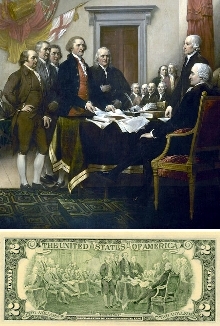
We hold these truths to be self-evident, that all men are created equal, that they are endowed by their Creator with certain unalienable Rights, that among these are Life, Liberty and the pursuit of Happiness.

Who is this “Creator”?  Is it Yahweh, the Christian god?  Is it a placeholder into which you can imagine any god so that Muslims can imagine Allah or Hindus can imagine Brahma?

No—the opening sentence clarifies: it’s not Yahweh but “Nature’s God.”  At the time, this phrase was understood as the deist god of Enlightenment philosophers like Spinoza and Voltaire.  Deism was popular in Revolutionary America, and Franklin, Jefferson, Washington, and other founding fathers were either deists or inspired by the movement.  Deism imagines a hands-off god, a creator who, once the clock is built and wound up, leaves it to tick by itself.

The role of this “Creator” is clarified in the Declaration:

Governments are instituted among Men, deriving their just powers from the consent of the governed.

In other words, the Creator has no role at all in government.  We’ve turned our back on the divine right of kings, where the king was God’s representative who served at God’s pleasure.  God isn’t the foundation on which authority rests.  No—it’s the consent of the governed.  The buck stops here, which is very empowering.

Remember that the purpose of the Declaration was to inform Britain that the colonies wanted to become independent.  When government becomes abusive, the recourse isn’t to appeal to God:

Whenever any Form of Government becomes destructive of these ends, it is the Right of the People to alter or to abolish it, and to institute new Government, laying its foundation on such principles and organizing its powers in such form, as to them shall seem most likely to effect their Safety and Happiness.

Again, we see that the government rules at the pleasure of the people, not God.

While the Declaration of Independence doesn’t give Christians what they may imagine it does—an acknowledgement of the existence of the Christian god and his sovereignty over this country—this exercise is largely irrelevant.  The Declaration isn’t the supreme law of the United States.  That is the Constitution, and it’s secular.  Watch out for Christian revisionist historians bringing up the Declaration.  That’s the white flag of surrender because they know that they have nothing where it really counts—the Constitution.

Photo credit: Wikimedia

Related posts:

Biblical Analysis of the Super Bowl

Christianity and atheism discussion and Does God exist?Everyone’s familiar with Tim Tebow’s public thanks to God for his football success and his love of the Bible verse John 3:16: “For God so loved the world that he gave his one and only Son, that whoever believes in him shall not perish but have eternal life.”

Many of us have heard some of the spooky 3:16 connections with Tebow’s next-to-last game this season.  The Broncos beat the Steelers on January 8 in Tebow’s first NFL playoff game, with Tebow throwing for 316 yards.  This was three years to the day that Tebow made a public splash wearing eye black that read “John 3:16” in the BCS Championship game.  In the win against the Steelers, Tebow averaged 31.6 yards for each pass completion, an NFL record for postseason games.

Let’s do the same kind of analysis on Eli Manning’s Super Bowl win on Sunday.  He threw a total of 296 yards.

There is no book in the Bible with the verse 2:96, so the significance must instead be in verse 29:6.  Several books have this verse.

Put the turban on his head and attach the sacred emblem to the turban. (Ex. 29:6)

Maybe this represents Manning being declared the game’s MVP.

My path was drenched with cream and the rock poured out for me streams of olive oil. (Job 29:6)

This may represent the accolades he received after the game.

The LORD Almighty will come with thunder and earthquake and great noise, with windstorm and tempest and flames of a devouring fire. (Isaiah 29:6)

That’s more like it—some godly justice!  God is obviously furious with the results of the game.  I’ll bet he was a Patriots fan.

That’s a big claim appropriate for the year’s biggest game.

Still, I wondered if there was more.  I realized my error when I converted yards into the biblical measure of cubits.  There’s a bit of fuzziness in the definition of the cubit, and 296 yards becomes something in the range 511 to 518 cubits.  Since Tebow’s quote is from the New Testament, let’s look there for verses in the range 5:11–18.

Mark 5:11–18 is the story of demons cast from a possessed man into 2000 pigs.  In Luke, it’s the story of Jesus healing leprosy.  In John, Jesus gets into trouble with the Jewish leaders because he heals on the Sabbath.  James and 1 John both state that prayer heals sick people, and they make a causal connection between sin and sickness.

The message starts to take shape—something about mental and physical illness being caused by sin and demons.

The breakthrough came when I went back to the quarterback’s name—Eli Manning.  That’s Elisha Manning.  Of course—the Old Testament prophet Elisha!  it wasn’t the New Testament but the Old Testament that had the clue.  And there it was, in 2 Kings 5:11–18, the story of Naaman, a general from Aram (today’s central Syria), who had leprosy.

Naaman had heard of the power of the Yahweh and came to Israel for healing.  Elisha commanded him to wash seven times in the Jordan.  Naaman had expected some ordeal or fee and considered this a snub, but his servants persuaded him to give it a try, and sure enough, his leprosy was cured.  Naaman realized the power of Yahweh and asked forgiveness when he would be obliged to bow before Rimmon (Baal) back in Syria.  Elisha granted it, saying “Go in peace.”

The scales fell from my eyes.  God’s message in this Super Bowl is that he can cure leprosy.  Leprosy is now reliably treated with antibiotics, of course, so this isn’t especially relevant, but it’s good to know that God’s still concerned about diseases that have little or no impact on society today.

I know what Christian apologists will say about my analysis.  They’ll say that this is arbitrary, that I’m just picking and choosing verses based on what I want to find, collecting ridiculous passages and ignoring the rest.  They’ll say that the chapter and verse divisions are not divinely inspired, with the New Testament being divided into verses only in the 1500s.  They’ll say that this entire analysis is nonsense, built on nothing solid.

And to that I say …

Busted!  You got me.  That’s exactly what I was doing.  I was indeed picking verses with an agenda.

But then if it’s nonsense when I do it, why is it any more meaningful when Christians do it?

Photo credit: Catholic Online