
And God isn’t Good, Either

This post is an homage to Christopher Hitchens (1949–2011), the powerful speaker and eloquent author of God is not Great and much more.  Hitchens fought nonsense till the end, and he has been an inspiration to me and countless other atheists.  In my own small way, I hope I’m continuing the fight against nonsense. 

Thanks, Christopher.

The child’s blessing goes, “God is great, God is good, let us thank him for our food.”  Hitchens’ God is not Great is an eloquent rebuttal to the first claim of this prayer.  Let’s consider here the second claim: God is good.  Indeed, the Bible makes this clear: “Praise the Lord, for the Lord is good” (Ps. 135:3).

But does the dictionary agree?  We must use words according to their meaning.

Here is what God commands about cities that refuse to submit to the Israelites: “Completely destroy them—the Hittites, Amorites, Canaanites, Perizzites, Hivites and Jebusites—as the Lord your God has commanded you” (Deut. 20:17).

You and I know what “good” means.  If you were a king or general and you ordered the genocide of those tribes—over ten million people, according to the Bible1—would you be considered good?

But you might say that this was wartime, and the rules were different.  Yes it was wartime, but the Israelites were the invaders, displacing Canaanites from land they had occupied for centuries.  God tells the Israelites to destroy the Amalekites: “Attack the Amalekites and totally destroy all that belongs to them.  Do not spare them; put to death men and women, children and infants” (1 Sam. 15:3).

What could the infants have possibly done to deserve to die?

Moses tells the Israelites that they must kill all of the Midianites, with one exception: “Now kill all the boys. And kill every woman who has slept with a man, but save for yourselves every girl who has never slept with a man” (Num. 31:17–18).

Who’s ever heard any of these verses made the subject of a sermon?

The immoral commands don’t stop with genocide.  Slavery wasn’t prohibited in the Bible; in fact, it was so much a part of everyday life that it was regulated.  In the same way that God told the merchants to sell using fair weights and measures (Deut. 25:15), he told the Israelites how to handle slaves—how to treat a fellow Israelite as a slave (Ex. 21:4–6 and Lev. 25:39), how to sell your daughter into slavery (Ex. 21:7), how to decide when a beating was too harsh (Ex. 21:20–21), and so on.

And this doesn’t even consider the Flood.  God may exist and he may be powerful, but can the word “good” be applied to a being who acts like this?

Let’s turn from God’s unsavory side to his attempts at encouraging good behavior.  It’s odd that the Ten Commandments has room for “don’t covet” but no prohibitions against slavery, rape, genocide, or infanticide.  Christopher Hitchens cuts through the problem:

It’s interesting to note that the tenth Commandment, do not covet, is given at a time when the Israelites wandering in the desert are kept alive with covetous dreams—of taking the land, livestock, and women from the people living in Palestine.  In fact, the reason why injunctions against rape, genocide, and slavery aren’t in the Ten Commandments is because they’ll be mandatory pretty soon when the conquest of Palestine takes place.2

So they’re not crimes—they’re tools!

Christians respond in several ways.

1. But things were different back then.  We can’t judge Jews in Palestine 2500 years ago with today’s standards.

Can we assent to these crimes at any time in history?  I agree that standards of morality have changed, but I thought Christians were supposed to reject moral relativism.  They’re the ones who imagine an unchanging, objective morality.  If slavery is wrong now, they must insist that it was wrong then.

2. But God’s actions are good—they just are.  His actions are the very definition of good.  That’s as fundamental a truth as we have.

Shouldn’t God follow his own rules?  If God is the standard for goodness (Matt. 5:48), what else can this mean but that we should look to God’s actions as examples for us to follow?

Abraham made clear that God was held to the same moral standards as Man.  He said, “Will not the Judge of all the earth do right?” as he argued against God’s plan to destroy Sodom and Gomorrah.  And God agreed (see Gen. 18:20–33).

If Christians modify the dictionary so that no action of God’s could ever be bad, assigning the word “good” to God’s actions says nothing.  They hope to make an important statement with “God is good,” but debasing the dictionary has made the word meaningless.

Playing games with the dictionary causes other problems.  If there are two supernatural agents, God and Satan, how do you tell which is which?  If the one that controls our realm is “good” by definition, maybe we’re stuck with Satan and have simply convinced ourselves to call him good.  That’s not a crazy idea, given the world’s natural disasters, disease, war, and other horrors.  Imagine Satan ruling this world and convincing us that the death of an innocent child is part of a greater plan, if you can believe such a thing.  And yet that’s the world we live in!  People look at all the bad in the world and dismiss it, giving Satan a pass.  (… or are we giving God a pass?  I can’t tell which.)

If this thinking is getting a bit bizarre, that’s the point.  That’s what happens if you declare God’s actions good by definition.

3. But the Canaanites were terrible, immoral people!  They sacrificed babies! 

How reliable are these summaries of the Canaanites’ morals?  If these tales come from their enemies, how objective are these accounts?  And even if the Canaanites did sacrifice babies, isn’t solving this with genocide like using a sledgehammer to swat a fly?  Couldn’t an omniscient guy like God figure out a better way than genocide to encourage a tribe to improve their behavior?

4. C’mon—can’t you recognize hyperbole when you see it?  This is just soldiers bragging around the campfire that grew until it was incorporated into Israelite lore.  You don’t really believe the genocide stories, do you?  Indeed, archeologists show no evidence of this mass slaughter.

Take your pick—is the Bible reliable history or not?  I disagree with the Bible literalists, but at least they wouldn’t be so hypocritical as to abandon the Bible when it embarrasses them.

Christians who label some Bible passages exaggerations and others as history are using their own judgment to figure this out.  I’m not complaining—that’s what I do myself—but they can’t then turn around and say that they get their guidance from the Bible.  No, my friend—the interpretation comes from you, not the Bible!

5. A bad thing today sets us up for a greater good in the future.

This is no more plausible than the reverse: “a good thing today sets us up for a greater bad in the future.”  Why imagine one over the other?  Only because we presuppose God’s existence, the thing we’re trying to prove.  And it’s ridiculous to imagine an omniscient God deliberately causing the Haiti earthquake (in which 300,000 people died) because he can act no more precisely than this.

6. But God is unjudgeable.  God said, “As the heavens are higher than the earth, so are my ways higher than your ways and my thoughts than your thoughts” (Is. 55:9).  It’s presumptuous of us to judge God.  If God says that the Amalekites deserved to die, that’s good enough for me.

Okay, let’s not judge God then.  Let’s avoid labeling him.  But then not only can we not label his shocking actions “bad,” we can’t label his pleasing actions “good.”  The good God is no more.

And there’s more fallout from the “we imperfect humans can’t judge God” argument.  Consider this from Bob Price:

[The ultimate certainty in your mind, the believer’s mind, is] the guarantee that [God] will honor that ticket to heaven he supposedly issued you.  Here’s a troublesome thought.  Suppose you get to the Day of Judgment and God cancels the ticket.  No explanation.  No appeal.  You’re just screwed.  Won’t you have to allow that God must have reasons for it that you, a mere mortal, are not privy to?  Who are you, like Job, to call God to account?

Of course many Christians want it both ways.  They want to judge God’s noble actions as “good” but withhold judgment for actions that any thoughtful person would find hideous.  But if you can’t understand God’s actions when they look bad, why flatter yourself that you understand them when they look good?

I think of this as the Word Hygiene argument.  You can either call a spade a spade and acknowledge God’s cruelty or say that he’s unjudgeable.  Take your pick—either way, you can’t call him “good.”

Photo credit: Church Sign Maker

Here’s the math behind that figure: Israel had 600,000 men before entering Canaan (Ex. 12:37), or about two million people total.  These six tribes are all larger than Israel (Deut. 7:1).  That makes well over ten million people in the tribes God orders exterminated.

Hitchens makes this point in videos here and here.

Related links:

  • About the Ten Commandments, Hitchens concludes: “Don’t swallow your moral code in tablet form” (video).

It’s Launch Day for my Book, Cross Examined!

Cover of "Cross Examined" by Bob SeidenstickerIt’s launch day for my new book—please buy early and often!

I posted a summary of the book yesterday, but here’s the one-liner: a young man takes a reluctant journey into the defense of Christianity and realizes that the truth of religion is something you must decide for yourself.

While the books of the New Atheists are nonfiction rebuttals of the reasons for Christianity, Cross Examined: An Unconventional Spiritual Journey explores that material as fiction.  I hope that for many readers, ideas that might be tedious or boring become part of an engaging and mind-broadening journey.

Atheism has been a plot element in many novels, but this may be the first that explores the specific arguments in defense of Christianity that are energetically discussed in society today.  Whether you’re a thoughtful Christian who enjoyed the intellectual workout of books such as C. S. Lewis’ Mere Christianity or an atheist who prefers Richard Dawkins’ The God Delusion, this book has something for you.

Buy Cross Examined at Amazon today (270 pages, paperback, $11.95).

Thank you!

What to Get the Atheists on Your Christmas List

Book cover for "Cross Examined" by Bob SeidenstickerThe toughest people on your Christmas list—it’s always the atheists, right?

You can give a Jesus Dressup refrigerator magnet.  Or a Darwin Fish car sticker.  Or a Buddy Christ dashboard statue.  But let me suggest something that’s a little more intellectual.

My new book, Cross Examined: An Unconventional Spiritual Journey is now available at Amazon.  I wrote my first notes about this project over eight years ago, so I’m pretty excited to finally be able to share it with you.

While many books defend the atheist position, this book takes a fictional approach to tough counter-apologetics arguments.  Indeed, the intellectual debate nearly becomes another character within the story.

The book targets two audiences.  First, I want to give thoughtful Christians something to think about and to encourage complacent Christians to critique the foundations of their religion.  Many Christian leaders make exactly this point, that they too want to push Christians to think.  I think of the book as an intellectual workout—a taxing project, perhaps, but one that leaves the reader a stronger person.

Second, I want to reach atheists who might enjoy approaching these intellectual arguments in fiction rather than in the usual nonfiction form.

The book is set in Los Angeles in 1906, in an odd new church that is suddenly world famous.  The pastor’s prediction of imminent disaster had been front-page news the day before the great San Francisco earthquake—true story.  Here’s the back-cover summary:

In 1906, three men share a destiny forged by a prophecy of destruction.  That prophecy comes true with staggering force with the San Francisco earthquake and fire, and young assistant pastor Paul Winston is cast into spiritual darkness when his fiancée is among the dead.  Soon Paul finds himself torn between two powerful mentors: the charismatic pastor who rescued him from the street and an eccentric atheist who gradually undercuts Christianity’s intellectual foundation.

As he grapples with the shock to love and faith, Paul’s past haunts him.  He struggles to retain his faith, the redemptive lifesaver that keeps him afloat in a sea of guilt.  But the belief that once saved him now threatens to destroy the man he is becoming.

Paul discovers that redemption comes in many forms.  A miracle of life.  A fall from grace.  A friend resurrected.  A secret discovered.  And maybe, a new path taken.  He realizes that religion is too important to let someone else decide it for him.  The choice in the end is his—will it be one he can live with?

Cross Examined challenges the popular intellectual arguments for Christianity and invites the reader to shore them up … or discard them. Take the journey and see where it leads you.

Buy copies for those hard-to-buy-for friends who would enjoy a different approach to the Christian/atheist debate.  It’s guaranteed to be far more intellectually stimulating than a refrigerator magnet or a Buddy Christ dashboard statue (and less cliché than frankincense or myrrh).  Thanks!

Bob Seidensticker

An Atheist Ad Campaign—a Holiday Tradition!

Atheist ad campaign asks does god exist

Today, Seattle Atheists launches an ad campaign on local buses.  Twelve buses will carry banner ads with photos of four people in average settings with the tag line, “1 in 4 is an Atheist.”  The campaign runs through early January.

One in four Seattle residents has no god belief—in other words, they are atheists.  Seattleites may not consider that the person who sold them their morning coffee might have been an atheist.  Or the person who drove their bus or repaired their car or did their taxes or treated their illness.  Atheists are their coworkers, their friends, their family.  Whether they realize it or not, they know plenty of atheists.

These are smart people who take pride in their work and love their families and appreciate the great things about America, just like religious people.

The Problem.  While atheists do their part within society, they don’t always get the same consideration in return.  They’re sometimes told, “This is a Christian nation and if you don’t like it, move to Europe.”  Some risk their jobs by revealing who they are, and some risk ostracism and the loss of their family or community.  Some are bullied or discriminated against within schools or by the military.  Seeing this, many atheists remain silent.  Many churchgoers are among these silent atheists.

The political season is a time when atheists are particularly reminded how out of step they are with much of America.  The U.S. House recently passed a resolution to reassure us that, yes, “In God We Trust” is still our national motto.  Governors appeal for prayer to solve problems rather than using the power of their office.  Political candidates often vie with each other to be the most Christian.  When it comes to people we wouldn’t vote for, atheists are at the bottom.

What Atheists Want (and What They Don’t Want).  Many of the fears Christians have about atheists are invented by clergy or politicians.  American already is a secular nation—the Constitution makes this clear—but that’s not a threat to Christians.  Indeed, it’s the best environment for Christians.

Christians can send their children to public school and know that they won’t hear a Bahá’í or Satanist prayer.  Christians can go to a city council meeting and not see “Allahu Akbar” in Arabic script on the wall.  Christians can go into a courtroom and not see a Shinto or Hindu god of jurisprudence glaring down at him.  But while government is constrained in its religious speech, citizens are not, and Christians can still preach or hand out flyers in the public square.  Everyone wins.

Atheists don’t want Christians denied their right to free speech.  When atheists object to preachers recommending political candidates or “Under God” in the Pledge of Allegiance, they don’t want to limit the rights of Christians or get special privileges, they just want equality.

Next Steps.  If you’re an atheist, consider coming out.  Politely make your presence known.  The biggest factor in the American public becoming more tolerant of homosexuals was simply knowing one, and it works the same way for atheists.  But whether or not you feel comfortable making your atheism public, find local atheist or freethought groups and connect with your community.

If you’re a theist, be aware that there are atheists all around you.  These are people just like you, honest and hardworking.  Instead of praying before a meeting, evangelizing in the workplace, or putting a Jesus fish on your web site, consider if actions like these may offend others.  Encourage your friends to speak their mind and be who they are.

Jesus and Santa Claus

What is Christianity?  And how does Santa Claus help?Harriett Hall (the SkepDoc) wrote a clever story about two kids trying to figure out whether the tooth fairy really exists or not.  Inspired by that, and in keeping with the season, I’d like to imagine two kids arguing about Santa.

It was early December, and little Jerry had begun to doubt the existence of Santa Claus.  He made his case to his younger brother Kyle.

“I don’t think Santa is real.  I think it’s just Mom and Dad buying us presents,” Jerry said.

“Prove it,” Kyle said.

“Okay, why are there all those Santas on the street corners ringing for money?  How can Santa be at all those stores at once?”

“They’re not the real Santa, just his helpers,” Kyle said.  “And maybe they’re just testing us to see if we’ll still believe.  I’m going to believe, because if you don’t, you don’t get presents.”

“But I recognized one of them—it was the father of one of my friends.”

“Then those are just ordinary people imitating Santa, raising money for a good cause.  Anyway, I’ve seen Santa on TV at Thanksgiving—everyone has.”

Jerry sees that he’s not making any progress, so he gives up.  On Christmas afternoon, he’s alone with Kyle and tries again.  “Remember that video game that you told Mom about and then you forgot to tell Santa?” Jerry said.  “But you got it anyway.  Mom must’ve bought it and written on the package that it came from Santa.” 

“Mom just told Santa,” Kyle said. 

“But how can Santa get around the world in one night?”

“My friends all say that Santa is real.  Anyway, Santa has magic.  And the cookie plate we leave out for Santa always has just crumbs on Christmas morning.”

“With the Junior Detective kit that I got this morning, I dusted the cookie plate for fingerprints, and they were Mom’s.”

“Mom set out the plate, and Santa wears gloves.”

Jerry gives up for the year.  On Christmas afternoon the next year, he tries again.  “Lots of the older kids don’t believe in Santa.  They say that their presents only come from their parents.”

“Sure,” Kyle said.  “Santa only gives presents to those who still believe in him.”

“A few months ago, I was snooping in Dad’s sock drawer, and I found every letter we ever wrote to Santa.”

“Why not?  Santa didn’t need them anymore and each year just gives them to Mom and Dad for keepsakes.”

“The only fingerprints on our presents are Mom’s or Dad’s.” 

“Mom and Dad always get up early on Christmas.  They could’ve rearranged them.”

“Last week, I found all our presents hidden in a corner in the attic.”  Jerry pawed through some of the torn wrapping paper.  “I wrote my initials on the bottom of each package.  And look—here they are.  That proves that Santa didn’t bring them here last night.”

“I asked Mom, and she said that Santa is real.  Anyway, how do I know you didn’t write your initials on the wrapping paper this morning?”

Like little Kyle, if you’re determined to believe something, you can rationalize away any unwelcome evidence.  (By rationalize, I mean taking an idea as fact and then selecting or interpreting all relevant evidence to make it support that idea.)

It’s tempting to list the many ways Christians rationalize.  They rationalize away contradictions in the Bible, the oddity of a hidden God, or why so much bad happens to the people God loves.  They can find a dozen reasons why a particular prayer wasn’t answered, even though the Bible promises, “Ask and ye shall receive.”  But the Christian says that he’s simply defending the truth: “I’m not rationalizing; I’m right.”

In five minutes we can see flaws in others that we don’t see in ourselves in a lifetime.  Perhaps this episode with Jerry and Kyle will encourage us to see our own rationalizations.

I recently came across the Galileo Was Wrong; The Church Was Right blog.  That’s right, it argues for geocentrism, an earth-centered universe.  With a little work, even the nuttiest theory can be given a scholarly sheen, so imagine what a few thousand years of scholarly work can do to a religion.  Any Christian can point to centuries of scholarship to give a patina of credibility to their position (but, of course, so can Muslims, Hindus, and those in many other religions).

I can’t prove Santa doesn’t exist.  Nor can I disprove the existence of leprechauns, Russell’s Flying Teapot, the Flying Spaghetti Monster, or God.  The thoughtful person goes where the evidence points rather than accepting only the evidence that supports his preconception.

And Jesus is Santa Claus for adults.

Photo credit: Robot Nine

Plantinga’s Nutty Evolutionary Argument Against Naturalism

Where is Jesus?What better way to respond to atheists but to turn one of their own tools against them?  That’s the approach philosopher Alvin Plantinga tries to use with his Evolutionary Argument Against Naturalism (EAAN).  It’s not a new idea, and both C.S. Lewis and Charles Darwin anticipated it.  In brief, the question is: how can a human mind that’s the result of the clumsy process of evolution be trusted?

About “Darwin’s doubt,” Plantinga argues that only Christians can have confidence that their interpretation of the world is correct.  Naturalists can’t prove that minds are reliable until they’ve proven that the source of this claim (the mind!) is worth listening to.

Here’s where Plantinga claims to have turned the tables:

The high priests of evolutionary naturalism loudly proclaim that Christian and even theistic belief is bankrupt and foolish.  The fact, however, is that the shoe is on the other foot.  It is evolutionary naturalism, not Christian belief, that can’t rationally be accepted.

He says that if evolution is true, human beliefs have been selected for survival value, not truth, so why trust them?  And yet our beliefs are reliable, suggesting to Plantinga that something besides evolution created them.

Before we get into the specifics of Plantinga’s argument, let’s first establish a baseline.  Plantinga and naturalists agree that humans’ needs and desires are pretty logically matched:

Plantinga normal world

This is straightforward.  You go toward cuddly things, you run from scary things, you get to clean air if you can’t breathe, and so on.  This is the world we all know and understand.  But Plantinga imagines the naturalist’s world in which these links are jumbled.  He imagines a hominid Paul who has some problematic beliefs about predators:

Perhaps [Paul] thinks the tiger is a large, friendly, cuddly pussycat and wants to pet it; but he also believes that the best way to pet it is to run away from it.

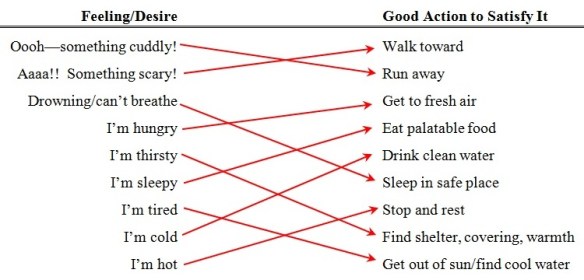
So Paul’s instincts toward tigers keep him alive, but only by luck.  But unreasonable beliefs don’t stop with tigers.  Plantinga imagines the naturalist’s view of the world with beliefs having no connection with reality.  That is, he imagines something like this:

Paul’s response to the tiger was just a roll of the dice, and he got lucky.  But Plantinga supposes that all of Paul’s beliefs are arbitrary, not just those about tigers.  Some actions in this chart are benign, but some are dangerous.  When Paul sees something scary, his reaction is to walk toward it.  When he’s drowning, he’ll try to sleep.  When he’s hungry, he’ll satisfy that need with fresh air, and so on.  With his basic desires paired with ineffective methods, this guy is clearly too dumb to live.

This is where natural selection comes in.  Natural selection is unforgiving, and actions that don’t lead to survival are discarded.  Evolution easily explains why Plantinga’s Paul could not exist.

An article at Skeptic.com neatly skewers Plantinga’s argument with a familiar example.

If a professional baseball player [incorrectly perceived reality,] that is, if his perception of the movement and location of a baseball was something other than what it actually is, then he would not be able to consistently hit ninety-five mile per hour fastballs.

As an aside, let me admit that I have a hard time maintaining respect for those at the leading edge of philosophy.  Do they do work that’s relevant and pushes the frontier of human knowledge?  I’d like to think so, but when this is the kind of argument they give, it’s hard to keep the faith.

My advice to philosophers: when you get the urge to play scientist, better lie down until the feeling goes away.

Photo credit: Wikimedia

Related links:

  • “EAAN—a sad footnote to an illustrious career,” Shamelessly Atheist blog, 8/22/09.
  • “Evolutionary Argument Against Naturalism,” Iron Chariots Wiki.
  • PZ Myers, “Alvin Plantinga Gives Philosophy a Bad Name,” Pharyngula blog, 5/29/09.
  • Michael Dahlen, “What’s So Great About Kant?  A Critique of Dinesh D’Souza’s Attack on Reason,” eSkeptic, 8/17/11.
  • Greg Kokul, “The Evolutionary Argument Against Naturalism,” Stand to Reason (video, 3:59), 8/15/11.
  • “Evolutionary Argument Against Naturalism,” Wikipedia.