Post #100

Using fiction to explore Christianity and atheismWelcome to post #100!  It’s time to see how far this blog has come since I started last August.

Many of you know that this is actually two blogs.  Galileo Unchained (“For Those Who Have No Use for Faith”) is the doorway aimed at atheists, and Cross Examined (“Clear Thinking About Christianity”) is aimed at Christians.  The content is the same, so hang out wherever you feel more comfortable.

In December, I launched my novel, Cross Examined: An Unconventional Spiritual Journey.  My goal with both the book and this blog is primarily to encourage Christians to think.  Whether they become atheists or stronger Christians isn’t the issue but rather that they think about the intellectual foundations that support their faith.  Too commonly, in my opinion, Christians act out their faith on autopilot, not thinking much about what they claim is life’s most important issue.

And, of course, I hope to have provocative content for atheists as well, both in this blog in the book.

If you haven’t poked around in the toolbar, that’s been gradually updated, with a page listing all the posts, a glossary (with each of the Words of the Day), and a summary of the book with the first couple of chapters.

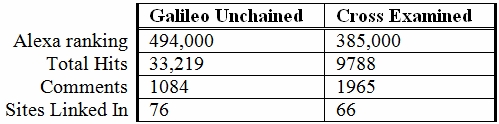
Here are some of the stats for the blogs:

Alexa ranks web sites by global popularity, and a smaller number is better.  It says that 0.00034% of global Internet users visit CrossExaminedBlog.com.  (Woo hoo—look out, PZ Myers!)

There’s no easy way to figure out word count, but all the posts add up to roughly 50,000 words.

So what’s next?  I’m thinking about podcasting the blogs.  That is, the same content, just spoken.  I hope that will provide a new audience.  I’m also thinking about consolidating the blogs, which would mean focusing on Cross Examined and no longer updating or creating links to Galileo Unchained.  (Your thoughts on these changes?)

Here’s where I need your help.

  • Who do you think would find the book useful?  Do you know of any thoughtful Christians comfortable enough in their beliefs who would be interested in exploring the foundations of Christianity?  Please pass on a link.  I’m also looking for blurbs (brief recommendations), so let me know of anyone with interesting credentials—a pastor or professor, perhaps—who might share my goal of encouraging Christians to think and who would like a free review copy.
  • Who would find the blog interesting?  Please recommend it to anyone you think would appreciate plain talk on Christianity.
  • What recommendations do you have for the blog?  Any changes in format?  Topics ideas?  Add your thoughts to the comments below or email me.

Thanks for dropping by, and I hope you find this a worthwhile destination on the internet!

Bob Seidensticker

Photo credit: kslavin

“Cross Examined” Available on Kindle!

My novel is now available on Kindle, with more electronic formats in process.

If you haven’t heard about the book, here’s the one-liner: a young man takes a reluctant journey into the defense of Christianity and realizes that the truth of religion is something you must decide for yourself.

The book targets two audiences.  First, I want to give thoughtful Christians something to think about and to encourage complacent Christians to critique the foundations of their religion.  Many Christian leaders make exactly this point, that they too want to push Christians to think.  I think of the book as an intellectual workout—a taxing project, perhaps, but one that leaves the reader a stronger person.

Second, I want to reach atheists who might enjoy approaching these intellectual arguments in fiction rather than in the usual nonfiction form.

The book is set in Los Angeles in 1906, in an odd new church that is suddenly world famous.  The pastor’s prediction of imminent disaster had been front-page news the day before the great San Francisco earthquake—true story.  Here’s the back-cover summary:

In 1906, three men share a destiny forged by a prophecy of destruction.  That prophecy comes true with staggering force with the San Francisco earthquake and fire, and young assistant pastor Paul Winston is cast into spiritual darkness when his fiancée is among the dead.  Soon Paul finds himself torn between two powerful mentors: the charismatic pastor who rescued him from the street and an eccentric atheist who gradually undercuts Christianity’s intellectual foundation.

As he grapples with the shock to love and faith, Paul’s past haunts him.  He struggles to retain his faith, the redemptive lifesaver that keeps him afloat in a sea of guilt.  But the belief that once saved him now threatens to destroy the man he is becoming.

Paul discovers that redemption comes in many forms.  A miracle of life.  A fall from grace.  A friend resurrected.  A secret discovered.  And maybe, a new path taken.  He realizes that religion is too important to let someone else decide it for him.  The choice in the end is his—will it be one he can live with?

Cross Examined challenges the popular intellectual arguments for Christianity and invites the reader to shore them up … or discard them. Take the journey and see where it leads you.

Buy Cross Examined at Amazon today (270 pages, paperback, $11.95 or Kindle version, $2.99).

Related posts:

  • Read excerpts of the book here.

“God Did It” Explains Everything … or Maybe Not

"Creation of Adam" painting raises the question: does God even exist?It’s time once again to check in with apologist Greg Koukl. In a recent podcast (“Is Consciousness an Illusion?“ 12/4/11), he talked about Daniel Dennett’s 2006 book Breaking the Spell.

Let me first seize the opportunity to agree with something. Koukl says, “Reality is the kind of thing … that will injure you if you don’t take it seriously.” It’s good to see us with the same goal of seeing reality clearly.

But we don’t agree on everything. Koukl said:

[Dennett has] made a claim in this book about something that is very, very difficult for a materialist to deal with that makes sense completely within a Christian worldview. (3:05)

The “something” is consciousness. So Koukl says that the scientist has a tough time explaining consciousness, but it’s easy for the Christian.

While it’s true that science has much to discover about consciousness and how it works, I don’t see anything in particular that ought to keep the naturalist up at night. Science has an unanswered question—big deal. Science has lots of unanswered questions. It also has a marvelous track record for answering them.

But what trips me up here is the idea that the Christian worldview adds to the discussion. How does God explain anything?

Let me make clear that I can never prove that God didn’t do something. For example, let’s consider a few claims about God by Pat Robertson. He said that God is “lifting His protection from this nation” to allow terrorist attacks (2001). And that Hurricane Katrina might be God’s doing (2005). And that the people of Haiti made a pact with the devil, in response to which God allowed the earthquake that killed 300,000 (2010). These are assertions without evidence (and, in the case of Haiti in particular, of much contrary evidence), but I can’t prove that “God did it” is false.

The fact is, “God did it” can explain everything. As a result, it explains nothing.

“God did it” is simply a repackaging of “I don’t know.” It tells us nothing new. I’m no smarter after hearing “God did it” than before. It tamps down one set of questions, but others pop up: Who is God and how does he act in the world? Is he one of the thousands of gods that humans have already formed religions around or someone new? Why did God do what he did? What natural laws did God use to do it, and what laws did he suspend? How can we communicate with him?

And think about the size of various claims. The claim “1 + 1 = 2” is not controversial. The claim “I had a sandwich for lunch” is unsurprising, and thorough evidence could be provided to back it up. But the claim “There is a being that created the universe” is without scientific precedent—that is, science knows of no supernatural anything, let alone a being that could create the universe. I can think of no bolder claim than “God did it.” It’s baffling to me how apologists can toss out that immense claim and simply let it hang there, supported by nothing more than wishful thinking and tradition.

“God did it” doesn’t do it. It satisfies only those who want their preconceptions affirmed.

But let me take a step back for a moment. I’m treating this claim with the dignity due those that make testable pronouncements about reality. Perhaps that’s my mistake—if it’s simply a theological claim divorced from reality, fine. In that case, it’s a claim to be taken simply on faith, with no pretense of evidence or verifiability, and I have no use for it.

Let me end with a song, “Tell Me Why” by Pat Benatar*, which nicely makes the “God did it” claim.

Tell me why the stars do shine,
Tell me why the ivy twines,
Tell me what makes skies so blue,
And I’ll tell you why I love you.

(refrain)
Because God made the ivy twine.
Because God made the stars to shine.
Because God made the sky so blue.
Because God made you, that’s why I love you.

This Christian explanation is poetic, but for those of us who prefer to actually understand the world, Isaac Asimov has a new and improved refrain:

Nuclear fusion makes stars to shine,
Tropisms make the ivy twine,
Rayleigh scattering make skies so blue,
Testicular hormones are why I love you.

I’ll stick with the discipline with the track record for explaining reality.

Photo credit: Wikipedia

*Lyrics © Warner/Chappell Music, Inc., Sony/ATV Music Publishing LLC, EMI Music Publishing.

Related posts:

  • Don’t Move the Goalposts. Apologists often say about the puzzling questions at the limits of science, “If you can’t answer them, we can!” For the old questions (such as “What causes disease?” or “What causes drought?”) this claim is now laughable. Why is Christianity’s claim to answer the new questions any less so?
  • Philosophical Grounding: A Parable. We’re told, “The atheist borrows from the Christian worldview!” But dig into this claim, and you’ll see there’s nothing there.

500 Eyewitnesses to the Risen Christ? Not likely.

How does Christianity stand up to atheist critique?Christians often point to 1 Corinthians 15 as important evidence for the resurrection.  This book, Paul’s first epistle to the church in Corinth, was written roughly a decade before the earliest gospel of Mark (written in 65–70CE).  This makes it the earliest claim for the resurrection of Jesus.

Here’s the interesting section:

For what I received I passed on to you as of first importance: that Christ died for our sins according to the Scriptures, that he was buried, that he was raised on the third day according to the Scriptures, and that he appeared to [Peter], and then to the Twelve. After that, he appeared to more than five hundred of the brothers and sisters at the same time, most of whom are still living, though some have [died]. Then he appeared to James, then to all the apostles, and last of all he appeared to me also, as to one abnormally born. (1 Cor. 15:3–8)

Claims about this important passage are all over the map.  Some argue that it actually precedes Paul’s writing.  They say that it appears to be in a different style, as if it were a creedal statement (like the modern Apostle’s Creed) that would have been recited by believers.  That is, though Paul wrote this passage 25 years after the crucifixion, it had been an oral creed since as early as a few years after Jesus’ death.  They cite this as evidence that belief in the resurrection was even earlier than Paul’s writing.

Others propose a very different interpretation: that the different style suggests that it was added to copies decades after Paul’s writing.

To understand this interpretation, consider how we know what the epistle says.  Our earliest copy is from papyrus P46, part of the Chester Beatty collection.  This manuscript was written in roughly 200 CE, which means that our best copy of 1 Corinthians is 150 years older than the original letter.  150 years gives a lot of opportunity for hanky-panky as scribes copy and recopy the letter, especially during the early turbulent years of the new religion of Christianity.

But I give this simply as background.  We can’t resolve this scholarly debate about the authenticity of this passage.  What I find more interesting is one verse:

[Jesus] appeared to more than five hundred of the brothers and sisters at the same time, most of whom are still living, though some have [died].  (1 Cor. 15:6).

This is a popular passage among apologists, and they see it as powerful evidence in favor of the resurrection story.  Granting for now that Paul actually wrote this in the mid-50s CE, that’s a lot of eyewitnesses, and Paul in effect dares his readers to go check out his claim if they want.  Who would make a claim like this, making himself vulnerable to readers catching him in a lie (or at least an error), if he didn’t know it were true?

But this bold and confident defense of the resurrection wilts under scrutiny.  Let’s imagine that we’re in that church in Corinth and we have just received Paul’s letter.

1. Who are these 500 people?  Names and addresses, please?  To find out, someone would need to send a letter back to Paul (200 miles across the Aegean Sea in Ephesus) to ask.  Paul’s challenge is vague, not inviting.

2. How many will still be around?  Paul is writing in about 55CE about a supposed event that occurred over 20 years earlier.  Of the 500 eyewitnesses, how many are still alive and still in Jerusalem, ready to be questioned?

3. Who would make this trip?  Jerusalem is 800 miles away, and getting there would involve a long, dangerous, and expensive trip.

4. How many candidates for this trip?  If the church in Corinth had thousands of members, the risk of someone with the means and motivation to make the big trip to Jerusalem might be high.  But Paul had only started the church a couple of years earlier.  How many members would there have been … maybe 100?

5. Who would challenge Paul?  If the founder of the church says something, who’s likely to question it?  There might well have been people who were unimpressed by Paul’s message, but these would never have joined the church.  Others within the church might have become disappointed and left.  Even if these people might have wanted to topple Paul, they wouldn’t have been in the church community to learn of the claim.

6. What did the eyewitnesses actually see?  Let’s imagine that we have the money and daring to make the trip, we’ve found at least a handful of names that we can search for to find many of the eyewitnesses, and we’re rebellious enough to spit in the face of our church’s founder and see if he’s a liar.

After many adventures, we reach Jerusalem.  What will the eyewitnesses say?  At best they’ll say that, over 20 years ago, they saw a man.  Big deal.  Did they see him dead before?  Were they close enough to the movement to be certain that they recognized Jesus?  Human memory is notoriously inaccurate.  There’s a big difference between the certainty one has in a memory and its accuracy—these don’t always go together.

7. So what?  Suppose all these unlikely things happen—we make the long trip and we track down eyewitnesses—and we conclude that Paul’s story is nonsense.  If we successfully make the long trip back, what difference will this make?  Even if we had the guts to tell everyone that Paul’s story was wrong, so what?  Who would believe us over the church’s founder?  We’d be labeled as bad apples, we’d be expelled from the church, and the church would proceed as before.  And Paul’s letter would still be copied through the centuries for us to read today!

As with the Naysayer Hypothesis, apologists imagine that this argument is far stronger than it is.  And if Paul’s claim is such compelling evidence, why didn’t the gospels include it?  None do, and they were all written after 1 Corinthians.

Who would imagine that a supernatural claim written two thousand years ago would be compelling when we wouldn’t find it compelling if written two minutes ago?

Let’s consider two possible conclusions about this verse.

  1. The resurrection happened as the gospels describe it.  (Let’s grant for now that the gospels all tell the same story.)
  2. Tales circulated orally in the years after the crucifixion among Jesus’s followers, with the number of eyewitnesses to the risen Christ growing with time.

Why imagine a supernatural story when a natural story explains the facts?  Even supposing that Paul invented the story to boost his credibility or strengthen his church, this is a plausible natural explanation that trumps the supernatural one.

Photo credit: University of Michigan

Articles in support of the Christian position:

  • “1 Corinthians 15:3–8,” Agent Intellect blog, 2/24/09.
  • Keith Krell, “The Facts of Faith (1 Corinthians 15:1-11),” bible.org.

Understanding Morality—It’s Really Not that Hard

Does God exist?  Maybe not.Greg Koukl tries to hold atheists’ feet to the fire to show how they misuse moral thinking. His analysis provides good instruction in poor argumentation, but not quite in the way he hopes.

The podcast is “Making Sense of Morality” (3/6/11). As I quote Koukl below, I will use approximate time markers from the audio stream.

He starts by claiming that there are objective moral values. He didn’t define them, but William Lane Craig’s definition works: “moral values that are valid and binding whether anybody believes in them or not.”1 That’s a big claim—these are moral values that are somehow grounded supernaturally or transcendentally. Never having seen evidence for supernatural or transcendent anything, I was eager to hear Koukl justify their existence. Here he goes:

Virtually no one believes the opposite. (3:23)

And that’s it. Apparently, Koukl has no argument besides, “You believe that … right?” We’re not off to a good start.

From this flabby grounding, he proposes to dismantle what many Christian apologists have admitted is the most challenging problem they face, the Problem of Evil. There is no Problem of Evil, Koukl says, unless there are objective moral values.

Such a problem could only exist if morals were objective, not relative, because we can only complain about the existence of a good powerful god with regards to the existence of evil in the world if there is actually objectively, really evil in the world, not just “evil” in our own preferences. (4:20)

No. The Problem of Evil simply points out a paradox: the Christian imagines (1) a good god who (2) tolerates a world with plenty of evil in it. How is this possible?

This is quite simple: you, Greg, would not be called good if (for example) you had the power to diffuse the tectonic energy that caused the Haiti earthquake that killed 300,000 people but didn’t—this is the Word Hygiene argument. The words “good” and “evil” are defined in the dictionary, and we don’t change the definitions when we talk about God. No objective anything is required—the Problem of Evil simply assumes that your god exists for the sake of the argument, and then it takes this idea for a drive and runs it off the unavoidable logical cliff.

Koukl continues, noting that atheists often say that evolution can explain morality. But:

[Evolution] is not going to get you a genuine, bona fide objective moral obligation; it’s just going to get you maybe the feeling of morality when morality doesn’t actually exist. (6:03)

Koukl is saying that morality is either objective or it’s nothing.

So let’s check the dictionary. “Moral” is defined as “of or relating to principles of right and wrong in behavior; ethical” or “conforming to a standard of right behavior” (Merriam-Webster). And what are these principles and standards? I suggest that they’re the laws and customs of society. The dictionary mentions no objective, supernatural, or absolute anything. Evolution programs us with moral instincts; Koukl’s imagined concern vanishes.

Next, Koukl talked about listening to an interview with professor and author Steven Stuart Williams. Williams rejected objective morality and said that we should minimize suffering. But why does he say this?

Because that’s the way I like it. (10:15)

(Note that this is Koukl’s paraphrase of Williams’ answer.) This seemed to be a bombshell to Koukl, though I don’t see why. That could be a clumsy paraphrase of my own thinking: that we strive to minimize suffering because our programming (our conscience) tells us to. This conscience punishes us with guilt when we resist it—when we didn’t stop to help someone or when we took an action that caused harm.

Why is this shocking? Greg, isn’t this the way it works for you?

The interviewer next asked Williams how he would counter a Stalin or Pol Pot.

By what standard does [Williams] say that his preference is a better morally speaking preference than those other preferences that are opposite his? And for this he had no answer. (12:30)

That’s okay—I have an answer. This is just the moral relativism fallacy. Koukl apparently imagines a dilemma: you must accept either

  • objective morality, with a supernatural or transcendental grounding for morality, or
  • relative morality, where I have my moral truths and you have yours, and I have no ability to criticize.

The problem is that this doesn’t define all the options. I see no evidence for objective morality (and Koukl doesn’t provide any), but I’m quite happy to criticize moral claims with which I don’t agree.

I think we have a shared (not objective) grounding in the programming common to all humans. That is, we aren’t seeing God’s universal moral truth but rather universally held moral instincts. Wouldn’t that explain the facts?

And now it’s time to get in a dig at the New Atheists. Koukl says that the “old time atheists” were much more intellectually honest. They followed their thinking to its logical conclusion and took their medicine, whatever that was. He cautioned his Christian listeners about slippery atheists playing games.

The old style guys would bite the bullet and they’d say, “Nope, no morality, no right and wrong, all personal preferences, just emotions … no meaning in life.” (14:50)

If you want to debate the “old style guys,” Greg, go ahead, but this doesn’t describe me. I have plenty of morality and meaning in my life, but thanks for asking. It’s just not supernaturally grounded … but then there’s no reason to think yours is, either.

So what you’re saying is, there is no transcendent morality, it is just a matter of personal opinion, and when you are put up against Mao Tse-tung, you can’t give me a reason why one person would choose one rather than the other. (15:50)

Can Koukl have never had an argument about a moral issue? Each person makes a case using the shared moral ideas of our species and culture—that’s how it’s done. Or look at a legislative debate for a more formal example.

Bizarrely, the interviewer then asks,

Wouldn’t it be more satisfying to have God ground [morality] on a purely pragmatic basis? (16:25)

Do you hear what you’re saying? You’re wondering if reality is satisfying? As if we have a choice! It’s reality—we’re stuck with it! The focus should be on figuring out what reality is and working with it.

Williams argued that he could live a good life, but Koukl accuses him of playing word games:

What exactly do you mean by “good” here? I know what he meant by “good”; he meant by “good” the same thing his theistic interviewer meant by “good.” The problem is, he has no right to those terms because they aren’t at home in the worldview he was arguing for. (18:20)

And we’re back to consulting the dictionary. Show me the objective part of the definition of “good” that would make it inappropriate if said by an atheist. We have a common definition for words; that’s how communication works. Where’s the problem?

When we say we can punish people for doing bad, [Williams means] that we could still punish people for doing things that are contrary to [his] personal preference. (20:45)

Duh—doesn’t everyone want laws to be in accord with their own views of right and wrong? We make compromises as members of a society, but obviously we’d like the laws to be as in line with our personal morality as possible.

Koukl ends by encouraging his listeners to listen carefully to make sure the other guy is using moral language and concepts correctly.

Finally—something we can agree on.

Photo credit: Wikipedia

1William Lane Craig and Walter Sinnott-Armstrong, God? A Debate Between a Christian and an Atheist (Oxford University Press, 2004), p. 17.

Related links:

  • “Morality 1: Good without Gods,” QualiaSoup (video, 13:25), 6/23/11.
  • “Morality 2: Not-so-good Books,” QualiaSoup (video, 14:10), 7/28/11.
  • “Morality 3: Of Objectivity and Oughtness,” QualiaSoup (video, 17:12), 11/6/11.
It’s Launch Day for my Book, Cross Examined!

Cover of "Cross Examined" by Bob SeidenstickerIt’s launch day for my new book—please buy early and often!

I posted a summary of the book yesterday, but here’s the one-liner: a young man takes a reluctant journey into the defense of Christianity and realizes that the truth of religion is something you must decide for yourself.

While the books of the New Atheists are nonfiction rebuttals of the reasons for Christianity, Cross Examined: An Unconventional Spiritual Journey explores that material as fiction.  I hope that for many readers, ideas that might be tedious or boring become part of an engaging and mind-broadening journey.

Atheism has been a plot element in many novels, but this may be the first that explores the specific arguments in defense of Christianity that are energetically discussed in society today.  Whether you’re a thoughtful Christian who enjoyed the intellectual workout of books such as C. S. Lewis’ Mere Christianity or an atheist who prefers Richard Dawkins’ The God Delusion, this book has something for you.

Buy Cross Examined at Amazon today (270 pages, paperback, $11.95).

Thank you!