Finding Jesus Through Board Games

Does Jesus exist?The Atheist Experience podcast discussed an interesting apologetic several years ago.  Here is my interpretation of this thinking.

Imagine a board game called “Monopoly Plus,” an updated version of the popular board game.  There’s a track around the outside of the board that’s divided into cells.  Each player is represented by a token on the board—a dog, a car, a top hat, and so on—and each player in turn rolls dice to see how many steps to move.  You start with a certain amount of money, and you can buy the properties that you land on as you move around the board.  Players who then land on one of the owned properties must pay the owner rent, and the owner can pay to improve properties so that the rent is higher.

Here’s how you win: you must accept Jesus Christ as your lord and savior.

Yep, that’s a pretty bad game.  The motivations within the game have absolutely nothing to do with how you win.

Now take that idea about a million times larger, and we have the game of Christianity®—ordinary reality filtered through a Christian worldview.  It’s far more complicated than any board game.  In Christianity, there are good things (love, friendships, possessions, accomplishments, personal victories, etc.) and bad things (illness, death, sorrow, disappointment, personal defeats, etc.), and skillful players maximize the good things and minimize the bad.

Immersed in this huge mass of complexity, we’re told that, in the big picture, it all doesn’t matter.  To win the game you must accept Jesus as your lord and savior.

Why is the game of Christianity any less out of touch with reality than the game of Monopoly Plus?

Photo credit: Wikimedia

Related links:

10 Reasons the Crucifixion Story Makes No Sense

Does God exist?  You wouldn't think so given the bizarre crucifixion story.I’m afraid that the crucifixion story doesn’t strike me as that big a deal.

The Christian will say that death by crucifixion was a horrible, humiliating way to die.  That the death of Jesus was a tremendous sacrifice, more noble and selfless than a person sacrificing himself for the benefit of a butterfly.  And isn’t it worth praising something that gets us into heaven?

Here are ten reasons why I’m unimpressed.

1. Sure, death sucks, but why single out this one?  Lots of people die.  In fact, lots died from crucifixion.  The death of one man doesn’t make all the others insignificant.  Was Jesus not a man but actually a god?  If so, that fact has yet to be shown.

It’s not like this death is dramatically worse than death today.  Crucifixion may no longer be a worry, but cancer is.  Six hours of agony on the cross is pretty bad, but so is six months of agony from cancer.

2. What about that whole hell thing?  An eternity of torment for even a single person makes Jesus’s agony insignificant by comparison, and it counts for nothing when you consider the billions that are apparently going to hell.

3. Jesus didn’t even die.  The absurdity of the story, of course, is the resurrection.  If Jesus died, there’s no miraculous resurrection, and if there’s a resurrection, there’s no sacrifice through death.  Miracle or sacrifice—you can’t have it both ways.  The gospels don’t say that he died for our sins but that he had a rough couple of days for our sins.

4. Taking on the sin vs. removal of sin aren’t symmetric.  We didn’t do anything to get original sin.  We just inherited it from Adam.  So why do we have to do anything to get the redemption?  If God demands a sacrifice, he got it.  That’s enough.  Why the requirement to believe to access the solution?

5. The reason behind the sacrifice—mankind’s original sin—makes no sense.  Why blame Adam for a moral lapse that he couldn’t even understand?  Remember that he hadn’t yet eaten the fruit of the Tree of the Knowledge of Good and Evil, so who could blame him when he made a moral mistake?

And how can we inherit original sin from Adam?  Why blame us for something we didn’t do?  That’s not justice, and the Bible agrees:

Parents are not to be put to death for their children, nor children put to death for their parents; each will die for their own sin (Deut. 24:16)

6. Jesus made a sacrifice—big deal.  Jesus is perfect, so his doing something noble is like water flowing downhill.  It’s unremarkable since he’s only acting out his nature.  What else would you expect from a perfect being?

But imagine if I sacrificed myself for someone.  In the right circumstance, I’d risk my life for a stranger—or at least I hope I would.  That kind of sacrifice is very different.  A selfish, imperfect man acting against his nature to make the ultimate unselfish sacrifice is far more remarkable than a perfect being acting according to his nature, and yet people make sacrifices for others all the time.  So why single out the actions of Jesus?  Aren’t everyday noble actions by ordinary people more remarkable and laudable?

7. What is left for God to forgive?  The Jesus story says that we’ve sinned against God (a debt).  Let’s look at two resolutions to this debt.

(1) God could forgive the debt of sin.  You and I are asked to forgive wrongs done against us, so why can’t God?  Some Christians say that to forgive would violate God’s sense of justice, but when one person forgives another’s debt, there’s no violation of justice.  For unspecified reasons, God doesn’t like this route.

And that leaves (2) where Jesus pays for our sin.  But we need to pick 1 or 2, not both.  If Jesus paid the debt, there’s no need for God’s forgiveness.  There’s no longer anything for God to forgive, since there’s no outstanding debt.

Here’s an everyday example: when I pay off my mortgage, the bank doesn’t in addition forgive my debt.  There’s no longer a debt to forgive!  Why imagine that God must forgive us after he’s already gotten his payment?

8. The Jesus story isn’t even remarkable within mythology.  Jesus’s sacrifice was small compared to the Greek god Prometheus, who stole fire from Olympus and gave it to humanity.  Zeus discovered the crime and punished Prometheus by chaining him to a rock so that a vulture could eat his liver.  Each night, his liver grew back and the next day the vulture would return, day after agonizing day.  The gospel story, where Jesus is crucified once and then pops back into existence several days later, is unimpressive by comparison.

9. The Bible itself rejects God’s savage “justice.”  This is the 21st century.  Must Iron Age customs persist so that we need a human sacrifice?  If God loves us deeply and he wants to forgive us, couldn’t he just … forgive us?  That’s how we do it, and that’s the lesson we get from the parable of the Prodigal Son where the father forgives the son even after being wronged by him.  If that’s the standard of mercy, why can’t God follow it?  Since God is so much greater a being than a human, wouldn’t he be that much more understanding and willing to forgive?

If we were to twist the Prodigal Son parable to match the crucifixion story, the father might demand that the innocent son be flogged to pay for the crime of the prodigal son.  Where’s the logic in that?

10. The entire story is incoherent.  Let’s try to stumble through the drunken logic behind the Jesus story.

God made mankind imperfect and inherently vulnerable to sin.  Living a sinless life is impossible, so hell becomes unavoidable.  That is, God creates people knowing for certain that they’re going to deserve eternity in hell when they die.  Why create people that he knew would be destined for eternal torment?

But don’t worry—God sacrificed Jesus, one of the persons of God, so mankind could go to heaven instead.

So God sacrificed himself to himself so we could bypass a rule that God made himself and that God deliberately designed us to never be able to meet?  I can’t even understand that; I certainly feel no need to praise God for something so nonsensical.  It’s like an abused wife thanking her abuser.  We can just as logically curse God for consigning us to hell from birth.

Perhaps I can be forgiven for being unimpressed by the crucifixion story.

Photo credit: Wikimedia

The Bible Shows Why Prayer Doesn’t Work

Illuminated (illustrated) manuscript I think I’ve figured it out!  The Bible itself makes clear why prayer doesn’t work, and the clues are all from within the same gospel, Matthew.

I’ve heard stories of people in fast food restaurants who aren’t content to simply pray to themselves but stand and pray aloud for everyone’s benefit.  Jesus isn’t keen on these pretentious people.

When you pray, do not be like the hypocrites, for they love to pray standing in the synagogues and on the street corners to be seen by others. Truly I tell you, they have received their reward in full.  But when you pray, go into your room, close the door and pray to your Father, who is unseen. Then your Father, who sees what is done in secret, will reward you.  (Matt. 6:5–6)

But later in the same book, Jesus says something different.

If two of you on earth agree about anything they ask for, it will be done for them by my Father in heaven.  For where two or three gather in my name, there am I with them.  (Matt. 18:19–20)

There’s the problem—prayer requires both a gathering and being by yourself.

No wonder it never works!

Photo credit: Wikipedia

Related posts:

Contradictions in the Resurrection Account

A Swiss Army knife with dozens of crazy "blades"How many days did Jesus teach after his resurrection?  Most Christians know that “He appeared to them over a period of forty days” (Acts 1:3).  But the supposed author of that book wrote elsewhere that he ascended into heaven the same day as the resurrection (Luke 24:51).
When Jesus died, did an earthquake open the graves of many people, who walked around Jerusalem and were seen by many?  Only Matthew reports this remarkable event.  It’s hard to imagine any reliable version of the story omitting this zombie apocalypse.

The different accounts of the resurrection are full of contradictions like this.  They can’t even agree on whether Jesus was crucified on the day before Passover (John) or the day after (the other three).

  • What were the last words of Jesus?  Three gospels give three different versions.
  • Who buried Jesus?  Matthew says that it was Joseph of Arimathea.  No, apparently it was the Jews and their rulers, all strangers to Jesus (Acts).
  • How many women came to the tomb Easter morning?  Was it one, as told in John?  Two (Matthew)?  Three (Mark)?  Or more (Luke)?
  • Did an angel cause a great earthquake that rolled back the stone in front of the tomb?  Yes, according to Matthew.  The other gospels are silent on this extraordinary detail.
  • Who did the women see at the tomb?  One person (Matthew and Mark) or two (Luke and John)?
  • Was the tomb already open when they got there?  Matthew says no; the other three say yes.
  • Did the women tell the disciples?  Matthew and Luke make clear that they did so immediately.  But Mark says, “Trembling and bewildered, the women went out and fled from the tomb.  They said nothing to anyone, because they were afraid.”  And that’s where the book ends, which makes it a mystery how Mark thinks that the resurrection story ever got out.
  • Did Mary Magdalene cry at the tomb?  That makes sense—the tomb was empty and Jesus’s body was gone.  At least, that’s the story according to John.  But wait a minute—in Matthew’s account, the women were “filled with joy.”
  • Did Mary Magdalene recognize Jesus?  Of course!  She’d known him for years.  At least, Matthew says that she did.  But John and Luke make clear that she didn’t.
  • Could Jesus’s followers touch him?  John says no; the other gospels say yes.
  • Where did Jesus tell the disciples to meet him?  In Galilee (Matthew and Mark) or Jerusalem (Luke and Acts)?
  • Who saw Jesus resurrected?  Paul says that a group of over 500 people saw him (1 Cor. 15:6).  Sounds like crucial evidence, but why don’t any of the gospels record it?
  • Should the gospel be preached to everyone?  In Matthew 28:19, Jesus says to “teach all nations.”  But hold on—in the same book he says, “Do not go among the Gentiles or enter any town of the Samaritans” (Matt. 10:5).  Which is it?

Many Christians cite the resurrection as the most important historical claim that the Bible makes.  If the resurrection is true, they argue, the gospel message must be taken seriously.  I’ll agree with that.  But how reliable is an account riddled with these contradictions?

I’ve seen Christians respond in three ways.

(1) They’ll nitpick the definition of “contradiction.”  Contradictions, they’ll say, are two sentences of the form “A” and “not-A.”  For example: “Jesus was born in Bethlehem” and “Jesus was not born in Bethlehem.”  Being precise helps make sure we communicate clearly, but this can also be a caltrop argument, a way of dodging the issue.  These sure sound like contradictions to me, but if you’d prefer to imagine that we’re talking about “incongruities” or “inconsistencies,” feel free.

(2) They’ll respond to these “inconsistencies” by harmonizing the gospels.  That is, instead of following the facts where they lead and considering that the gospels might be legend instead of history, they insist on their Christian presupposition, reject any alternatives, and bludgeon all the gospels together like a misshapen Swiss Army knife.

  • How many women were at the tomb?  Obviously, five or more, our apologist will say.  When John only says that Mary Magdalene came to the tomb, he’s not saying that others didn’t come, right?  Checkmate, atheists!
  • Why didn’t all the gospels note that a group of 500 people saw Jesus (instead of only Paul)?  Why didn’t they all record the earthquakes and the zombie apocalypse (instead of only Matthew)?  Our apologist will argue that each author is entitled to make editorial adjustments as he sees fit.
  • Was the tomb already open or not?  Did Mary Magdalene recognize Jesus or not?  Did Jesus remain for 40 days or not?  Should the gospel be preached to everyone or not?  Did the women tell the disciples or not?  Was Jesus crucified the day after Passover or not?  Who knows what he’ll come up with, but our apologist will have some sort of harmonization for these, too.

Yep, the ol’ kindergarten try.

(3) They’ll try to turn this weakness into a strength by arguing that four independent stories (the gospels aren’t, but never mind) shouldn’t agree on every detail.  If they did, one would imagine collusion rather than accurate biography.  Yes, biography and collusion are two possibilities, but another is that this could be legend.

Let’s drop any preconceptions and find the best explanation.

Photo credit: ThinkGeek

Acknowledgement: This list was inspired by one composed by Richard Russell.

Related links:

Jesus and Aliens

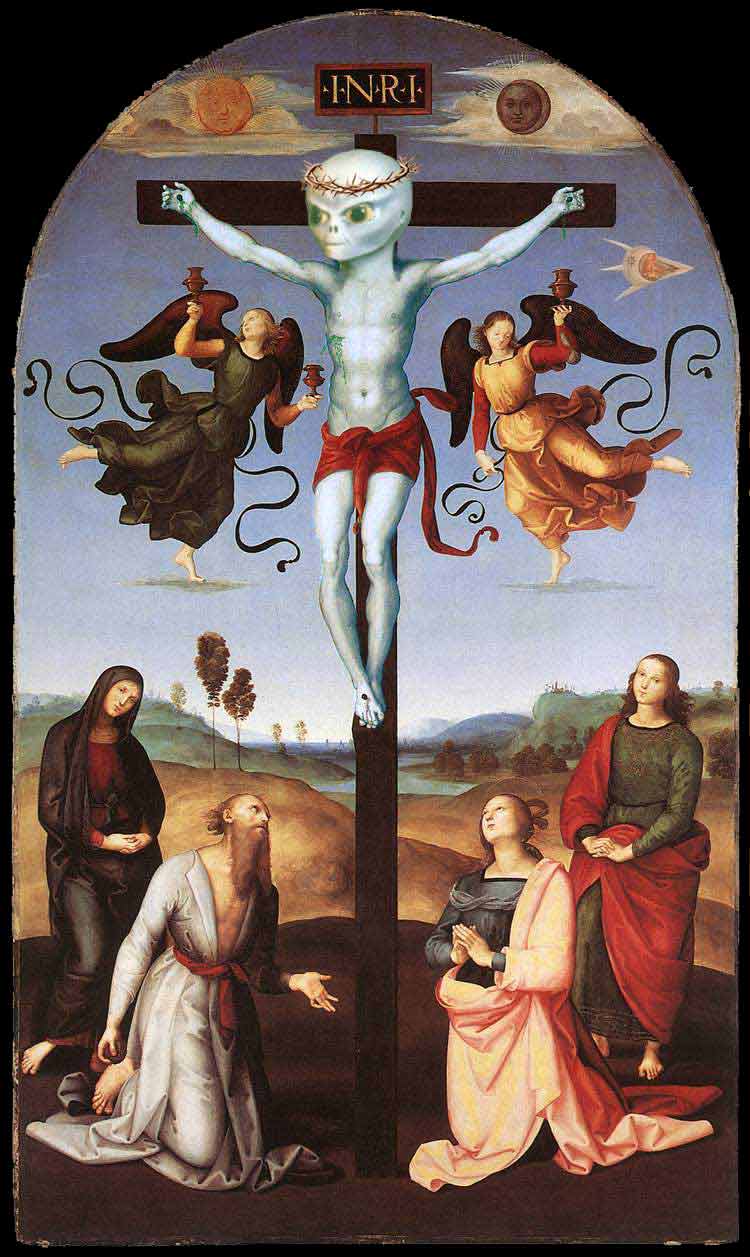
Raphael’s “Mond Crucifixion” painting is modified to show an alien-headed Jesus on the crossThe editor of the New York Times recently published an article called “Asking Candidates Tougher Questions About Faith.”  He opens with this:

If a candidate for president said he believed that space aliens dwell among us, would that affect your willingness to vote for him?  Personally, I might not disqualify him out of hand; one out of three Americans believe we have had Visitors and, hey, who knows?  But I would certainly want to ask a few questions.  Like, where does he get his information?  Does he talk to the aliens?  Do they have an economic plan?

Yet when it comes to the religious beliefs of our would-be presidents, we are a little squeamish about probing too aggressively.

My own view is that religion is off topic.  Candidates for a job as pastor can expect questions about religion.  But for the job of president?  Religious questions are out of bounds.  We’re governed by a secular constitution that includes the constraint, “No religious Test shall ever be required as a Qualification to any Office or public Trust.”

I long for the day when a candidate will dismiss a question about his/her religion with, “That’s irrelevant.  Next question.”  Ask about candidates’ values, their specific plans, their qualifications, and so on, but one’s religion is as relevant and as personal as questions about the style of one’s underwear.

A columnist from GetReligion.org was quick with a response.  She seemed outraged at the Jesus/aliens comparison, but her most substantial comment was to reprint the comparison and state, “I’m not joking.”

Is outrage appropriate?  Which belief—in aliens or Jesus—raises the bigger questions about a candidate’s ability to reason?

Sure, I see the difference between Jesus belief and alien belief.  Jesus is supernatural.  Space aliens are not.  We have nothing to compare a supernatural Jesus to except myths or legends, which sure makes the Jesus story look like a myth or a legend.

On the other hand, aliens aren’t supernatural.  They are life forms (we know about plenty of those) who travel using technology (we know about plenty of that).  Science keeps finding strange new animals on earth living in extreme environments—at the bottom of the ocean, under miles of rock, in glaciers.  Is it so hard to imagine them on other worlds?  Their discovery would be surprising or even shocking, but we wouldn’t need to discard any scientific laws if aliens presented themselves.

I’ll agree that belief in aliens with insufficient evidence is a bit nutty.  But that’s nothing like believing in supernatural beings with insufficient evidence.  I’m not joking.

Photo credit: Jesus Was a Space Alien

Related links:

  • Bill Keller, “Asking Candidates Tougher Questions About Faith,” New York Times Magazine, 8/25/11.
  • Sarah Pulliam Bailey, “NYT takes on aliens, baggage, Trojan horse faith,” GetReligion.org, 8/25/11.
  • Issues, Etc. interviewed GetReligion.org columnist Sarah Pulliam Bailey in its 9/1/11 podcast, “Media Coverage of the GOP Candidates’ Religious Views.”