Word of the Day: Pareidolia

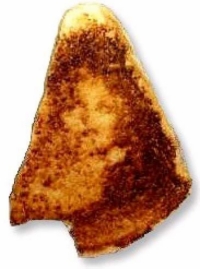
Does Jesus exist?Pareidolia is perceiving meaning in something random, such as seeing a face in clouds or hearing speech in a recording played backwards.  People have imagined a sculpture on Mars or ghost voices in random noise.  And, of course, Jesus has been seen in food and ruder places.  Mary has been seen in water stains on the side of a building and in the cheese sandwich shown here.

The familiar Rorschach test is a deliberate attempt to explore these patterns.

A similar word is apophenia, making connections in random or meaningless data (pareidolia is a type of apophenia).

Some people wonder if surprises such as the image of Mary are deliberate instead of random.  But why, aside from a desire to support one’s presupposition, would you imagine a supernatural explanation when the natural explanation of pareidolia suffices?

If these images are deliberate, there’s much more reason to imagine that it was Photoshop rather than God behind it.

Related posts:

Related links:

Word of the Day: Poe’s Law

About a month ago, I wrote a post titled, “A Powerful Defense of Reason … or Maybe Not.”  It was a letter from a pastor arguing both sides of the question of reason—that reason is a gift from God … but that it steers the honest Christian man or woman away from faith.  That reason eliminated disease like smallpox … but that Martin Luther called it “the greatest enemy of faith.”

The pastor who wrote it was Rev. Phineas P. Stopgauge—a made-up name for a made-up letter.  Though it was a parody (and had decent clues that it was), I received feedback from someone who seemed to have thought it real.

And this brings up Poe’s Law:

Without a winking smiley or other blatant display of humor, it is impossible to create a parody of Fundamentalism that someone won’t mistake for the real thing.

Is Landover Baptist Church a parody?  Apparently so.  How about Fred “God Hates Fags” Phelps?  Apparently not.  It’s hard to tell.  This shows the versatility of the (supposedly) immutable religion that it can morph into any form, even as parody, and still be mistaken for earnest Christianity.

We see an early example in the Cardiff Giant, a giant petrified man discovered by well diggers near Syracuse, NY in 1869.  But the entire thing was a hoax, commissioned by atheist George Hull and planted where it would be accidentally “discovered.”  Hull’s goal was to show how easy it was to fool Americans, especially Christians who believed that “There were giants in the earth in those days” (Gen. 6:4).

Even after scientists rejected the find and Hull admitted to the hoax, the Giant was still a popular tourist attraction.  P.T. Barnum offered the modern equivalent of millions of dollars, but the owners wouldn’t sell.  He created his own Giant to display and argued that his was the real fake and the other one was the fake fake.  Barnum’s conclusion: “The American people love to be humbugged.”

A recent example was the “GOD IS SO GOOD!!!!” video by TamTamPamela, an earnest 20-something woman from Florida talking about how fantastic it was that, in the lead-up to Easter, God showed himself to atheists through the March 11 Japan earthquake and tsunami (find more details about this event at the ThinkAtheist blog).

A few days later, after her address and phone number had been publicized and she received the obligatory delivery of unwanted pizza, she publicly stated that the whole thing had been just a provocation.

That this wasn’t obvious to begin with, and that a Christian could plausibly make this statement, makes this a classic example of Poe’s Law.

Photo credit: Wikimedia

Related posts:
Word of the Day: Apologetics

Dictionary or Bible, we can ask: Does God exist?Apologetics is the discipline of defending a position using reason.  The word is so tied to the defense of Christianity that “Christian apologetics” is almost redundant.  An apologetic is a specific argument (the Design Argument or Pascal’s Wager, for example).

Though “apologetics” has its origin in common with the word “apology,” the apologist does not apologize.  The original Greek work apologia meant to make a spoken defense, such as you’d give if you were the defendant in court.

A Christian could argue for Christianity in an emotional way, but that wouldn’t be apologetics.  These nonapologetic claims might be “Christianity makes me feel good” or “I just like the worldview” or “You’ll love the community.”

Counter-apologetics uses reason to rebut specific Christian apologetic arguments.

Photo credit: Wikimedia

Related posts:
Related links:

Word of the Day: Opiate of the Masses

A woman lies comatose in an opium denKarl Marx said, “[Religion] is the opium of the people” in 1843.  This is often assumed to mean that religion is like a drug, dulling the intellect of those under its influence.

But this isn’t correct.  Here is the quote in context:

Religion is the sigh of the oppressed creature, the heart of a heartless world, and the soul of soulless conditions.  It is the opium of the people.

Marx is saying that religion is a coping mechanism, like a security blanket or a crutch.  It’s a symptom of a broken society.  In the same way that opium is valuable medicine for someone who is hurting, religion provides valuable relief to those hurting within society.

His larger point is that treating the symptom isn’t a bad start, but it’s only a start, and we must address society’s root problems.  Opium reduces the pain of cancer, but don’t fool yourself that it’s treating the cancer.  Similarly, religion reduces the pain caused by a dysfunctional society, but don’t fool yourself that you’re treating the underlying problem.

If someone needs crutches, don’t kick them away.  Acknowledge that they serve a purpose.  But don’t think that that person is whole!  Find the problem and solve it.  You don’t take away someone’s crutch; you let that person discard it himself when it is no longer needed.

Christianity has faded in Europe, but that’s not because it was outlawed; people have discarded that crutch by themselves.  What mechanisms have they adopted to reduce society’s problems so that Christianity’s pain-soothing properties aren’t necessary?  Adopt those, and religion withers away by itself as unnecessary.

Photo credit: Wikimedia

Related posts:

Word of the Day: Deepity

Dictionary openA deepity is basically the opposite of a profundity.  A deepity is a statement that, to the extent that it’s true, is trivial, and to the extent that it’s profound, is false.

Daniel Dennett, one of the four horsemen of the atheist apocalypse, invented the word, and he defined it this way:

A deepity is a proposition that seems to be profound because it is actually logically ill-formed.  It has (at least) two readings and balances precariously between them.  On one reading it is true but trivial.  And on another reading it is false, but would be earth-shattering if true.

Here’s an example: “Evolution is only a theory.”  Yes, evolution is a theory.  This statement is trivially true.  But to the extent that it’s profound (evolution has a long way to go before it becomes truly accepted, say), it’s false.

A New Age-y sort of deepity might be “God is the universe” or “God is nature.”  Sure, we can redefine God to have the same meaning as anything we want.  Trivial.  But the profound implication (we’ve now explained God or proven his existence) is meaningless.

Slogans on church signs are a great source of deepities.  “Good without God becomes 0.”  It’s trivially true that removing all the letters except the third one from the word good gives you just the letter o (or a zero, if you prefer), but the profound implication (you can’t be good without God) is nonsense.

A deepity can deceive if the truth of the first (trivial) interpretation is allowed to rub off on the second.

Photo credit: Wikimedia

Related posts:

Related links:

Word of the Day: Hoare’s Dictum

C.A.R. Hoare and his wife stand outside Buckingham Palace after he was knighted by the queenSir Charles Hoare was a pioneer in computer science.  He observed:

There are two methods in software design.  One is to make the program so simple, there are obviously no errors.  The other is to make it so complicated, there are no obvious errors.

This applies to logical arguments as well: you can make the argument so simple that there are obviously no errors.  Or you can make it so complicated that there are no obvious errors.

A simple, straightforward argument for God’s existence might be, “Of course God exists.  He’s sitting right over there!”  Many arguments claim to be simple and straightforward—“the Bible is obviously correct” or “God obviously exists” for example—but are mere assertions rather than arguments backed with evidence.

Lots of apologetic arguments fall on the wrong side of this Hoare’s Dictum.  The Transcendental Argument, for example, is often a five-minute dissertation about what grounds logic and whether a mind must exist to hold it.

The Ontological Argument goes like this.  First we define “God” as the greatest possible being that we can imagine.  Two: consider existence only in someone’s mind versus existence in reality—the latter is obviously greater.  Three: since “God” must be the greatest possible being, he must exist in reality.  If he didn’t, he wouldn’t meet his definition as the greatest possible being.

When hit with an argument like this for the first time, you’re left scratching your head, unsure what to conclude.  These arguments are effective not because they’re correct (in fact, they fall apart under examination) but because they’re confusing.

The colloquial version of the argument is:

If you can’t dazzle ’em with brilliance, then baffle ’em with bullshit.

Photo credit: Microsoft

Related posts:

Related links:

  • Hoare’s Dictum” has been defined in computer science as, “Premature optimization is the root of all evil,” so perhaps this use should be Hoare’s Second Dictum.