War on Christmas?

Are atheists grinches for their war on Christmas?Catholic League president Bill Donohue is hot under the collar about the War on Christmas.  He’s annoyed at some of the requirements of living in a country governed by a secular Constitution.  He laments:

A school counselor at an Arkansas elementary school has been told that she must remove her posting of a nativity scene on her billboard; her decoration was permitted for more than 20 years. Tulsa, Oklahoma has long had a Christmas parade, but this year it was renamed the Holiday parade.

And would it have been a problem if a school counselor had been told to remove public displays of a Wiccan celebration for Samhain or a Satanic celebration for the winter solstice?  Or if city money had been prevented from funding celebrations of the Hindu festivals of Holi or Diwali?

The Constitution demands that public schools and publicly funded celebrations be religion-neutral.  Isn’t that the best for both the Christian and the atheist?

In another article:

There are two ways government can practice neutrality: the tolerant way, which is to allow all world religions a limited period of time to display their wares in the public square; and the intolerant way, favored by liberals, which is to censor everyone.  We vote for the former.

And then you have cases like Santa Monica, in which 21 spots for displays in a public park were distributed by lottery.  Atheist organizations won 18 of them, and some Christians are up in arms.  Sometimes when you play the “allow all religions time to display their wares” game, it backfires.

Here’s a simple solution: avoid using public land or buildings for religious displays.  Easy, right?

Donohue seems to imagine that religions don’t have the opportunity to spread the word or that their existence is a mystery to people.  Or perhaps he fears that Christians are so precarious in their faith that they must be frequently reminded of it.

Either he’s out of touch with reality or he doesn’t trust that Christianity’s message is compelling.  Neither casts him in a good light.

Photo credit: Wikimedia

An Atheist Ad Campaign—a Holiday Tradition!

Atheist ad campaign asks does god exist

Today, Seattle Atheists launches an ad campaign on local buses.  Twelve buses will carry banner ads with photos of four people in average settings with the tag line, “1 in 4 is an Atheist.”  The campaign runs through early January.

One in four Seattle residents has no god belief—in other words, they are atheists.  Seattleites may not consider that the person who sold them their morning coffee might have been an atheist.  Or the person who drove their bus or repaired their car or did their taxes or treated their illness.  Atheists are their coworkers, their friends, their family.  Whether they realize it or not, they know plenty of atheists.

These are smart people who take pride in their work and love their families and appreciate the great things about America, just like religious people.

The Problem.  While atheists do their part within society, they don’t always get the same consideration in return.  They’re sometimes told, “This is a Christian nation and if you don’t like it, move to Europe.”  Some risk their jobs by revealing who they are, and some risk ostracism and the loss of their family or community.  Some are bullied or discriminated against within schools or by the military.  Seeing this, many atheists remain silent.  Many churchgoers are among these silent atheists.

The political season is a time when atheists are particularly reminded how out of step they are with much of America.  The U.S. House recently passed a resolution to reassure us that, yes, “In God We Trust” is still our national motto.  Governors appeal for prayer to solve problems rather than using the power of their office.  Political candidates often vie with each other to be the most Christian.  When it comes to people we wouldn’t vote for, atheists are at the bottom.

What Atheists Want (and What They Don’t Want).  Many of the fears Christians have about atheists are invented by clergy or politicians.  American already is a secular nation—the Constitution makes this clear—but that’s not a threat to Christians.  Indeed, it’s the best environment for Christians.

Christians can send their children to public school and know that they won’t hear a Bahá’í or Satanist prayer.  Christians can go to a city council meeting and not see “Allahu Akbar” in Arabic script on the wall.  Christians can go into a courtroom and not see a Shinto or Hindu god of jurisprudence glaring down at him.  But while government is constrained in its religious speech, citizens are not, and Christians can still preach or hand out flyers in the public square.  Everyone wins.

Atheists don’t want Christians denied their right to free speech.  When atheists object to preachers recommending political candidates or “Under God” in the Pledge of Allegiance, they don’t want to limit the rights of Christians or get special privileges, they just want equality.

Next Steps.  If you’re an atheist, consider coming out.  Politely make your presence known.  The biggest factor in the American public becoming more tolerant of homosexuals was simply knowing one, and it works the same way for atheists.  But whether or not you feel comfortable making your atheism public, find local atheist or freethought groups and connect with your community.

If you’re a theist, be aware that there are atheists all around you.  These are people just like you, honest and hardworking.  Instead of praying before a meeting, evangelizing in the workplace, or putting a Jesus fish on your web site, consider if actions like these may offend others.  Encourage your friends to speak their mind and be who they are.

James Dobson Needs My Money (and an Education)

Big wad of US currencyJames Dobson, founder of Focus on the Family, was good enough to send me a letter a few days ago.  Not a personal letter—he basically just wants me to give him some of my money—but a letter nonetheless.  He outlined some of his views about the Christian foundation our country was built on, reported how our country is going to hell in a jet-propelled handbasket, and made the irresistible swipe at homosexuality.

In case he forgot to send you one, I’ve highlighted a few interesting bits of his letter to reply to.

Our Founding Fathers clearly understood the relationship between Christian Truth and the stability of our (then) new nation. Here are just a few quotes that express that essential connection.

And he goes on to quote mine the founding fathers’ writings to find their most pro-Christian statements.

When pundits bring up quotes from the founders, you know that they’re out of arguments.  The U.S. Constitution is the law of the land, regardless of what the founders thought, wrote, or wanted.  They had their chance to define how the country should be run, and they seized it.  That document was revolutionary at the time and now, with a few amendments, effectively governs us more than two centuries later.  It supersedes the other writings of the founders.

Thomas Jefferson, … revisionists tell us, wanted a “wall of separation” to protect the government from people of faith.

No need for revisionists—Thomas Jefferson himself talked about “a wall of separation between church and state.”  And, to be precise, the First Amendment protects the people (whether or not of faith) from the government, not the other way around.

Dobson then goes on to give a long quote by Abraham Lincoln.  Well, not really by Lincoln.  This was a Senate resolution for a National Fast Day signed by Lincoln.  And this was the same Lincoln who said, “When I do good, I feel good; when I do bad, I feel bad.  That’s my religion.”

This was the same Lincoln who said, “The Bible is not my book, and Christianity is not my religion.”

This was the same Lincoln who said, “My earlier views of the unsoundness of the Christian scheme of salvation and the human origin of the scriptures have become clearer and stronger with advancing years, and I see no reason for thinking I shall ever change them.”

The private Lincoln wasn’t the strong Christian that Dobson imagines.  (And it wouldn’t change the Constitution if he were.)

We are witnessing an unprecedented campaign to secularize our society and “de-moralize” our institutions from the top down. …  Most forms of prayer have been declared unconstitutional in the nation’s schools. The Ten Commandments have been prohibited on school bulletin boards. …  In this wonderful Land of the Free, we have gagged and bound all of our public officials, our teachers, our elected representatives, and our judges.

Again: read the Constitution.  Prayer should never have been allowed in schools.  Ten Commandments in courthouses or in schools?  Clearly out of step with the Constitution.

I don’t want to see Christian citizens gagged; I want them to have the same public speech rights that I do.  But when you’re acting as a public official, teacher, or elected representative, the rules are different.  The First Amendment demands that you create an unbiased environment.  Evangelism with prayer or religious documents is forbidden.  Dobson somehow finds this a shocking new realization, but the First Amendment was adopted in 1791.

As a secularist, I know when to stop.  I’m only asking that the First Amendment be followed.  I want no Christian preferences—such as “In God We Trust” as the motto, prayers before government meetings, Creationism in schools, crosses on public land, and so on—but when we have that situation, I will stop.  I’m not striving for a society where Christianity is illegal.  (See what a good friend a secular Constitution is for the Christian?)

But I see no stopping point on the other side, no fairly unambiguous standard that Christians are pushing for.  If they got prayer back in schools, what would be next?

Since we have effectively censored their expressions of faith in public life, the predictable is happening: a generation of young people is growing up with very little understanding of the spiritual principles on which our country was founded. And we wonder why so many of them can kill, steal, take drugs, and engage in promiscuous sex with no pangs of conscience.

I wonder what happens when Christianity fades away?  Does that society devolve into the post-apocalyptic Mad Max world that Dobson imagines?

Let’s compare other Western societies to find out.  Looking at quantifiable social metrics (homicides, incarceration, juvenile mortality, STDs, abortions, adolescent pregnancies, marriage duration, income disparity, and so on) in 17 Western countries, a 2009 study concluded: “Of the 25 socioeconomic and environmental indicators, the most theistic and procreationist western nation, the U.S., scores the worst in 14 and by a very large margin in 8, very poorly in 2, average in 4, well or very in 4, and the best in 1.”1

Ouch—religiosity is inversely correlated with social health.  Sorry, Dr. Dobson.

It is breathtaking to see how hostile our government has become to traditional marriage, and how both Democrats and Republicans are increasingly antagonistic to parental rights, Christian training, and the financial underpinnings of family life.

I assume that “hostile … to traditional marriage” refers to same-sex marriage.

Help me understand this.  At a time when Christian traditionalists like Dobson lament the high divorce rate and the acceptability of couples living together and even having children without the benefit of marriage, they dismiss a group that is actually embracing marriage.

Same-sex marriage is a celebration of marriage, not an attack.

The hope of the future is prayer and a spiritual renewal that will sweep the nation. It has happened before, and with concerted prayer, could occur again. …  If we continue down the road we are now traveling, I fear for us all.

Yeah, following the rise in Christian fundamentalism does sound like a worrisome future.  We’ve seen that secular, gay-loving Europe eclipses the U.S. in social metrics.

Candidly, this ministry continues to struggle financially, and our very survival will depend on the generosity of our constituents in the next two months.

Translated: “Give me some money.”

Please pray with us about the future of this ministry.

Translated: “Give me some money.”  (I’ve written before about how prayer requests of this sort admit that prayer is useless.)

I suppose that this kind of lashing out at other people brings in the money.  But it’d be nice to see more credible arguments.

1Gregory Paul, “The Chronic Dependence of Popular Religiosity upon Dysfunctional Psychosociological Conditions,” Evolutionary Psychology, www.epjournal.net (2009).  7(3): 416.

Photo credit: 401K

Related posts:
Bungling the Facts Behind Evolution

A series of images show how the horse evolved over 50 million yearsA Huffington Post article earlier this week asked, “Does Questioning Evolution Make You Anti-Science?

Yeah, pretty much.

The author notes the flak Rick Perry received for stating that evolution was “just a theory” and that it has “some gaps in it” and tried to make the case that Republicans aren’t as anti-science as they’re portrayed.  I’m not interested in the politics here, but the science (or failure to understand science) is worth mentioning.

Denial of both climate change and evolution is popular among conservatives.  The author said, “While I cannot comment on climate-change science, I do have a great deal to say about evolution.”  He lists his credentials as organizing an annual science vs. religion debate at Oxford University, which were typically about evolution, and giving Richard Dawkins a good thrashing at another debate for good measure.

But for someone who’s well versed in these matters, his understanding of science seems stunted.

What I learned from these debates, as well as reading extensively on evolution, is that evolutionists have a tough time defending the theory when challenged in open dialogue.

I doubt that, but let’s assume it’s the case.  Who cares?  Science, not debate, is where our confidence in evolution comes from.

[Attacks on evolution do not] mean that evolution is not true or that theory is without merit or evidence. It does, however, corroborate what Governor Perry said.  Evolution is a theory.  Unlike, say, the laws of thermodynamics, it has never been proven beyond the shadow of a doubt to be true.

Wow—where do you start?

Evolution is an explanation.  It claims to give us the mechanism explaining how life got to be the way it is.  The best evolution can hope for is to become a theory, and it has done so.  The same is true for germ theory, another explanation, which has also reached that pinnacle and can’t become anything better.

By contrast, a scientific law is Continue reading

Jesus and Aliens

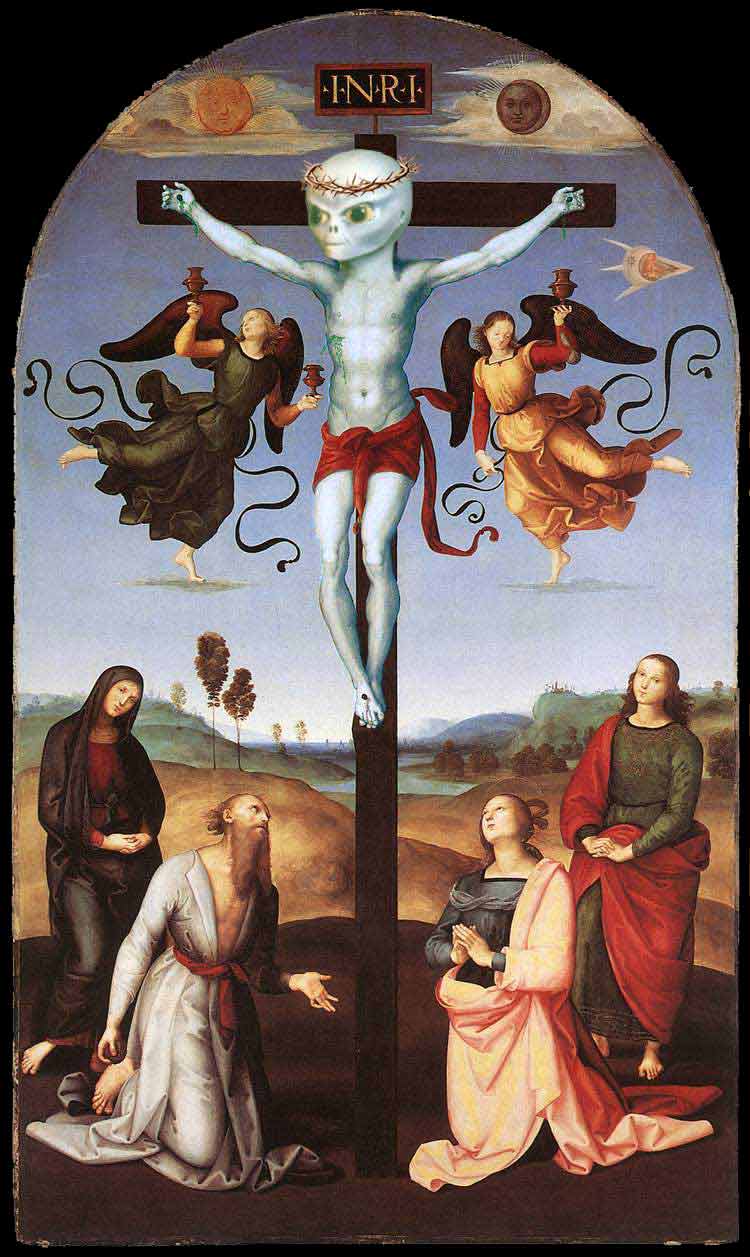
Raphael’s “Mond Crucifixion” painting is modified to show an alien-headed Jesus on the crossThe editor of the New York Times recently published an article called “Asking Candidates Tougher Questions About Faith.”  He opens with this:

If a candidate for president said he believed that space aliens dwell among us, would that affect your willingness to vote for him?  Personally, I might not disqualify him out of hand; one out of three Americans believe we have had Visitors and, hey, who knows?  But I would certainly want to ask a few questions.  Like, where does he get his information?  Does he talk to the aliens?  Do they have an economic plan?

Yet when it comes to the religious beliefs of our would-be presidents, we are a little squeamish about probing too aggressively.

My own view is that religion is off topic.  Candidates for a job as pastor can expect questions about religion.  But for the job of president?  Religious questions are out of bounds.  We’re governed by a secular constitution that includes the constraint, “No religious Test shall ever be required as a Qualification to any Office or public Trust.”

I long for the day when a candidate will dismiss a question about his/her religion with, “That’s irrelevant.  Next question.”  Ask about candidates’ values, their specific plans, their qualifications, and so on, but one’s religion is as relevant and as personal as questions about the style of one’s underwear.

A columnist from GetReligion.org was quick with a response.  She seemed outraged at the Jesus/aliens comparison, but her most substantial comment was to reprint the comparison and state, “I’m not joking.”

Is outrage appropriate?  Which belief—in aliens or Jesus—raises the bigger questions about a candidate’s ability to reason?

Sure, I see the difference between Jesus belief and alien belief.  Jesus is supernatural.  Space aliens are not.  We have nothing to compare a supernatural Jesus to except myths or legends, which sure makes the Jesus story look like a myth or a legend.

On the other hand, aliens aren’t supernatural.  They are life forms (we know about plenty of those) who travel using technology (we know about plenty of that).  Science keeps finding strange new animals on earth living in extreme environments—at the bottom of the ocean, under miles of rock, in glaciers.  Is it so hard to imagine them on other worlds?  Their discovery would be surprising or even shocking, but we wouldn’t need to discard any scientific laws if aliens presented themselves.

I’ll agree that belief in aliens with insufficient evidence is a bit nutty.  But that’s nothing like believing in supernatural beings with insufficient evidence.  I’m not joking.

Photo credit: Jesus Was a Space Alien

Related links:

  • Bill Keller, “Asking Candidates Tougher Questions About Faith,” New York Times Magazine, 8/25/11.
  • Sarah Pulliam Bailey, “NYT takes on aliens, baggage, Trojan horse faith,” GetReligion.org, 8/25/11.
  • Issues, Etc. interviewed GetReligion.org columnist Sarah Pulliam Bailey in its 9/1/11 podcast, “Media Coverage of the GOP Candidates’ Religious Views.”

Why Worry About a God That Isn’t There?

You don’t call yourself an a-unicornist.  Or an a-Santaist.  Why call yourself an a-theist?

I get this a lot.  “Why do you worry about something you don’t even think exists?  Why call yourself an atheist?”

That’s a reasonable question.  People with no God belief may not call themselves atheists for lots of reasons.  Maybe they prefer another name like freethinker or agnostic.  Maybe they want to focus on what they do believe in and so think of themselves as humanists or naturalists.  Maybe, as the cartoon suggests, not believing in God is as irrelevant to their lives as not believing in unicorns or Santa Claus.

But I do call myself an atheist.  God belief impacts society in ways that unicorn belief or Santa belief could never do.  In the list of Christian excesses below, see if you agree that only religion—and not mere belief in mythical creatures—could provoke these actions.

  • The Pope says that condoms shouldn’t be used in Africa to stop the spread of HIV
  • U.S. preachers provoke anti-gay legislation in Uganda
  • Some churches forbid birth control
  • Stem cell research is held up
  • Young women are urged not to get the HPV vaccine that protects against cervical cancer
  • In-vitro fertilization, which has brought four million children to parents unable to conceive, is attacked by the Catholic church
  • Some Christians push for Creationism to be taught in science class, for Christian prayers to be said in public schools, and for the Ten Commandments to be displayed in courthouses
  • Christian belief seems to increasingly be a requirement for public office, despite the fact that the Constitution makes clear that no religious test shall ever be required
  • … and other excesses that come to mind for you.

If Christianity could work and play well with others, that would be great, and I’d find other activities to occupy my time.  But it doesn’t.

If you’re a Christian reading this, you may respond that your church doesn’t do this.  In that case, agree with me!  Agree that Christianity—in some versions, anyway—crosses the line and must be kept in check.

Artwork credit: Mike Stanfill