Don’t Like Abortion? Then Support Sex Education.

There’s a reality disconnect within the pro-life community. They reject abortion while they also reject the solution to abortion, sex education. Is abortion an American Holocaust, as Ray Comfort says? If so, then join forces with the pro-choice camp and teach teens how to avoid it!

Being against abortion but rejecting sex education is like being against deaths through unclean water but rejecting sewer systems.

Here’s an excellent infographic on sex education from PublicHealthDegree.com.  Pass it on.

Reproductive Health Education
Created by: PublicHealthDegree.com

Related posts:

It’s Funny Until Someone Gets Hurt, then it’s Hilarious

Creationists make themselves look foolish when they pick and choose their scienceI’ve been amazed at the popularity of Creationism/Intelligent Design among Christian pundits.

Old-earth Creationism accepts the consensus within the field of cosmology about the Big Bang and the formation of the solar system 4.6 billion years ago but rejects evolution.  Young-earth Creationism also rejects evolution and argues that the earth is less than 10,000 years old.  This view is predominant among evangelical pastors.

Dr. Karl Giberson recently pointed out an interesting downside of this mindless rejection of science.  He begins by citing a Barna survey that lists six reasons why most evangelical Christians disconnect from the church, at least temporarily, after age 15.  The most interesting reason: “Churches come across as antagonistic to science.”

Of the young adults surveyed,

  • 23% say they had “been turned off by the creation-versus-evolution debate”
  • 25% say “Christianity is anti-science”
  • 29% say “churches are out of step with the scientific world we live in”
  • 35% say “Christians are too confident they know all the answers”

As an example of this rejection of science, Giberson points to the technique recommended to schoolchildren by Creation Museum founder Ken Ham.  Ham encourages students to ask, “Were you there?” when the biology teacher says that life on earth appeared roughly 4 billion years ago or the physics teacher says that the Big Bang gave us the universe in its present form 13.7 billion years ago.

Ham proudly blogged about nine-year-old Emma B., who wrote to tell Ham how she attacked a curator’s statement that a moon rock was 3.75 billion years old with “Were you there?”

Biologist PZ Myers nicely deflated Ham’s anti-science question with a gentle reply to Emma B.  Myers recommends using instead “How do you know that?” which is a question from which you can actually learn something.

Contrast that with Ham’s “Were you there?” which is designed simply to shut down discussion and to which you already know the answer.

“Were you there?” is a subset of the more general question, “Did you experience this with your own senses?”  To Science, this question lost significance hundreds of years ago.  The days when Isaac Newton used taste as a tool to understand new chemicals are long gone.  Modern science relies heavily on instruments to reliably provide information about nature—from simple ones like compasses, voltmeters, and pH meters to complex ones like the Pioneer spacecraft, Hubble space telescope, and Large Hadron Collider.

Personal observation is often necessary (finding new animal species, for example), but this is no longer a requirement for obtaining credible scientific evidence.

From the standpoint of mainstream Christianity, Ham’s position as a young-earth Creationist and Bible literalist is a bit extreme, but higher profile figures like William Lane Craig also give themselves the option to pick and choose their science.  Craig uses science a lot—at least, when it suits his purposes.  The Big Bang suggests a beginning for the universe, so he takes that.  Evolution suggests that life on earth didn’t need God, so he rejects that bit.

He imagines that he’s Hanes Inspector Number 12: “It’s not science until I say it’s science.”  It may be fun to pretend that, but what could possibly make you think that’s justifiable?

That reminds me of a joke:

Scientists figure out how to duplicate abiogenesis (the process by which molecules became something that could evolve).  They are so excited that they email God to say they want to show him.  So God clears some time on his calendar and has them in.

“Sounds like you’ve been busy,” God said.  “Show me what you’ve got.”

“Okay—first you take some dirt,” said one of the scientists.

“Hold on,” God said.  “Get your own dirt.”

And to William Lane Craig’s pontificating about science, I say, “Hold on—get your own science.”

You either play by the rules of science and accept the scientific consensus whether it’s compatible with your preconceptions or not, or you sit at the children’s table.  If you want to hang out with the adults, you can’t invent reasons to rationalize why this science is valid and that is not.

Evangelicals may want to rethink this picking and choosing of science.  Giberson ends his article:

The dismissive and even hostile approach to science taken by evangelical leaders like Ken Ham accounts for the Barna finding above.  In the name of protecting Christianity from a secularism perceived as corrosive to the faith, the creationists are unwittingly driving the best and brightest evangelicals out of the church….  What remains after their exodus is an even more intellectually impoverished parallel culture, with even fewer resources to think about complex issues.

Perhaps I should be more welcoming to Christian anti-science in the future.

Photo credit: commandoscorch

Related posts:

Related links:

  • Karl Giberson, “Creationists Drive Young People Out of the Church,” Huffington Post, 11/19/11.
  • “Six Reasons Young Christians Leave Church,” Barna, 9/28/11.
  • PZ Myers, “Dear Emma B,” Pharyngula blog, 10/3/11.
  • Ted Olsen, “Go Figure,” Christianity Today, 11/14/11.

16 Arguments Against Abortion, Addendum

Novel explores Christianity atheism apologetics themesThanks to the Prime Directive blog, I belatedly came across a long list of “Questions for Pro-Choice People” by Prof. Michael Pakaluk.  I’ve already responded to most of them with the spectrum argument, but here are three extra questions taken from this list that explore new ground and are worth highlighting.

17. Imagine a woman seeing an ultrasound of her unborn baby.  Sometimes the hands and feet are visible, and the baby is sometimes sucking its thumb.  Why aren’t such images shown to women considering abortions as part of informed consent?

Works for me.  But let’s add conditions to make this practical.

  • This should be an option rather than part of a mandatory gauntlet forced on women considering abortion.
  • This should not be the first time the woman has seen this information.  That is, education should teach about the stages of fetal development as part of comprehensive sex education that would minimize the chances of her having this unwanted pregnancy in the first place.
  • The woman’s choices should be made available as soon as possible.  Putting obstacles in her way—by closing down nearby clinics, encouraging pharmacists to refuse to offer morning-after pills, and so on—increases the age of the fetus she must consider aborting.  If an abortion is to happen, let’s make it early so that the woman doesn’t see a fetus sucking its thumb.

18. “Does anyone wish that his mother had chosen abortion for him? And, if not, then how can he consistently wish that any mother choose abortion for anyone else?”

This is a more eloquent version of my question 4, in an earlier post.

In the first place, if I’d been aborted, I wouldn’t be here to care.  In the second, this thinking isn’t far removed from the Quiverfull movement (my thoughts on that here), which encourages no restraint on birth and childishly “lets God decide” how many children to have.

Where do you draw the line?  If we are morally obliged to bring to term a 2-week-old fetus, are we also morally obliged to bring to term the thought, “Gee, I wonder if we should have another baby …”?

Seeing life as a spectrum is the only way to make sense of this.  Yes, that leaves unanswered the question of where to draw the line for abortion, but let’s first agree that a spectrum exists.

19. Let’s suppose that we’re doubtful that the unborn child is a human being with human rights (there is no doubt, but let’s imagine there is).  Given this uncertainty, shouldn’t we err on the side of the child?

I agree that there’s no doubt, but I’m sure my confidence is the opposite of yours.

A fetus is not a person.  Play games with the name all you want (“The fetus is a Homo sapiens, ‘human being’ is simply a synonym, and if a fetus is a human being, it must have human rights!”), but there’s no ambiguity here.  Despite your word games, a newborn baby is still not the same thing as a single cell.  There is a spectrum.

Photo credit

Related posts:

Related links:

  • The text of the opinion in Roe v. Wade is available here.  Though written in 1973, it gives a thorough analysis of both sides of the issue.  Anyone who objects to this decision should probably know what this decision actually says.
  • William Saletan, “The Pro-life Case for Planned Parenthood,” Slate, 12/11/08.

Word of the Day: Haggard’s Law

Christianity and atheism, does God exist?Rev. O’Neal Dozier, a Rick Santorum backer, says that homosexuality is the “paramount of sins” and that it is “something so nasty and disgusting that it makes God want to vomit.”

Pastor Ken Hutcherson, here in Seattle, is against Washington state’s new law-in-waiting allowing same-sex marriage.  He’s been riding this horse for years, ever since he complained about Microsoft offering health benefits to same-sex partners of employees.

Ted Haggard was the founder and former head of both the 10,000-member New Life Church and led the National Association of Evangelicals.  In the movie Jesus Camp, he said, “We don’t have to debate about what we should think about homosexual activity.  It’s written in the Bible.”

But Pastor Ted was brought low by claims that he had a long-term relationship with a gay prostitute.  This hypocrisy gave us Haggard’s Law: the likelihood of someone’s being gay increases in proportion to the force of that person’s public objections to homosexuality.  One wonders if the other pastors similarly doth protest too much.

The next time some guy with a religious or political platform bloviates about why a segment of society doesn’t deserve the same respect as everyone else, remember Haggard’s Law and wonder what he’s hiding.

Photo credit: Simon Varwell

Related posts:

Related links:

Ray Comfort’s Anti-Abortion Video “180”

Was Jesus the son of God?“A shocking, award-winning documentary!”  “Changing the heart of a nation.”  “33 minutes that will rock your world.”  Ray Comfort lavishes his work with superlatives, but does it hold up?

I watched 180 so that you won’t have to.  Spoiler alert: didn’t rock my world.

Motives are immediately suspect when the video opens with Hitler and Nazi rallies.  Right out of the gate, Godwin’s Law is in force, and Comfort makes clear that you’re either on his side or giving Hitler back rubs.

With that dichotomy clear, Comfort interviews people hanging out on a sunny day at some Los Angeles beach.  He begins by asking, “Who was Hitler?”  The snippets introducing us to the (typically) 20-somethings who we’ll see throughout the video all show them clueless in response.  If it was unclear before, it’s now obvious that he cherry picked only those interviews that gave him what he wanted.  This is a poor foundation on which to show us a half-dozen people at the end who are convinced by his message.  (Okay, Ray, but out of how many?)

We connect the present with Hitler through a long interview with a young American neo-Nazi with a tall blue Mohawk and a dashed “Cut here” tattoo across his throat.  And then, videos of concentration camp aftermath.

Comfort primes his interviewees with moral puzzles such as “Would you shoot Hitler if you could go back in time and do so?” or “Would you kill Jews if told that, if you didn’t, you would be killed and someone else would do the job?”

About a third of the way in, the conversation finally turns to abortion.  The use of Hitler and the Holocaust is justified when Comfort declares abortion to be the American holocaust, with killing fetuses equivalent to killing Jews.  His arguments are nothing new to many of us, but they were to this crowd:

  • Finish this sentence: “It’s okay to kill a baby in the womb when …”
  • What if a construction worker was about to blow up a building but wasn’t sure if there was a person in there or not.  If we’re not sure, we should always err on the side of life, right?
  • What if someone had aborted you?

I’ve already discussed these and other arguments.

Next, he brings up the sixth Commandment: “Thou shalt not kill.”  In the first place, he’s done nothing to show that there is a god behind these commandments and that it has any more supernatural warrant than “Use the Force, Luke!”  Additionally, the commandment is usually translated as “thou shalt not murder.”  If the correct word is “kill,” I need to see Comfort walking the walk by campaigning against capital punishment and war.  And if it’s an undefined “murder,” what is murder?  The commandment becomes a tautology: Thou shalt not do what is forbidden.

Granted, but how is this helpful?

Our interviewees seem a little off balance with a camera in their faces and are apparently not that sharp to begin with given their widespread ignorance of Hitler.  Ray picks snippets that give him what he wants to hear, that killing fetuses is equivalent to killing Jews.

The lesson is that you can make an effective emotional pro-life argument to people who haven’t thought much about the issue.  But people who change their minds so easily (Comfort brags about how quickly they changed) aren’t well established in their new position.  How many of these, after thinking about these ideas at leisure and discussing it with friends, are still in Comfort’s camp today?

There’s a fundamental confusion in his interviewees, and Comfort is not motivated to correct it.  There’s a big difference between “Abortion is wrong for me” and “Abortion is wrong for everyone, and we must impose that on society.”  People give him the former, but he hopes we’ll take away the latter.

We’re two thirds through the video now and are just hoping to get out with our sanity intact, but Comfort has saved the best for last.  The anti-abortion argument is dropped, and he falls back to his old favorite, the Ten Commandments challenge.  (One reviewer suggested that Comfort’s compulsive use of this argument is his personal form of Tourette’s.)  This is where Comfort ticks off the commandments: Have you ever lied?  Stolen?  Looked on someone with lust?

He concludes: “By your own admission, you’re a lying, thieving, blaspheming fornicator and must face God on Judgment Day™.  How do you think God should judge you?”  Again, of course, he ignores that we haven’t established the existence of God or the afterlife.

I did applaud one aspect of the movie, the text at the end that read, “We strongly condemn the use of any violence in connection with protesting abortion.”  At least, I applauded this until I realized that this was probably a legal demand since Comfort had pushed his interviewees to consider shooting Hitler early in the documentary.

Given Ray Comfort’s easy success with emotional appeals, what if someone did a rebuttal video?  It could open with stories of illegal and dangerous back-alley abortion clinics.  Then talk about Americans rejecting oppressive government—“the land of the free,” “no taxation without representation,” and all that.  Paint a picture of medieval Europe with the heavy hand of the church on every aspect of life for the poor peasant.  Overlay some stirring patriotic music on waving flags and eagles.

The interviews would focus on intuitive arguments like those I’ve discussed in Five Emotional Pro-Choice Arguments.  Here are several brief examples.

  • Suppose a building were on fire, and you could save either a five-year-old child or ten frozen embryos.  Which would you pick?  If you picked the child, what does that say about the argument that equates embryos with babies?
  • If you’ve seen anti-abortion videos or posters, you may have seen the bloody results of late-term abortions.  Why do you suppose they showed you that rather than a woman swallowing an emergency contraceptive (“morning after”) pill?  Do you suppose they really think that it’s a “baby” all the way back to that single cell?
  • Given that half of all pregnancies end in spontaneous abortion, do you suppose that God has much of a concern about abortion?
  • A week-old human blastocyst has fewer cells than the brain of a fly.  Does it make sense to equate that with a one trillion-cell newborn?  The newborn has eyes, ears, legs, arms, a brain and a nervous system, a heart and a circulatory system—in fact, all the components of the human body that you do—while the blastocyst has just 100 undifferentiated cells.  Does it make sense to equate them?
  • Who better to weigh the impact of a child than the mother herself?

Do you think we’d get similar results with this video?

Photo credit: Wikipedia

Related posts:

Related links:
The Declaration of Independence—A Christian Document?

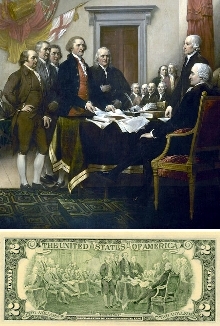
Does God exist?  Weak Christian apologetics don't make much of an argument.Is America a Christian nation?  Some Christians eagerly point to the word “Creator” in the Declaration of Independence (1776) as evidence:

We hold these truths to be self-evident, that all men are created equal, that they are endowed by their Creator with certain unalienable Rights, that among these are Life, Liberty and the pursuit of Happiness.

Who is this “Creator”?  Is it Yahweh, the Christian god?  Is it a placeholder into which you can imagine any god so that Muslims can imagine Allah or Hindus can imagine Brahma?

No—the opening sentence clarifies: it’s not Yahweh but “Nature’s God.”  At the time, this phrase was understood as the deist god of Enlightenment philosophers like Spinoza and Voltaire.  Deism was popular in Revolutionary America, and Franklin, Jefferson, Washington, and other founding fathers were either deists or inspired by the movement.  Deism imagines a hands-off god, a creator who, once the clock is built and wound up, leaves it to tick by itself.

The role of this “Creator” is clarified in the Declaration:

Governments are instituted among Men, deriving their just powers from the consent of the governed.

In other words, the Creator has no role at all in government.  We’ve turned our back on the divine right of kings, where the king was God’s representative who served at God’s pleasure.  God isn’t the foundation on which authority rests.  No—it’s the consent of the governed.  The buck stops here, which is very empowering.

Remember that the purpose of the Declaration was to inform Britain that the colonies wanted to become independent.  When government becomes abusive, the recourse isn’t to appeal to God:

Whenever any Form of Government becomes destructive of these ends, it is the Right of the People to alter or to abolish it, and to institute new Government, laying its foundation on such principles and organizing its powers in such form, as to them shall seem most likely to effect their Safety and Happiness.

Again, we see that the government rules at the pleasure of the people, not God.

While the Declaration of Independence doesn’t give Christians what they may imagine it does—an acknowledgement of the existence of the Christian god and his sovereignty over this country—this exercise is largely irrelevant.  The Declaration isn’t the supreme law of the United States.  That is the Constitution, and it’s secular.  Watch out for Christian revisionist historians bringing up the Declaration.  That’s the white flag of surrender because they know that they have nothing where it really counts—the Constitution.

Photo credit: Wikimedia

Related posts: