
Pastors Speak Their Mind (and Flout the Rules)

Jesus, God, and all thatIt’s another dreaded election year, and the leaders of many religious organizations somehow feel put upon by the IRS because they can’t preach about politics.

But why?  No one forced tax-exempt donations on them—in fact, they took them willingly—so it’s surprising that they’re now chafing at the regulations that come along for the ride.  The solution is easy: if nonprofit status is a deal with the devil, then don’t accept nonprofit status.

The Internal Revenue Service makes clear that churches and pastors may organize non-partisan voter education activities, voter registration, and get-out-the-vote drives (with an emphasis on non-partisan).  Religious leaders speaking for themselves can say whatever they want, and they can speak “about important issues of public policy.”

However, all nonprofit organizations, including religious organizations

are absolutely prohibited from directly or indirectly participating in, or intervening in, any political campaign on behalf of (or in opposition to) any candidate for elective public office. Contributions to political campaign funds or public statements of position (verbal or written) made by or on behalf of the organization in favor of or in opposition to any candidate for public office clearly violate the prohibition against political campaign activity. … Religious leaders cannot make partisan comments in official organization publications or at official church functions. …

[Nonprofits] must avoid any issue advocacy that functions as political campaign intervention.  Even if a statement does not expressly tell an audience to vote for or against a specific candidate, an organization delivering the statement is at risk of violating the political campaign intervention prohibition if there is any message favoring or opposing a candidate.

But many pastors can’t accept this.  I don’t know if they honestly think that it’s unfair or if they figure that they’ve already tipped the playing field so much in their favor that they’ll try their luck for even more, but the Alliance Defense Fund has organized the annual Pulpit Freedom Sunday (October 7 this year).  On this day:

The pastors will exercise their First Amendment right to preach on the subject [of the moral qualifications of candidates seeking public office], despite federal tax regulations that prohibit intervening or participating in a political campaign. …

The point of the Pulpit Initiative is very simple: the IRS should not be the one making the decision by threatening to revoke a church’s tax-exempt status.  We need to get the government out of the pulpit.

Wow—strange thinking.  Tax-exempt status is granted by the government.  It’s a contract, not a right, and it comes with strings attached.  If we the public will be subsidizing an organization, we are entitled to limit its actions.  No one’s strong-arming the church, and they can drop both the nonprofit status and the strings attached any time they want.

To some extent, it’s a zero-sum game.  (For example, when Mormon desires for polygamy clashed with the needs of the state, someone had to lose.)  The head of the IRS addressed this conflict of tax-exempt status and freedom of speech:

Freedom of speech and religious liberty are essential elements of our democracy.  But the Supreme Court has in essence held that tax exemption is a privilege, not a right, stating, “Congress has not violated [an organization’s] First Amendment rights by declining to subsidize its First Amendment activities.”

If the IRS constraints against speaking out on political issues are a problem, then don’t enter into a contract with the IRS.  Drop your nonprofit status, tell church members that they can no longer deduct donations, and then you can give your opinion about any candidate or issue.

But to keep your nonprofit status, you must follow the rules.

See the first post in this series: What do Churches Have to Hide?

Photo credit: Wikimedia

Related links:

Church Accountability

Does God exist?In November, 2007, Senator Chuck Grassley (R-Iowa) asked six high-profile televangelist organizations to provide more information about how they work.  Grassley said: “My goal is to help improve accountability and good governance so tax-exempt groups maintain public confidence in their operations.”

The investigated organizations (I’ll use the names of the public faces) were:

  • Joyce Meyer.  She responded fully to Grassley’s questions, joined the Evangelical Council for Financial Accountability (ECFA), and discloses her annual revenue to MinistryWatch (about $110 million per year).
  • Benny Hinn also gave complete answers to Grassley’s questions.  However, MinistryWatch gave him a transparency grade of F.  His ministry’s income is about the same as Meyer’s.
  • Kenneth Copeland: incomplete information.  He claimed (go here and search “Torpedoed!”) that his 40-year-old ministry has taken in a total of about $1.5 billion.  MinistryWatch grade: F.
  • Creflo Dollar: incomplete information.  MinistryWatch grade: F.
  • Eddie Long: incomplete information and not listed in MinistryWatch.
  • Paula White: incomplete information and not listed in MinistryWatch.

Let’s dwell on this a moment.  A U.S. senator asks for information, as the Senate Finance Committee is empowered to do, and he is (more or less) given the finger.  And there is no fallout?  These ministries can tap dance away from this request for information with no meaningful loss of face?  The faithful still shower them with $100 million per year?  What kind of disconnect from reality is this?

This is a contract between U.S. taxpayers and these nonprofit organizations, mediated by the IRS.  We provide the nonprofit status and, in return, they prove that they deserve that status.  If religious organizations policed themselves and they made their finances public (by voluntarily submitting their information to the IRS like all other nonprofits), this wouldn’t be a problem.  But they don’t.  With $100 billion in tax-exempt contributions to the religion industry every year, shielded from inspection, it’s obvious that this exemption is a bad idea.

A memo prepared by Sen. Grassley’s staff highlights some of the foundational principles that are relevant to this discussion.

The Constitution does not require the government to exempt churches from federal income taxation or from filing tax and information returns.

And:

Requiring churches to file an annual information return does not offend either the Free Exercise Clause or the Establishment Clause [of the First Amendment].

Some ministries have complained that an obligatory filing would entangle the government in church business, but the opposite may be more accurate.  Today, the IRS must define what a church is, since the legal code doesn’t.  For example, after a long legal battle, Scientology was granted tax-exempt status as a church.  Putting churches in the same bin as other nonprofits would eliminate this unwelcome role for the IRS.

The Grassley memo admits that there should be no constitutional problem with a level playing field, but it argues that some problems will remain:

  • Eliminating the exemption “would unnecessarily burden the overwhelming majority of churches.”  Why?  The 1.5 million nonprofits with less than $100,000 in annual income can follow the rules.  Surely a church that can keep its books can fill out a four-page 990-EZ form.  The only tough part is taking that deep breath and disclosing to the world how you spend your income.
  • This would burden the IRS’s Exempt Organizations Office, which is stretched as it is.  When a ministry is simply a piggy bank for a few people at the top, no laws are being broken.  Things change if we can force the churches to commit publicly.  Let’s let a little sunshine in and let public scrutiny (and possible condemnation) do its work.  Could a sleazy ministry lie?  Of course, but when it does, it’s now breaking the law.  At that point, there’s a crime that the IRS can go after and assets that can help fund the process.
  • This would be contrary to the intent of Congress.  True, but the desires of Congress can change.  If ordinary Christians, embarrassed by the secrecy of churches, demanded a level playing field for all nonprofits, Congress just might turn around.  Without public demand, there will be no energy for this initiative.

The ECFA is a good step.  Though it’s expensive to join, it provides what amounts to a Good Housekeeping seal of approval to ministries that abide by its code.  But even they don’t demand that salaries be revealed, and members need only provide financial information on written request.  It’s a baby step, when a level playing field is the obvious solution.

The IRS has a form 990 and 1.5 million nonprofit organizations already using it.  It works.  It should be our window into the operation of all nonprofits, including churches.

What are the next steps?  An atheist organization like the Freedom From Religion Foundation could file lawsuits, but a push for this from within the Christian community would be far more effective.  Christians, you have the power.  Aren’t you embarrassed by being lumped in with the worst of the televangelists?  Wouldn’t you like to see some public scrutiny on Scientology and other organizations hiding behind this loophole?

You won’t like me when I’m angry,
because I always back up my rage
with facts and documented sources.
— the Credible Hulk

Photo credit: Wikimedia

Related posts:

Related links:

What do Churches Have to Hide?

IRS filings don't help show that God existsThe Freedom From Religion Foundation is a freethought organization that has won some high-profile lawsuits that support the separation of church and state.  It is also known for displaying freethought statements to balance religious Christmas messages on state property.

Want to know what the revenue of the FFRF is?  For 2010, it was $2,234,307.  Exactly.

Want to know how I know that?  I looked it up; it’s public information.  That’s true for all U.S. nonprofits.  All nonprofits, that is, except churches and other religious organizations.

Isn’t it startling that church leaders, who supposedly believe that the all-knowing Accountant in the Sky will judge them eternally for how ethically they spend the money given by parishioners, are embarrassed to show their financial records to the rest of us?  That they want church donations to be tax exempt but refuse to show the public (who is picking up the slack for the missing taxes) how they spend this money?  What do you suppose they have to hide?

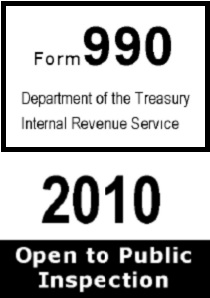
The Freedom From Religion Foundation’s form 990 has a bold “Open to Public Inspection” at the top.  The form gives the salaries of each staff member, to the dollar.  It shows revenue, expenses, cash in the bank, mortgages, and lots more financial details.  They seem to shoulder this burden pretty well, and I think churches can, too.

Go to GuideStar, the Foundation Center, or similar organizations to look up any nonprofit to which you’re considering a donation to check how they spend their money.

Any nonprofit, that is, except churches.

Let’s remember what religion we’re talking about.  It’s the religion that tells the story of the rich man who was (tragically) too attached to his wealth to follow Jesus’s command, “Sell everything you have and give to the poor, and you will have treasure in heaven” (Mark 10:17–31).  It’s the religion in which Jesus will say to the worthy people, “Whatever you did for one of the least of these brothers and sisters of mine, you did for me” (Matt. 25:31–46).  And, “It is easier for a camel to go through the eye of a needle than for a rich man to enter the kingdom of God” (Luke 18:25).  And, “Do not store up for yourselves treasures on earth … but store up for yourselves treasures in heaven … for where your treasure is, there your heart will be also” (Matt. 6:19–21).

Apparently Jesus didn’t care much for rich people but cared greatly for the poor.  How do you suppose he would react to churches and ministries being secretive today about how they spend the money given to them?  About churches exempting themselves from the requirement to open their books?

There are some groups trying to fix this problem.  MinistryWatch asks for financial information from ministries and publicizes the results.  For example, Greg Koukl’s Stand to Reason gets an A rating, and they deserve praise for doing the right thing.  But this is just a baby step.  First, MinistryWatch has only 600 ministries in their list when there are an estimated 335,000 congregations in the U.S.  Second, the financial information is still not as thorough as that provided on Form 990s by nonreligious nonprofits.

And third, many of the ministries don’t get an A rating.  In fact, those who get an F (typically because they ignored MinistryWatch’s request for information) are a Who’s Who of high-profile televangelists and religious newsmakers: Benny Hinn, Creflo Dollar, John Hagee, Kenneth Copeland, TD Jakes, Trinity Broadcasting Network, Rod Parsley, Robert Schuller’s Crystal Cathedral, Harold Camping’s Family Radio, and more.  They all got an F.  Doesn’t this evasion reflect badly on all religious organizations?

Some churches are open about their finances, but only to members.  According to one survey, 92% of churches provide financial information upon request to members.  Why is this not 100%?  And what good is this to the U.S. taxpayer who wants to verify the claimed benefit that churches provide a good to society that earns them nonprofit status?  Compare this with the financial records of the more than 1.5 million ordinary nonprofits easily accessible in a single database.

Let’s make a simple, logical change—a change that helps churches look better.  This cloud of doubt hangs over every church.  The change costs churches and other ministries very little and makes things fair, and it shows that they have nothing to hide.  Remove the exemption allowing churches to avoid providing financial information.

Some ministries will have to clean up their acts, but isn’t that a good thing?  Doesn’t this benefit the Christians at the churches that spend their income honorably?

Photo credit: IRS

Other posts in this series:

Related links:

  • “Christian views on poverty and wealth,” Wikipedia.
  • “4th annual ‘State of the Plate’ Survey,” State of the Plate, 3/27/12.

National Day of Actually DOING Something

People working together, like this barn raising, is more effective than praying about itToday is the National Day of Prayer.  How about a National Day of Actually Doing Something instead?

The president issued the obligatory proclamation today: “Let us pray for all the citizens of our great Nation, particularly those who are sick, mourning, or without hope, and ask God for the sustenance to meet the challenges we face as a Nation” and blah, blah, blah.

We’ve had a National Day of Prayer since 1952.  What good has it done?  In 1952, the world had 50 million cases of smallpox each year.  Today, zero.  Guinea worm and polio should soon follow.  Computers?  Cell phones?  The internet?  Science delivers, not God.

I can appreciate that praying to Jesus can help someone feel better, but so can praying to Shiva or Quetzalcoatl or whatever god they’ve been raised with.  In terms of actual results, praying to Jesus is as effective as praying to a jug of milk.

I understand how the National Day of Prayer helps politicians get right with Christians.  But how it coexists with the First Amendment (“Congress shall make no law respecting an establishment of religion”), I can’t imagine.

My own departure from Christianity was pretty gentle, and I learned a lot from the painful road taken by Julia Sweeney (creator of “Letting Go of God”).  As she gradually fell away from first Catholicism, then Christianity, and finally religion, she realized with a shock how ineffective prayer had been.  Prayer lets you imagine that you’re doing something when you’re actually doing absolutely nothing.  All that prayer that had helped her feel like she was helping people—whether the person on hard times down the street or the city devastated by natural disaster around the world—had been worthless.

In fact, not only does prayer do nothing in cases like this, but it is actually harmful.  The pain that people naturally feel when they hear of disaster—that emotion that could be the motivator for action—is drained away by prayer.  Why bother doing something yourself when God is so much more capable?

Prayer becomes an abdication of responsibility, and atheism can open the doors to action.

Sweeney’s conclusion: if you want to help the victims of the tsunami in Haiti (or whatever the latest disaster is), you need to do something since God clearly isn’t doing anything.  Contribute to a charity that will help, or demand that the federal government spend more to help and demand the tax increase to pay for it.  If it’s a sick friend, Jesus isn’t going to take them soup and cheer them up … but you can.

Prayer doesn’t “work” like other things work.  Electricity works.  An antibiotic works.  Prayer doesn’t.  As the bumper sticker says, Nothing Fails Like Prayer.

Even televangelists make clear that prayer is useless.  Their shows are just long infomercials that end with a direct appeal in two parts: please pray for us, and send lots and lots of cash.  But what possible value could my $20 be compared to what the almighty Creator of the universe could do?

Televangelists’ appeals for money make clear that they know what I know: that praying is like waiting for the Great Pumpkin.  People can reliably deliver money, but prayer doesn’t deliver anything.

Instead of a National Day of Prayer, how about a National Day of Actually Doing Something?  Many local United Way offices organize a Day of Caring—what about something like that on a national level?

Doing something makes you feel good, just like prayer, but it actually delivers the results.

Prayer is like masturbation.
It makes you feel good but it doesn’t change the world.
Don Baker

Photo credit: Wikimedia

Related posts:

Related links:

  • “National Day of Prayer,” Wikipedia.
  • Elizabeth Tenety, “Do we need a National Day of Prayer?” Washington Post, 5/5/11.

More Pointless Parables

Atheism wrestles with ChristianityI’ve posted before about some modern-day Christian parables.  Here are two more.

Ah, for the good old days when biblical parables made a compelling point!  These are pretty weak.  If you come across more, let me know.

Here’s one I heard on the radio.

A man goes into his pastor’s office.  “I’ve got money problems,” he says.  “I try to give what God commands of me, but I’m having a hard time making ends meet.  At the end of the month, there are still bills to pay.”

The pastor says, “What if you did what God commands of you and then, at the end of the month, you bring any bills that aren’t covered to me and I’ll pay them.  Would you do that?”

“You’d do that?  You’d pay the extra bills?”

“That’s not the question,” said the pastor.  “If I agreed to pay the extra bills, would you do that?”

“Sure!”

The pastor said, “Isn’t it odd that you’d trust a frail human like me when you wouldn’t trust God, the all-powerful creator of the universe to help you with your problems …” and blah, blah, blah about how fabulous God is and all the stuff that he’s done for us.

If you’re already drinking the Kool-Aid, this one might hit home, but it does nothing as an argument for Christianity.  And the pastor is making a very testable claim—almost a science experiment.  He’s all but quoting Luke 12:27–8:

Consider the lilies, how they grow: they neither toil nor spin; but I tell you, not even Solomon in all his glory clothed himself like one of these.  But if God so clothes the grass in the field, which is alive today and tomorrow is thrown into the furnace, how much more will He clothe you?  You men of little faith!

Test the claim!  I wouldn’t hold my breath for verifiable results, though.

I heard the next story decades ago.

In the early days of the space program, NASA scientists were checking the position of the sun, moon, and planets to make sure that they could safely put up satellites.  They checked thousands of years in the future and the past, but the computers ground to a halt.  The problem was a missing day in elapsed time.  They rechecked their data and the software, but the problem wouldn’t go away.

Puzzling over the problem, one scientist said, “You know, I remember a story from Sunday school.  Something about God making the sun stand still so that Joshua could win a battle.  Could that be it?” 

The scientists were skeptical, but they found a Bible.  With a little searching found Joshua 10:12–13.  “The sun stopped in the middle of the sky and delayed going down about a full day.”  With a little calculation, they found that this accounted for 23 hours and 20 minutes.  They were much closer but were still stuck.  They had to resolve that last 40 minutes.

The other scientists looked expectantly at the one with the Sunday school story.  “Well, I remember another story,” he said.  All eyes were on him.  “Something about the sun going backwards.”

There were a few chuckles, but they got out the Bible again and found 2 Kings 20:8–11, where King Hezekiah asked God for a sign, that the sun move backwards ten degrees.  Ten degrees out of 360 degrees in a circle—that is, 1/36 of a day.  In other words, exactly 40 minutes!

The scientists plugged in this information, and, sure enough, the calculations ran smoothly.

Ooh—let me guess the moral!  Modern science needs to get its guidance from the Bible.  (Did I get that right?)

Well, Mr. Smarty Pants Scientist—looks like the Goliath of Science has been defeated by the David of Christian Truth!

Despite its longevity and popularity—this story originated in a 1936 book by Harry Rimmer and was popularized by a 1974 book by Harold Hill—it’s bogus.  NASA even released a press release denying the popular story.

There are lots of red flags.  Even if God had stopped the sun 3000 years ago, there is no way to deduce that from information available to astronomers today, so the entire premise is flawed.  And let’s not even speculate at what “stopping the sun” (that is, stopping the rotation of the earth) would’ve done.  Concluding 23 hours and 20 minutes from “about a full day” is wishful thinking, and the ten degrees is more properly translated as “ten steps”—an angle based on local instrumentation that we can’t reproduce.

As usual, imagining that the Bible’s miracle stories really happened takes us to nowhere that can be scientifically justified.

Photo credit: Wikipedia

Other links:

MS-DOS and Objective Truth

Jesus, atheists, Christians, and apologeticsBack in the character-based Stone Age of the personal computer, all IBM-compatible MS-DOS PCs started up with a C-prompt, the “C:\>” text with a blinking cursor.  At least, all PCs that weren’t broken.

Can we conclude anything from that?  That “C:\>” is a reflection of some supernatural or transcendental truth?  That it is an insight into God’s mind?  No—it’s just a useful trait shared by this class of PCs.  There’s no objective meaning behind these characters.  This text is useful (it shows the directory in which any typed commands will take place), so it was selected.  There’s nothing more profound than this behind it.

Human morality is like this.  Almost all humans have shared moral instincts, not dissimilar from instincts in other animals.  Through instinct, honeybees communicate where the nectar is, newborn sea turtles go toward the ocean, and juvenile birds fly.  Training or acculturation can override human instincts, of course, but in general we have a shared moral sense—a shared acceptance of the Golden Rule, for example.

We think our moral instincts are pretty important, and that’s understandable, but there’s no reason to imagine that they are objectively true—that is, based on some supernatural grounding.  Said another way, we think that our morality is true because it tells us that it’s true, but we can’t infer from this that it is grounded outside us.

We must not confuse universally shared moral instincts with universal moral truths.

Human moral instincts are what our programming says they are—it’s no more profound than that.  There’s as much reason to imagine that they are a window into the transcendent as that the MS-DOS C-prompt is.

Related posts: