Word of the Day: Burqa, Niqab, Hijab

A novel that tackles Christian apologeticsHijab is the Muslim dress code for women.  It is typically interpreted to permit only the hands and face to be visible in public.  It also refers to the headscarf that covers the head but not the face.

The niqab is a cloth that covers the face.  It can reveal the eyes or have a mesh or veil that covers the eyes.  Seeing through the veil is reportedly no more difficult than seeing through sunglasses.

The burqa is a loose-fitting outer garment that covers the body and includes both the niqab face covering and hijab head covering.  The hands and face are often treated together, with customs saying either that they may both be visible or must both be covered.  In the latter case, women often wear gloves.

The Arab world has many local customs, of course, and there are many variations.  For example, the chador is an Iranian cloak without fasteners that is held closed in front.

Demands on men are minimal by comparison, often interpreted to require covering the knees and avoiding jewelry.

France banned “ostentatious religious symbols” like the hijab from public schools in 2004.  Nicolas Sarkozy (then a French minister) justified it this way: “When I enter a mosque, I remove my shoes.  When a Muslim girl enters school, she must remove her veil.”  Turkey also prohibits the hijab in schools and universities.  The French law was extended in 2010 to ban face covering in public, including the niqab.

A Muslim-American woman is the second-best saber fencer in the U.S. and is hoping to represent the U.S. in the 2012 Olympics, even though it will fall in Ramadan, the month when she will be prohibited from eating or drinking during the day.  She conforms to hijab and was attracted to the sport because the uniform (inadvertently) also conforms to hijab.

From a Western standpoint, it’s easy to see the hijab requirement as oppressive, though from the inside it can be seen as a matter of cultural identity.  A cultural demand doesn’t always vanish when that demand is lifted.  During the Qing dynasty (1644–1912), Manchu rulers imposed queues (long ponytail with an otherwise shaved head) on Chinese men.  Not wearing one was considered disloyal and a capital crime, but when the dynasty ended, many men still wore the queue as a custom.

A fascinating example of unexpected consequences came when wearing the veil became mandatory in Iran after the 1979 revolution.  Protest came from an unexpected quarter—women who had been wearing the veil.  Before, they could publicly say, “God is great” by wearing the veil in public.  After, they were simply obeying the law.

Imagine a Christian theocracy in the West that made wearing crosses mandatory.  The same thing would happen to the cross as happened to the Iranian veil—the cross would no longer be a religious statement but a political one.

I wonder if there’s something of this kind of unexpected consequence with Christian morality.  Do Christians do good things just because they’re the right thing to do?  That is, do they do good things for the same reasons that atheists do them?  Or do they do them because God is watching?  Whether God is tallying up good and bad actions that will confront the Christian in heaven or the Christian is simply trying to put a smile on God’s face, I wonder if the Christian moral motivation is shallower than that of the atheist.

Related links:

Does the Christian Care About the Poor or Not?

A novel about Christian apologetics and atheist counter-apologetics

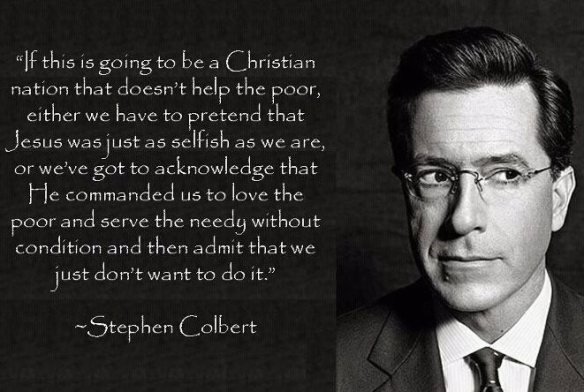
The New Testament is brimming with demands that the Christian care for the poor and needy.  Think of the parable of the Sheep and the Goats (Matt. 25:31–46), the parable of the Good Samaritan (Luke 10:25–37), or the story of Jesus and the rich young man (Luke 18:18–30).

How some politicians and religious leaders can juggle the hypocrisy is beyond me.  I’ll grant that the Bible can be picked apart and made to say just about anything, but isn’t charity a prime demand?

[Jesus said:] Go, sell everything you have and give to the poor, and you will have treasure in heaven. Then come, follow me. (Mark 10:21)

[John the Baptist said:] Anyone who has two coats should share with the one who has none, and anyone who has food should do the same. (Luke 3:11)

If anyone has material possessions and sees a brother or sister in need but has no pity on them, how can the love of God be in that person? Dear children, let us not love with words or speech but with actions and in truth. (1 John 3:17–18)

Religion that God our Father accepts as pure and faultless is this: to look after orphans and widows in their distress and to keep oneself from being polluted by the world. (James 1:27)

The Religious Foundation of Groundhog Day

Does God exist?  It's an important question.We’re all familiar with the major astronomical milestones in the year—the summer and winter solstices, when our hemisphere is tipped maximally toward or away from the sun, and the spring and fall equinoxes, when each day worldwide has roughly 12 hours of sunlight and 12 of darkness.  These dates separate the seasons—the spring equinox marks the beginning of spring, and so on.  They are to the calendar what north, south, east, and west are to the compass.
In the same way that the distance between the four cardinal compass points are divided by four ordinal points (northeast, southeast, and so on), the seasons defined by the four astronomical dates are divided by four cross-quarter days.  These were Gaelic festivals in medieval times.  They are Imbolc (February 2), Beltane (May 1), Lughnasadh (August 1), and Samhain (October 31).  Imbolc lines up with our Groundhog Day.

Most of us are familiar with the idea that on Halloween (All Hallows’ Eve, or Gaelic Samhain), spirits from the next world could enter ours, which is why ghosts and the dead are associated with Halloween.  In Gaelic mythology, the veil between our world and the next became thinner not only on Samhain but for each of the cross-quarter days.  These days provided opportunities for divining the future using information from beyond.

In the same way that Christmas subsumed pagan holidays on the winter solstice like Saturnalia and Yule, the Christian holiday of Candlemas subsumed Imbolc (February 2).  The Celtic goddess Brigit was associated with Imbolc, but she too was subsumed into Christianity as Saint Brigit.

Both pagans and the Christians who followed them observed nature on Imbolc/Candlemas to glean clues to how much longer winter would last.  Would it go the full six-and-a-half weeks until the spring equinox or would it be more gentle winter?

German immigrants to America had used hedgehogs to help predict the weather.  If it was sunny and the hedgehog could see its shadow, winter would go the distance.  But if it was cloudy, winter would be shorter.  With no hedgehogs in America, they switched to groundhogs.  (The two animals are not closely related, but their habitats are similar.)

This Imbolc, whether you follow Punxsutawney Phil (the center of the biggest Groundhog Day celebration in Punxsutawney, Pennsylvania) or some lesser-known groundhog prognosticator, keep in mind the spiritual origins of the tradition.

Photo credit: wvholst

Related links:

The U.S. Constitution is 100 Percent Secular—or Is It?

A novel focused on atheism and Christian apologeticsIn other blog posts, I’ve made the point that the secular U.S. Constitution prohibits the government from getting involved with religion, which makes the best environment for both atheists and Christians.  However, on several occasions, I’ve gotten pushback that the Constitution isn’t secular.

Let’s first consider a historic document that is easily seen to be religious, the Mayflower Compact (1620).  It’s quite short, and the majority of the body is here:

Having undertaken, for the Glory of God, and advancements of the Christian faith and honor of our King and Country, a voyage to plant the first colony in the Northern parts of Virginia, do by these presents, solemnly and mutually, in the presence of God, and one another, covenant and combine ourselves together into a civil body politic.

This is one of the documents that David Barton likes to use while bending history to take on his preconception of America as a Christian nation.  There are also several federal Thanksgiving declarations that acknowledge the Christian god.  For example, George Washington in 1789 created the first national Thanksgiving Day with this statement:

[Congress requests that the president] recommend to the People of the United States a day of public thanksgiving and prayer to be observed by acknowledging with grateful hearts the many signal favors of Almighty God.

The constitution of the Confederate States (1861) was adopted with few changes from the U.S. Constitution, one being the addition of “invoking the favor and guidance of Almighty God” in the preamble.

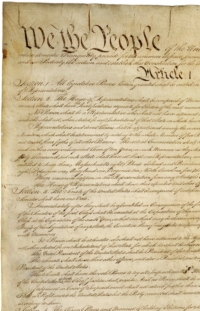
When we read the U.S. Constitution, this overtly Christian language isn’t there.  Neither is the vaguely deist language, as was present in the Declaration of Independence.  It’s 100% secular.  It’s not God making this constitution; it begins, in big letters, We the People.  In fact, Article 6 says in part, “no religious Test shall ever be required as a Qualification to any Office or public Trust under the United States.”

But is it secular?  Some Christians assert that it’s not.  The first example is from Article 1:

If any Bill shall not be returned by the President within ten Days (Sundays excepted) after it shall have been presented to him, the Same shall be a Law.

In other words, it recognized Sunday as a holiday.  The second example is the wrapup in Article 7:

done in Convention by the Unanimous Consent of the States present the Seventeenth Day of September in the Year of our Lord one thousand seven hundred and Eighty seven.

In other words, it replaces AD (Anno Domini—“in the year of our Lord”) with its English translation.

That’s it??  Those are the powerful counterexamples?  Compare this to the Mayflower Compact—a constitution with some balls that not only acknowledged God’s existence but said that the entire project was for his glory.

That Sunday was a holiday simply acknowledges the custom of the people of the time.  Spelling out AD and saying that this acknowledges Yahweh is like saying that the use of the names Thursday, Friday, and Saturday acknowledges the gods Thor, Frigg, and Saturn, respectively.  Or that the use of the names May and June acknowledges the Roman goddesses Maia and Juno.  “AD” is just another part of the same calendar.

The final irony is that “in the year of our Lord” isn’t even correct from a Christian standpoint.  The few clues we have of Jesus’s birth in the gospels make clear that he wasn’t born in the year 1 but probably around 5 BCE.

So, yes, the Constitution does reflect the customs and calendar of the people of the time.  But it’s still obviously and boldly secular.  And isn’t that the best for everyone who is governed by it?

Photo credit: Wikimedia

Related posts:

Post #100

Using fiction to explore Christianity and atheismWelcome to post #100!  It’s time to see how far this blog has come since I started last August.
Many of you know that this is actually two blogs.  Galileo Unchained (“For Those Who Have No Use for Faith”) is the doorway aimed at atheists, and Cross Examined (“Clear Thinking About Christianity”) is aimed at Christians.  The content is the same, so hang out wherever you feel more comfortable.

In December, I launched my novel, Cross Examined: An Unconventional Spiritual Journey.  My goal with both the book and this blog is primarily to encourage Christians to think.  Whether they become atheists or stronger Christians isn’t the issue but rather that they think about the intellectual foundations that support their faith.  Too commonly, in my opinion, Christians act out their faith on autopilot, not thinking much about what they claim is life’s most important issue.

And, of course, I hope to have provocative content for atheists as well, both in this blog in the book.

If you haven’t poked around in the toolbar, that’s been gradually updated, with a page listing all the posts, a glossary (with each of the Words of the Day), and a summary of the book with the first couple of chapters.

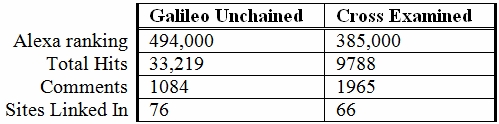
Here are some of the stats for the blogs:

Alexa ranks web sites by global popularity, and a smaller number is better.  It says that 0.00034% of global Internet users visit CrossExaminedBlog.com.  (Woo hoo—look out, PZ Myers!)

There’s no easy way to figure out word count, but all the posts add up to roughly 50,000 words.

So what’s next?  I’m thinking about podcasting the blogs.  That is, the same content, just spoken.  I hope that will provide a new audience.  I’m also thinking about consolidating the blogs, which would mean focusing on Cross Examined and no longer updating or creating links to Galileo Unchained.  (Your thoughts on these changes?)

Here’s where I need your help.

  • Who do you think would find the book useful?  Do you know of any thoughtful Christians comfortable enough in their beliefs who would be interested in exploring the foundations of Christianity?  Please pass on a link.  I’m also looking for blurbs (brief recommendations), so let me know of anyone with interesting credentials—a pastor or professor, perhaps—who might share my goal of encouraging Christians to think and who would like a free review copy.
  • Who would find the blog interesting?  Please recommend it to anyone you think would appreciate plain talk on Christianity.
  • What recommendations do you have for the blog?  Any changes in format?  Topics ideas?  Add your thoughts to the comments below or email me.

Thanks for dropping by, and I hope you find this a worthwhile destination on the internet!

Bob Seidensticker

Photo credit: kslavin

Christianity Infantilizes Adults

Cross Examined is a novel about Christian apologetics and atheismYeah, I know the Christmas season is over, but have you heard the song “Christmas Shoes,” which came out about ten years ago?  Patton Oswalt tore it up in a clever comedy bit (video, rated R), and he makes an excellent point about the illogic of what Christians tell themselves.

The song tells the story of a guy who’s in yet another long line before Christmas, not really in the Christmas spirit.  Ahead of him in line is a grubby kid holding a pair of shoes.  When it’s the kid’s turn, he tells the clerk his story, that he’s buying his mom shoes to make her feel better.  She’s sick, and he wants her to look her best if she meets Jesus that night.

The kid counts out the price in pennies, and it turns out that he doesn’t have enough.  So he turns to our hero who feels sorry for the kid and pays for the shoes.  The story concludes:

I knew I’d caught a glimpse of heaven’s love
As he thanked me and ran out
I knew that God had sent that little boy
To remind me just what Christmas is all about.

It’s a sweet story, and lots of people filter life’s events through a Christian lens in this way to see God’s benevolent purpose behind things.  But let’s analyze this to see how “heaven’s love” worked in this situation.

God sees the cranky guy in line.  He gives the kid’s mom some hideous disease, puts the kid in line in front of Mr. Cranky, and makes the kid a little short on cash so that this Christmas miracle could happen.  In other words, God needs to make someone die and leave a kid motherless to spread a little Christmas spirit.

Is that the best explanation for the evidence?  Is that an explanation that a Christian would want?  What kind of insane deity would do that?  Perhaps good and bad things just happen, without divine cause, and we can use events in our lives to prod us to consider what’s important.  We don’t need God and we don’t need to be a Christian to be delighted by life, find silver linings, and use everyday events to remind us of things to be thankful for.

It’s easy to reinterpret events through a Christian lens.  It can be comforting, and it patches leaks in the Good Ship Christianity where reason leaks in.  But this is simply a rationalization to support a presupposition, not an honest following of the evidence, and when you stop to think of what you’re actually saying, you’ll see that the reality you’ve invented makes no sense.

When Christians wonder why atheists get agitated, this kind of empty childish thinking is often the cause.

Consider another story.  Suppose a girl sick with cancer throws a coin into a wishing well and wishes to get better.  The net effect is that the girl is a little happier, like she took a happiness pill.

But this wishing well belief is just an ancient custom.  We all know that wishing wells don’t really do anything.  Should you break the news to her?

Few of us would.  What’s the point?  She actually does feel better, and she’ll have plenty of time as an adult to deal with reality.  She has adults in her life who will protect her as necessary, shielding her so that she can hold this belief.

But as she becomes an adult, she must grow up.  We leave behind wishing wells, Santa Claus, and other false beliefs as we become independent.  No longer are the necessities of life given to us; as adults, we must fend for ourselves—indeed, we want to fend for ourselves.  The parent who sugarcoats reality or keeps the child dependent for too long is doing that child no favors.

Reality is better than delusion, happy though that delusion may be.  The doctor saying, “You’ll be just fine” feels a lot better than “You have cancer,” but if I really have cancer, which one allows me to take steps to improve my future?

Religion infantilizes adults and keeps them dependent.  That’s a good thing for the 100-billion-dollar-a-year U.S. religion industry, but what is best for the individual—a pat on the head or reality?

Photo credit: seq