
F**kin’ Magnets—How do They Work?

Does God exist?The hip hop band Insane Clown Posse has created an interesting meme with its 2010 song “Miracles.”

Well, not so much interesting as bizarre.  Here’s a bowdlerized version of the verses in question:

Water, fire, air and dirt.
F**kin’ magnets, how do they work?
And I don’t wanna talk to a scientist.
Y’all motherf**kers lying and getting me pissed.

You really want to know how magnets work?  Here you go:

Does God exist?
These are Maxwell’s equations, the foundation of our understanding of electricity and magnetism.  A deep understanding would obviously take some effort, but the point is that this question is no mystery to science.

The song’s not all bad, but it wanders from justifiable wonder at nature (“Oceans spanning beyond my sight / And a million stars way above ’em at night”) to conflating wonder with ignorance.

Saturday Night Live did an excellent parody video.  The lyrics in their song “Magical Mysteries” include, “Where does the sun hide at night? / Did people really used to live in black and white?” which isn’t too far from denying our knowledge about magnets.

Maybe Bill O’Reilly is a Juggalo (a fan of Insane Clown Posse) because he has sounded a lot like them.  In a 2011 interview with David Silverman, president of American Atheists, O’Reilly said, “I’ll tell you why [religion is] not a scam, in my opinion.  Tide goes in, tide goes out.  Never a miscommunication.  You can’t explain that.”

(Uh … can you say, “Wikipedia”?)

And were there no consequences for O’Reilly for being this confused about reality?  He’s been lampooned for these statements (and a later defense, which was equally ridiculous) by people who weren’t his fans to begin with.  But doesn’t his fan base care about reality?  Can they possibly cheer on this willful ignorance?

Despite the contrary opinions of O’Reilly and Insane Clown Posse, learning about how things work can make them more amazing.  Actually understanding how magnets work doesn’t ruin the magic trick, it turns mysterious into marvelous.

Here’s an experiment: go outside on a clear night.  Hold out your hand, arm extended, and look at the nail of your little finger.  That fingernail is covering a million galaxies.  Not a million stars, a million galaxies.  Each galaxy has roughly 100 billion stars.  That’s 100,000,000,000,000,000 stars under just one fingernail.  Now look at how vast the sky is compared to that one tiny patch.

And how does the Bible treat this inconceivable vastness?  “[God] also made the stars” (Gen. 1:16).  That’s it.

The god of the Old Testament is little more than an absolute monarch with the wisdom of Solomon, the generalship of Alexander, and the physical strength of Hercules.  But science gives you the vastness of the universe, the energy of a supernova, the bizarreness of quantum physics, and the complexity of the human body.  The writers of the Bible were constrained by their imagination, and it shows.  There is so much out there that they couldn’t begin to imagine.  If you want wonder, discard the Bible and open a science book.

And this is not groundless myth, it’s science—the discipline that makes possible your reading this across the Internet, on a computer, powered by electricity (and governed by Maxwell’s equations).

Carl Sagan said, “We are star stuff” to suggest that we are literally made from the remnants of stars.  Two adjoining carbon atoms in a molecule in your body might have come from different exploding stars.  Science gives us this insight, not religion.

Second-century Christian author Tertullian is credited with the maxim, credo quia absurdum (I believe because it is absurd).  In other words, no one could make this stuff up.

If you believe anything either in spite of evidence to the contrary or because of it, science may not for you.  But if you want to understand reality to the best of humanity’s ability, rely on science.  C’mon in—the water’s fine!

Science does not make it impossible to believe in God,
but it does make it possible to not believe in God.
Steve Weinberg, Nobel Laureate in Physics

Photo credit: mutantMandias

Related posts:

Related links:

  • “Miracles” by Insane Clown Posse: video (cued to the magnets verse) and lyrics.  Caution: rated PG-13 for language.
  • “F*cking Magnets, How Do They Work?” Know Your Meme.
  • “Bill O’Reilly You Can’t Explain That,” Know Your Meme.
  • Robert Quigley, “Bill O’Reilly’s Tidal Skepticism Launches ‘You Can’t Explain That’ Meme,” Geekosystem, 2/10/11.
  • A succinct summary of how modern technology makes the marvels of Jesus look pathetic is here.

Ray Comfort’s Anti-Abortion Video “180”

Was Jesus the son of God?“A shocking, award-winning documentary!”  “Changing the heart of a nation.”  “33 minutes that will rock your world.”  Ray Comfort lavishes his work with superlatives, but does it hold up?

I watched 180 so that you won’t have to.  Spoiler alert: didn’t rock my world.

Motives are immediately suspect when the video opens with Hitler and Nazi rallies.  Right out of the gate, Godwin’s Law is in force, and Comfort makes clear that you’re either on his side or giving Hitler back rubs.

With that dichotomy clear, Comfort interviews people hanging out on a sunny day at some Los Angeles beach.  He begins by asking, “Who was Hitler?”  The snippets introducing us to the (typically) 20-somethings who we’ll see throughout the video all show them clueless in response.  If it was unclear before, it’s now obvious that he cherry picked only those interviews that gave him what he wanted.  This is a poor foundation on which to show us a half-dozen people at the end who are convinced by his message.  (Okay, Ray, but out of how many?)

We connect the present with Hitler through a long interview with a young American neo-Nazi with a tall blue Mohawk and a dashed “Cut here” tattoo across his throat.  And then, videos of concentration camp aftermath.

Comfort primes his interviewees with moral puzzles such as “Would you shoot Hitler if you could go back in time and do so?” or “Would you kill Jews if told that, if you didn’t, you would be killed and someone else would do the job?”

About a third of the way in, the conversation finally turns to abortion.  The use of Hitler and the Holocaust is justified when Comfort declares abortion to be the American holocaust, with killing fetuses equivalent to killing Jews.  His arguments are nothing new to many of us, but they were to this crowd:

  • Finish this sentence: “It’s okay to kill a baby in the womb when …”
  • What if a construction worker was about to blow up a building but wasn’t sure if there was a person in there or not.  If we’re not sure, we should always err on the side of life, right?
  • What if someone had aborted you?

I’ve already discussed these and other arguments.

Next, he brings up the sixth Commandment: “Thou shalt not kill.”  In the first place, he’s done nothing to show that there is a god behind these commandments and that it has any more supernatural warrant than “Use the Force, Luke!”  Additionally, the commandment is usually translated as “thou shalt not murder.”  If the correct word is “kill,” I need to see Comfort walking the walk by campaigning against capital punishment and war.  And if it’s an undefined “murder,” what is murder?  The commandment becomes a tautology: Thou shalt not do what is forbidden.

Granted, but how is this helpful?

Our interviewees seem a little off balance with a camera in their faces and are apparently not that sharp to begin with given their widespread ignorance of Hitler.  Ray picks snippets that give him what he wants to hear, that killing fetuses is equivalent to killing Jews.

The lesson is that you can make an effective emotional pro-life argument to people who haven’t thought much about the issue.  But people who change their minds so easily (Comfort brags about how quickly they changed) aren’t well established in their new position.  How many of these, after thinking about these ideas at leisure and discussing it with friends, are still in Comfort’s camp today?

There’s a fundamental confusion in his interviewees, and Comfort is not motivated to correct it.  There’s a big difference between “Abortion is wrong for me” and “Abortion is wrong for everyone, and we must impose that on society.”  People give him the former, but he hopes we’ll take away the latter.

We’re two thirds through the video now and are just hoping to get out with our sanity intact, but Comfort has saved the best for last.  The anti-abortion argument is dropped, and he falls back to his old favorite, the Ten Commandments challenge.  (One reviewer suggested that Comfort’s compulsive use of this argument is his personal form of Tourette’s.)  This is where Comfort ticks off the commandments: Have you ever lied?  Stolen?  Looked on someone with lust?

He concludes: “By your own admission, you’re a lying, thieving, blaspheming fornicator and must face God on Judgment Day™.  How do you think God should judge you?”  Again, of course, he ignores that we haven’t established the existence of God or the afterlife.

I did applaud one aspect of the movie, the text at the end that read, “We strongly condemn the use of any violence in connection with protesting abortion.”  At least, I applauded this until I realized that this was probably a legal demand since Comfort had pushed his interviewees to consider shooting Hitler early in the documentary.

Given Ray Comfort’s easy success with emotional appeals, what if someone did a rebuttal video?  It could open with stories of illegal and dangerous back-alley abortion clinics.  Then talk about Americans rejecting oppressive government—“the land of the free,” “no taxation without representation,” and all that.  Paint a picture of medieval Europe with the heavy hand of the church on every aspect of life for the poor peasant.  Overlay some stirring patriotic music on waving flags and eagles.

The interviews would focus on intuitive arguments like those I’ve discussed in Five Emotional Pro-Choice Arguments.  Here are several brief examples.

  • Suppose a building were on fire, and you could save either a five-year-old child or ten frozen embryos.  Which would you pick?  If you picked the child, what does that say about the argument that equates embryos with babies?
  • If you’ve seen anti-abortion videos or posters, you may have seen the bloody results of late-term abortions.  Why do you suppose they showed you that rather than a woman swallowing an emergency contraceptive (“morning after”) pill?  Do you suppose they really think that it’s a “baby” all the way back to that single cell?
  • Given that half of all pregnancies end in spontaneous abortion, do you suppose that God has much of a concern about abortion?
  • A week-old human blastocyst has fewer cells than the brain of a fly.  Does it make sense to equate that with a one trillion-cell newborn?  The newborn has eyes, ears, legs, arms, a brain and a nervous system, a heart and a circulatory system—in fact, all the components of the human body that you do—while the blastocyst has just 100 undifferentiated cells.  Does it make sense to equate them?
  • Who better to weigh the impact of a child than the mother herself?

Do you think we’d get similar results with this video?

Photo credit: Wikipedia

Related posts:

Related links:

Biblical Analysis of the Super Bowl

Christianity and atheism discussion and Does God exist?Everyone’s familiar with Tim Tebow’s public thanks to God for his football success and his love of the Bible verse John 3:16: “For God so loved the world that he gave his one and only Son, that whoever believes in him shall not perish but have eternal life.”

Many of us have heard some of the spooky 3:16 connections with Tebow’s next-to-last game this season.  The Broncos beat the Steelers on January 8 in Tebow’s first NFL playoff game, with Tebow throwing for 316 yards.  This was three years to the day that Tebow made a public splash wearing eye black that read “John 3:16” in the BCS Championship game.  In the win against the Steelers, Tebow averaged 31.6 yards for each pass completion, an NFL record for postseason games.

Let’s do the same kind of analysis on Eli Manning’s Super Bowl win on Sunday.  He threw a total of 296 yards.

There is no book in the Bible with the verse 2:96, so the significance must instead be in verse 29:6.  Several books have this verse.

Put the turban on his head and attach the sacred emblem to the turban. (Ex. 29:6)

Maybe this represents Manning being declared the game’s MVP.

My path was drenched with cream and the rock poured out for me streams of olive oil. (Job 29:6)

This may represent the accolades he received after the game.

The LORD Almighty will come with thunder and earthquake and great noise, with windstorm and tempest and flames of a devouring fire. (Isaiah 29:6)

That’s more like it—some godly justice!  God is obviously furious with the results of the game.  I’ll bet he was a Patriots fan.

That’s a big claim appropriate for the year’s biggest game.

Still, I wondered if there was more.  I realized my error when I converted yards into the biblical measure of cubits.  There’s a bit of fuzziness in the definition of the cubit, and 296 yards becomes something in the range 511 to 518 cubits.  Since Tebow’s quote is from the New Testament, let’s look there for verses in the range 5:11–18.

Mark 5:11–18 is the story of demons cast from a possessed man into 2000 pigs.  In Luke, it’s the story of Jesus healing leprosy.  In John, Jesus gets into trouble with the Jewish leaders because he heals on the Sabbath.  James and 1 John both state that prayer heals sick people, and they make a causal connection between sin and sickness.

The message starts to take shape—something about mental and physical illness being caused by sin and demons.

The breakthrough came when I went back to the quarterback’s name—Eli Manning.  That’s Elisha Manning.  Of course—the Old Testament prophet Elisha!  it wasn’t the New Testament but the Old Testament that had the clue.  And there it was, in 2 Kings 5:11–18, the story of Naaman, a general from Aram (today’s central Syria), who had leprosy.

Naaman had heard of the power of the Yahweh and came to Israel for healing.  Elisha commanded him to wash seven times in the Jordan.  Naaman had expected some ordeal or fee and considered this a snub, but his servants persuaded him to give it a try, and sure enough, his leprosy was cured.  Naaman realized the power of Yahweh and asked forgiveness when he would be obliged to bow before Rimmon (Baal) back in Syria.  Elisha granted it, saying “Go in peace.”

The scales fell from my eyes.  God’s message in this Super Bowl is that he can cure leprosy.  Leprosy is now reliably treated with antibiotics, of course, so this isn’t especially relevant, but it’s good to know that God’s still concerned about diseases that have little or no impact on society today.

I know what Christian apologists will say about my analysis.  They’ll say that this is arbitrary, that I’m just picking and choosing verses based on what I want to find, collecting ridiculous passages and ignoring the rest.  They’ll say that the chapter and verse divisions are not divinely inspired, with the New Testament being divided into verses only in the 1500s.  They’ll say that this entire analysis is nonsense, built on nothing solid.

And to that I say …

Busted!  You got me.  That’s exactly what I was doing.  I was indeed picking verses with an agenda.

But then if it’s nonsense when I do it, why is it any more meaningful when Christians do it?

Photo credit: Catholic Online

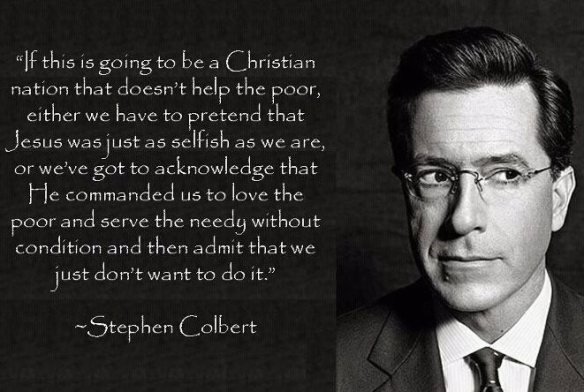
Does the Christian Care About the Poor or Not?

A novel about Christian apologetics and atheist counter-apologetics

The New Testament is brimming with demands that the Christian care for the poor and needy.  Think of the parable of the Sheep and the Goats (Matt. 25:31–46), the parable of the Good Samaritan (Luke 10:25–37), or the story of Jesus and the rich young man (Luke 18:18–30).

How some politicians and religious leaders can juggle the hypocrisy is beyond me.  I’ll grant that the Bible can be picked apart and made to say just about anything, but isn’t charity a prime demand?

[Jesus said:] Go, sell everything you have and give to the poor, and you will have treasure in heaven. Then come, follow me. (Mark 10:21)

[John the Baptist said:] Anyone who has two coats should share with the one who has none, and anyone who has food should do the same. (Luke 3:11)

If anyone has material possessions and sees a brother or sister in need but has no pity on them, how can the love of God be in that person? Dear children, let us not love with words or speech but with actions and in truth. (1 John 3:17–18)

Religion that God our Father accepts as pure and faultless is this: to look after orphans and widows in their distress and to keep oneself from being polluted by the world. (James 1:27)

The U.S. Constitution is 100 Percent Secular—or Is It?

A novel focused on atheism and Christian apologeticsIn other blog posts, I’ve made the point that the secular U.S. Constitution prohibits the government from getting involved with religion, which makes the best environment for both atheists and Christians.  However, on several occasions, I’ve gotten pushback that the Constitution isn’t secular.

Let’s first consider a historic document that is easily seen to be religious, the Mayflower Compact (1620).  It’s quite short, and the majority of the body is here:

Having undertaken, for the Glory of God, and advancements of the Christian faith and honor of our King and Country, a voyage to plant the first colony in the Northern parts of Virginia, do by these presents, solemnly and mutually, in the presence of God, and one another, covenant and combine ourselves together into a civil body politic.

This is one of the documents that David Barton likes to use while bending history to take on his preconception of America as a Christian nation.  There are also several federal Thanksgiving declarations that acknowledge the Christian god.  For example, George Washington in 1789 created the first national Thanksgiving Day with this statement:

[Congress requests that the president] recommend to the People of the United States a day of public thanksgiving and prayer to be observed by acknowledging with grateful hearts the many signal favors of Almighty God.

The constitution of the Confederate States (1861) was adopted with few changes from the U.S. Constitution, one being the addition of “invoking the favor and guidance of Almighty God” in the preamble.

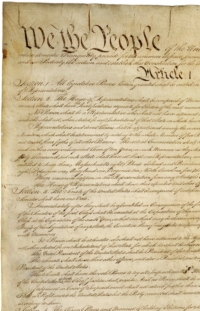
When we read the U.S. Constitution, this overtly Christian language isn’t there.  Neither is the vaguely deist language, as was present in the Declaration of Independence.  It’s 100% secular.  It’s not God making this constitution; it begins, in big letters, We the People.  In fact, Article 6 says in part, “no religious Test shall ever be required as a Qualification to any Office or public Trust under the United States.”

But is it secular?  Some Christians assert that it’s not.  The first example is from Article 1:

If any Bill shall not be returned by the President within ten Days (Sundays excepted) after it shall have been presented to him, the Same shall be a Law.

In other words, it recognized Sunday as a holiday.  The second example is the wrapup in Article 7:

done in Convention by the Unanimous Consent of the States present the Seventeenth Day of September in the Year of our Lord one thousand seven hundred and Eighty seven.

In other words, it replaces AD (Anno Domini—“in the year of our Lord”) with its English translation.

That’s it??  Those are the powerful counterexamples?  Compare this to the Mayflower Compact—a constitution with some balls that not only acknowledged God’s existence but said that the entire project was for his glory.

That Sunday was a holiday simply acknowledges the custom of the people of the time.  Spelling out AD and saying that this acknowledges Yahweh is like saying that the use of the names Thursday, Friday, and Saturday acknowledges the gods Thor, Frigg, and Saturn, respectively.  Or that the use of the names May and June acknowledges the Roman goddesses Maia and Juno.  “AD” is just another part of the same calendar.

The final irony is that “in the year of our Lord” isn’t even correct from a Christian standpoint.  The few clues we have of Jesus’s birth in the gospels make clear that he wasn’t born in the year 1 but probably around 5 BCE.

So, yes, the Constitution does reflect the customs and calendar of the people of the time.  But it’s still obviously and boldly secular.  And isn’t that the best for everyone who is governed by it?

Photo credit: Wikimedia

Related posts:

Post #100

Using fiction to explore Christianity and atheismWelcome to post #100!  It’s time to see how far this blog has come since I started last August.

Many of you know that this is actually two blogs.  Galileo Unchained (“For Those Who Have No Use for Faith”) is the doorway aimed at atheists, and Cross Examined (“Clear Thinking About Christianity”) is aimed at Christians.  The content is the same, so hang out wherever you feel more comfortable.

In December, I launched my novel, Cross Examined: An Unconventional Spiritual Journey.  My goal with both the book and this blog is primarily to encourage Christians to think.  Whether they become atheists or stronger Christians isn’t the issue but rather that they think about the intellectual foundations that support their faith.  Too commonly, in my opinion, Christians act out their faith on autopilot, not thinking much about what they claim is life’s most important issue.

And, of course, I hope to have provocative content for atheists as well, both in this blog in the book.

If you haven’t poked around in the toolbar, that’s been gradually updated, with a page listing all the posts, a glossary (with each of the Words of the Day), and a summary of the book with the first couple of chapters.

Here are some of the stats for the blogs:

Alexa ranks web sites by global popularity, and a smaller number is better.  It says that 0.00034% of global Internet users visit CrossExaminedBlog.com.  (Woo hoo—look out, PZ Myers!)

There’s no easy way to figure out word count, but all the posts add up to roughly 50,000 words.

So what’s next?  I’m thinking about podcasting the blogs.  That is, the same content, just spoken.  I hope that will provide a new audience.  I’m also thinking about consolidating the blogs, which would mean focusing on Cross Examined and no longer updating or creating links to Galileo Unchained.  (Your thoughts on these changes?)

Here’s where I need your help.

  • Who do you think would find the book useful?  Do you know of any thoughtful Christians comfortable enough in their beliefs who would be interested in exploring the foundations of Christianity?  Please pass on a link.  I’m also looking for blurbs (brief recommendations), so let me know of anyone with interesting credentials—a pastor or professor, perhaps—who might share my goal of encouraging Christians to think and who would like a free review copy.
  • Who would find the blog interesting?  Please recommend it to anyone you think would appreciate plain talk on Christianity.
  • What recommendations do you have for the blog?  Any changes in format?  Topics ideas?  Add your thoughts to the comments below or email me.

Thanks for dropping by, and I hope you find this a worthwhile destination on the internet!

Bob Seidensticker

Photo credit: kslavin