Biblical Slavery, Part 2

Slavery and the Bible--doesn't make God look very good(See Part 1 of this discussion.)

Let’s continue this critique of a podcast titled “Sex, Lies & Leviticus” from apologetics.com that responded to Dan Savage’s criticism of the Bible.  Italicized arguments are my paraphrases from the podcast.

“Slavery” in the Bible is simply not the same thing as slavery in the United States.  For example, consider Ex. 21:16:

Anyone who kidnaps someone is to be put to death, whether the victim has been sold or is still in the kidnapper’s possession.

See?  A rejection of slavery, right there in the Bible.

Nope.  This refers just to Jews kidnapping Jews—see the NET Bible comment on this verse.  The Bible makes a clear distinction between (1) Jews as slaves and (2) members of other tribes as slaves.

(Why is the atheist educating the Christians about their own book?  Don’t they know about these two aspects of biblical slavery?)

“We have a very different view here of what slavery was [comparing American slavery with biblical slavery] and you can see that it’s heavily regulated.”

Yes, slavery was regulated, just like commerce.  And, like commerce, slavery was kosher from God’s standpoint.

And yes, Africans enslaved in America was different than Jews enslaved by Jews (but we’ll get to that).

On the podcast, Brooks read the rules for treating Jewish slaves from Exodus 21:2–8.  A Jewish slave must be freed after six years; any wife or children that came with him would be free to go, but if the master buys him a wife, she remains behind; if the slave can’t bear to part with his wife, he can remain if he promises to be a slave for life; there are special rules for how to sell your daughter into slavery; and so on.

This is rather like indentured servitude used in the American colonies, the contract by which someone would be transported to the New World in return for five or so years of work.  These were European servants working for European masters.

But, incredibly, the discussion didn’t address the elephant in the room: the biblical rules for non-Jewish slavery.  This conversation went on for an hour, so it’s not like they didn’t have time.  Are they really unaware of this?  Or was this a deliberate deception on their part, a wager on the ignorance of their audience?

Well, if they won’t discuss it, I’ll be happy to.  Let’s wallow in the Bible’s radically pro-slavery message.

Your male and female slaves are to come from the nations around you; from them you may buy slaves. You may also buy some of the temporary residents living among you and members of their clans born in your country, and they will become your property. You can bequeath them to your children as inherited property and can make them slaves for life, but you must not rule over your fellow Israelites [harshly].  (Lev. 25:44–46)

This doesn’t look like indentured servitude, Toto.  Indeed, this looks very much like the slavery for life (chattel slavery) in America that the speakers were so frantic to distance themselves from.  The Jews treated the folks from their own tribe better than “those people” from other tribes.  Sound familiar?

Much is made in the Old Testament of how God rescued the Jews from slavery in Egypt, but slavery was a terrible burden only when applied to us.  When it’s applied to them, that’s a very different story.  In fact, the Jews enslaved the tribe of the Gibeonites as soon as they returned to Canaan after the exodus from Egypt (Joshua 9:23).

More biblical advice on slavery:

When you march up to attack a city, make its people an offer of peace. If they accept and open their gates, all the people in it shall be subject to forced labor and shall work for you.  (Deut. 20:10–11)

You could argue that slavery is better than being killed, which the following verses make clear is the alternative.  Indeed, the hosts make points like this—slavery is better than dying, slavery is the merciful alternative, Old Testament rules were kinder than those in some neighboring countries, and so on.

But I gotta wonder—is this is the best that can be said about the greatest moral document in history, that it wasn’t as bad as the morality in surrounding countries?  This is the best an omniscient, omni-benevolent God can do?

Speaking of forced labor, this is how King Solomon worked his famous mines (1 Kings 9:20–22).

Then there’s the category of sex slaves (or sex workers or concubines or whatever):

Now kill all the boys.  And kill every woman who has slept with a man, but save for yourselves every girl who has never slept with a man. (Num. 31:17–18; see also Deut. 21:11)

And no slave manual would be complete without a rule for how to beat slaves correctly:

If a man beats his male or female slave with a rod and the slave dies as a direct result, he must be punished, but he is not to be punished if the slave gets up after a day or two, since the slave is his property.  (Ex. 21:20–21) 

Again, this sounds very much like slavery in America.  These biblical laws sound similar to the laws governing the practice of slavery in America.  Some of these also protected slaves.  For example, the 1739 South Carolina code fined someone who killed a slave £700 and limited the number of hours that slaves could be made to work.  The 1833 Alabama law code dictated, “Any person who shall maliciously dismember or deprive a slave of life, shall suffer such punishment as would be inflicted in case the like offence had been committed on a free white person.”

Despite the hosts’ protestations to the contrary, American slavery and biblical slavery were quite similar institutions.

Continue reading: Part 3

He that will not reason is a bigot;
he that cannot reason is a fool;
he that dares not reason is a slave.
— William Drummond

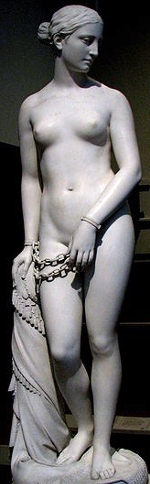
Photo credit: Wikimedia

Old Testament Slavery—Not so Bad?

Does God exist?You’ve probably been there—you’ve read one too many articles claiming that slavery in the Bible is not a big deal, and that biblical slavery wasn’t at all like slavery in America.

That’s where I am, so I’m afraid you’ll just have to deal with my venting.

I listened to “Sex, Lies & Leviticus” (5/13/12), a podcast from apologetics.com (the second hour is the interesting part, with Lindsay Brooks and guest Arthur Daniels Jr.).  It’s a diatribe against Dan Savage’s recent presentation to a group of high school students interested in journalism.  Savage’s point, roughly stated, is that we discard lots of nutty stuff from the Old Testament (no shellfish, slavery, animal sacrifice, etc.), so let’s discard hatred of homosexuality as well.

The interview begins with the guest mocking Savage’s claim that the Bible is “radically pro-slavery.”

The Bible is pro-slavery in the same way that it’s pro-commerce.  For example, the book of Proverbs says that God demands honest weights and measures—four times, in fact.  Commerce is regulated, so it’s pretty clear that God has no problem with commerce.  God is happy to set down prohibitions against wicked things, and there are none against honest commerce.  By similar thinking (the regulation and the lack of prohibition), the Bible is pro-slavery.

But more on that later—let’s follow the arguments in the interview.  Some of the arguments are truly ridiculous, but I include them for completeness and to give atheists a chance to become aware of them and Christians to realize what arguments need discarding.

The Bible prohibits lots of things, not just homosexuality.  Dan Savage is happy with prohibitions against murder, rape, stealing, and so on.  Why accept most of the Law but reject just the bits you don’t like?

Because no atheist goes to the Bible for moral guidance!  No one, including Christians, know that murder, rape, and stealing are wrong because they read it in the Bible.  They knew they were wrong first and saw that, coincidentally, the Bible rejects the same things.  Our moral compass is internal, and from that we can critique the Bible to know what to keep (don’t murder) and what to reject (acceptance of slavery).

Dan Savage ridicules the kosher food laws (rejections of shellfish, for example), but Paul’s epistle of First Timothy (4:4–5) overturns these food restrictions. 

In the first place, Pauline authorship for 1 Timothy is largely rejected by biblical scholars.  Apparently, these guys want Christians to follow some random dude rather than Jesus himself, who never questioned the kosher laws and indeed demanded that they be upheld:

Till heaven and earth pass, one jot or one tittle shall in no wise pass from the Law, till all be fulfilled. Whosoever therefore shall break one of these least commandments, and shall teach men so, he shall be called the least in the kingdom of heaven.  (Matthew 5:17–20)

And secondly, laws aren’t considered and rejected one by one.  Do they have a counter-verse to reject death for adultery (Lev. 20:10), for sassing your parents (Lev. 20:9), and every other nutty Old Testament prohibition that no Christian follows?  Christians more typically reject the Old Testament laws with a blanket claim that the sacrifice of Jesus made those laws unnecessary (for example, see Hebrews chapters 7, 8, and 10).

The problem there, of course, is that prohibitions against homosexual acts are discarded along with the rest.  You don’t get to keep just the ones you’re fond of.  I discuss this more here.

Dan Savage is speaking out of turn.  Like other atheists, he simply doesn’t know his Bible well.

Or not.  American atheists are famously better informed than any religious group.  And we’ll see that Savage is on target about slavery.

Continue reading: Part 2

Americans treat the Bible
like a website Terms of Use agreement.
They don’t bother reading it; they just click “I agree.”
Unknown

Photo credit: Wikimedia

See the other posts in this series:

Related posts:

Related links:

Word of the Day: Cottlingley Fairies

In 1917, two girls spent much of their summer playing by a stream.  Repeatedly scolded for returning home wet and muddy, they said that they were playing with fairies.  To prove it, they borrowed a camera and returned claiming that they had proof.  That photo is shown here.

A total of five photos were taken over several years.  The fairies were called the Cottingley fairies after Cottingley, England, the town where the girls lived.

A relative showed two of the photos at a 1919 public meeting of the Theosophical Society, a spiritualist organization.  From there, Sir Arthur Conan Doyle, a devotee of spiritualism, took the baton.  He wrote a 1920 article in The Strand Magazine that made the photos famous.  To his credit, Conan Doyle asked experts to critique the photos.  The opinions were mixed, but he decided to go with the story anyway.

Spiritualism, the popular belief that we can communicate with the spirits of the dead, was waning at the time of the article.  Magician Harry Houdini, annoyed by fakers using tricks to defraud the gullible, devoted much time to debunking psychics and mediums in the 1920s until his death in 1926.

Houdini and Conan Doyle had been friends, but the friendship failed because of their opposite views on spiritualism.  Conan Doyle believed that Houdini himself had supernatural powers and was using them to suppress the powers of the psychics that he debunked.

Research in 1983 exposed details of the Cottingley hoax, and the two principles finally admitted that they had faked the fairies by using cardboard cutouts of drawings copied from a book.

I learned of a modern parallel to this hoax at The Amazing Meeting in 2004.  James Randi told the story of Project Alpha, during which he planted two fake psychics (Steve Shaw and Michael Edwards, actually talented amateur magicians) in the McDonnell Laboratory for Psychical Research in 1979.  Randi contacted the researchers before planting his fakes to caution them how to avoid being deceived.  The advice was thorough and genuine, and if they’d followed it, they would have uncovered the trickery.

Two years later, after the lab’s successes were well known within the psychic community and the fake psychics were celebrities, the deception was made public.  The press was so bad that the McDonnell laboratory shut down.

The moral of the story: unless you’re a magician, don’t pretend that you can expose a magician.  Said another way, just because you’re smart (and let’s assume both that the researchers were smart and most skeptics are smart), don’t think that you can’t be duped.  This was Conan Doyle’s failing.

Magician Ricky Jay said, “The ideal audience would be Nobel Prize winners. …  They often have an ego with them that says, ‘I am really smart so I can’t be fooled.’  No one is easier to fool.”

If you believe in the existence of fairies at the bottom of the garden,
you are deemed fit for the [loony] bin.
If you believe in parthenogenesis, ascension, transubstantiation and all the rest of it,
you are deemed fit to govern the country.
— Jonathan Meades

Photo credit: Wikimedia

Related posts:

Related links:

  • Paul Hoffman, “Why Are Smart People Some of the Most Gullible People Around?” Discover, 2/10/11.
  • “Cottingley Fairies,” Wikipedia.
  • “The Derbyshire Fairy,” Museum of Hoaxes.
  • Emma Clayton, “Photographic expert uncovered hoax after testing cameras used by Cottingley cousins,” Telegraph & Argus, 11/17/10.