
 The Freedom From Religion Foundation is a freethought organization that has won some high-profile lawsuits that support the separation of church and state. It is also known for displaying freethought statements to balance religious Christmas messages on state property.
Want to know what the revenue of the FFRF is? For 2010, it was $2,234,307. Exactly.
Want to know how I know that? I looked it up; it’s public information. That’s true for all U.S. nonprofits. All nonprofits, that is, except churches and other religious organizations.
Isn’t it startling that church leaders, who supposedly believe that the all-knowing Accountant in the Sky will judge them eternally for how ethically they spend the money given by parishioners, are embarrassed to show their financial records to the rest of us? That they want church donations to be tax exempt but refuse to show the public (who is picking up the slack for the missing taxes) how they spend this money? What do you suppose they have to hide?
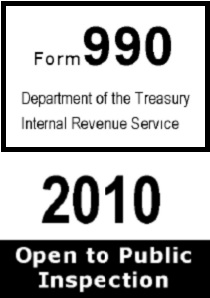
The Freedom From Religion Foundation’s form 990 has a bold “Open to Public Inspection” at the top. The form gives the salaries of each staff member, to the dollar. It shows revenue, expenses, cash in the bank, mortgages, and lots more financial details. They seem to shoulder this burden pretty well, and I think churches can, too.
Go to GuideStar, the Foundation Center, or similar organizations to look up any nonprofit to which you’re considering a donation to check how they spend their money.
Any nonprofit, that is, except churches.
Let’s remember what religion we’re talking about. It’s the religion that tells the story of the rich man who was (tragically) too attached to his wealth to follow Jesus’s command, “Sell everything you have and give to the poor, and you will have treasure in heaven” (Mark 10:17–31). It’s the religion in which Jesus will say to the worthy people, “Whatever you did for one of the least of these brothers and sisters of mine, you did for me” (Matt. 25:31–46). And, “It is easier for a camel to go through the eye of a needle than for a rich man to enter the kingdom of God” (Luke 18:25). And, “Do not store up for yourselves treasures on earth … but store up for yourselves treasures in heaven … for where your treasure is, there your heart will be also” (Matt. 6:19–21).
Apparently Jesus didn’t care much for rich people but cared greatly for the poor. How do you suppose he would react to churches and ministries being secretive today about how they spend the money given to them? About churches exempting themselves from the requirement to open their books?
There are some groups trying to fix this problem. MinistryWatch asks for financial information from ministries and publicizes the results. For example, Greg Koukl’s Stand to Reason gets an A rating, and they deserve praise for doing the right thing. But this is just a baby step. First, MinistryWatch has only 600 ministries in their list when there are an estimated 335,000 congregations in the U.S. Second, the financial information is still not as thorough as that provided on Form 990s by nonreligious nonprofits.
And third, many of the ministries don’t get an A rating. In fact, those who get an F (typically because they ignored MinistryWatch’s request for information) are a Who’s Who of high-profile televangelists and religious newsmakers: Benny Hinn, Creflo Dollar, John Hagee, Kenneth Copeland, TD Jakes, Trinity Broadcasting Network, Rod Parsley, Robert Schuller’s Crystal Cathedral, Harold Camping’s Family Radio, and more. They all got an F. Doesn’t this evasion reflect badly on all religious organizations?
Some churches are open about their finances, but only to members. According to one survey, 92% of churches provide financial information upon request to members. Why is this not 100%? And what good is this to the U.S. taxpayer who wants to verify the claimed benefit that churches provide a good to society that earns them nonprofit status? Compare this with the financial records of the more than 1.5 million ordinary nonprofits easily accessible in a single database.
Let’s make a simple, logical change—a change that helps churches look better. This cloud of doubt hangs over every church. The change costs churches and other ministries very little and makes things fair, and it shows that they have nothing to hide. Remove the exemption allowing churches to avoid providing financial information.
Some ministries will have to clean up their acts, but isn’t that a good thing? Doesn’t this benefit the Christians at the churches that spend their income honorably?
Photo credit: IRS
Other posts in this series:
- How Religious are Americans? Not as Much as You Think.
- Church Accountability
- Pastors Speak Their Mind (and Flout the Rules)
- Are Churches More Like Charities or Country Clubs?
Related links:
- “Christian views on poverty and wealth,” Wikipedia.
- “4th annual ‘State of the Plate’ Survey,” State of the Plate, 3/27/12.

 Today is the National Day of Prayer. How about a National Day of Actually Doing Something instead?
 Galileo Unchained
